

Organic Carbon and Carbonate as Paleoproductivity Proxies
327
Atlantic upwelling area off Namibia (WR; Walvis
Ridge) and the other from the oligotrophic northern Brazil Basin (WA; West Atlantic) (Fig. 2), a
location with a primary production comparable to
that of the ocean area at site GeoB 1523. The
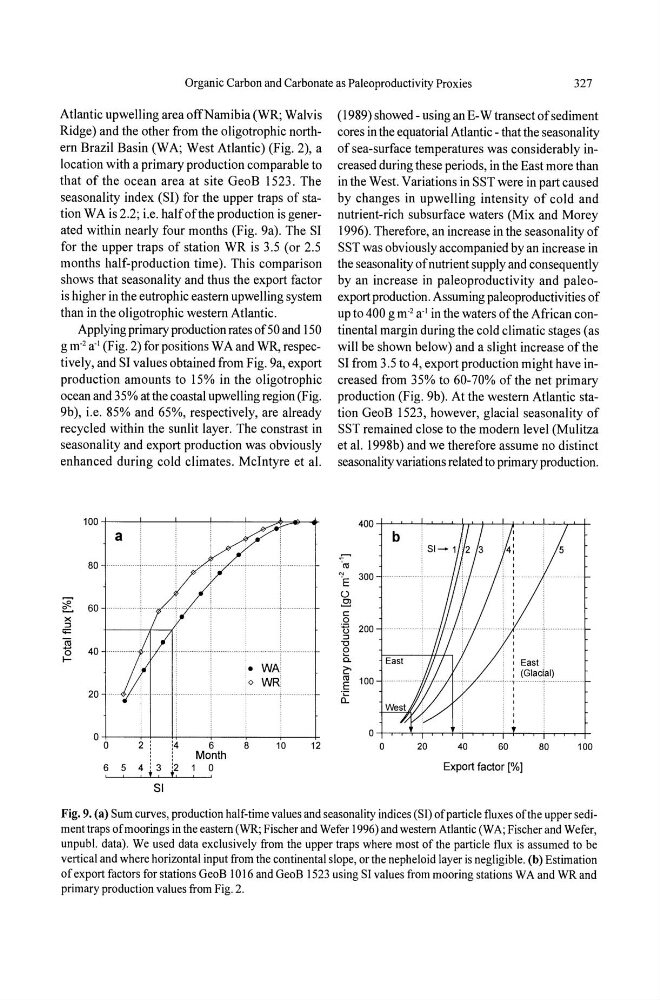
seasonality index (SJ) for the upper traps of station WA is 2.2; i.e. half ofthe production is generated within nearly four months (Fig. 9a). The SJ
for the upper traps of station WR is 3.5 (or 2.5
months half-production time). This comparison
shows that seasonality and thus the export factor
is higher in the eutrophic eastern upwelling system
than in the oligotrophic western Atlantic.
Applying primary productionrates of 50 and ISO
g m" a· 1 (Fig. 2) for positions WA and WR, respectively, and SI values obtained from Fig. 9a, export
production amounts to 15% in the oligotrophic
ocean and 35% at the coastal upwelling region (Fig.
9b), i.e. 85% and 65%, respectively, are already
recycled within the sunlit layer. The constrast in
seasonality and export production was obviously
enhanced during cold climates. McIntyre et al.
100
a
80
~ 60
x
:::J
0::
"iii
0 40
l20
0 a
2 i
i4
6
8
10
12
Month
6 5 4 : 3 :2 1 a
, :I, i,
Sl
(1989) showed - using an E-W transect of sediment
cores in the equatorial Atlantic - that the seasonality
of sea-surface temperatures was considerably increased during these periods, in the East more than
in the West. Variations in SST were in part caused
by changes in upwelling intensity of cold and
nutrient-rich subsurface waters (Mix and Morey
1996). Therefore, an increase in the seasonal ity of
SST was obviously accompanied by an increase in
the seasonality of nutrient supply and consequently
by an increase in paleoproductivity and paleoexport production. Assuming paleoproductivities of
up to 400 g m" a· 1 in the waters of the African continental margin during the cold climatic stages (as
will be shown below) and a slight increase of the
SI from 3.5 to 4, export production might have increased from 35% to 60-70% of the net primary
production (Fig. 9b). At the western Atlantic station GeoB 1523, however, glacial seasonality of
SST remained close to the modern level (Mulitza
et al. 1998b) and we therefore assume no distinct
seasonality variations related to primary production.
400
b
co
"Eo
300
0
.3
c:
0
t5 200
:::J
"0
e e.
East
East,
i::'
(Glacial)
co 100
E
~
a
a
20
40
60
80
100
Export factor [%]
Fig. 9. (a) Sum curves, production half-time values and seasonality indices (SJ) of particle fluxes of the upper sedimenttraps of moorings in the eastern (WR; Fischer and Wefer 1996) and western Atlantic (WA; Fischer and Wefer,
unpub!. data). We used data exclusively from the upper traps where most of the particle flux is assumed to be
vertical and where horizontal input from the continental slope, or the nepheloid layer is negligible. (b) Estimation
of export factors for stations GeoB 1016 and GeoB 1523 using SI values from mooring stations WA and WR and
primary production values from Fig. 2.
327
Atlantic upwelling area off Namibia (WR; Walvis
Ridge) and the other from the oligotrophic northern Brazil Basin (WA; West Atlantic) (Fig. 2), a
location with a primary production comparable to
that of the ocean area at site GeoB 1523. The
seasonality index (SJ) for the upper traps of station WA is 2.2; i.e. half ofthe production is generated within nearly four months (Fig. 9a). The SJ
for the upper traps of station WR is 3.5 (or 2.5
months half-production time). This comparison
shows that seasonality and thus the export factor
is higher in the eutrophic eastern upwelling system
than in the oligotrophic western Atlantic.
Applying primary productionrates of 50 and ISO
g m" a· 1 (Fig. 2) for positions WA and WR, respectively, and SI values obtained from Fig. 9a, export
production amounts to 15% in the oligotrophic
ocean and 35% at the coastal upwelling region (Fig.
9b), i.e. 85% and 65%, respectively, are already
recycled within the sunlit layer. The constrast in
seasonality and export production was obviously
enhanced during cold climates. McIntyre et al.
100
a
80
~ 60
x
:::J
0::
"iii
0 40
l20
0 a
2 i
i4
6
8
10
12
Month
6 5 4 : 3 :2 1 a
, :I, i,
Sl
(1989) showed - using an E-W transect of sediment
cores in the equatorial Atlantic - that the seasonality
of sea-surface temperatures was considerably increased during these periods, in the East more than
in the West. Variations in SST were in part caused
by changes in upwelling intensity of cold and
nutrient-rich subsurface waters (Mix and Morey
1996). Therefore, an increase in the seasonal ity of
SST was obviously accompanied by an increase in
the seasonality of nutrient supply and consequently
by an increase in paleoproductivity and paleoexport production. Assuming paleoproductivities of
up to 400 g m" a· 1 in the waters of the African continental margin during the cold climatic stages (as
will be shown below) and a slight increase of the
SI from 3.5 to 4, export production might have increased from 35% to 60-70% of the net primary
production (Fig. 9b). At the western Atlantic station GeoB 1523, however, glacial seasonality of
SST remained close to the modern level (Mulitza
et al. 1998b) and we therefore assume no distinct
seasonality variations related to primary production.
400
b
co
"Eo
300
0
.3
c:
0
t5 200
:::J
"0
e e.
East
East,
i::'
(Glacial)
co 100
E
~
a
a
20
40
60
80
100
Export factor [%]
Fig. 9. (a) Sum curves, production half-time values and seasonality indices (SJ) of particle fluxes of the upper sedimenttraps of moorings in the eastern (WR; Fischer and Wefer 1996) and western Atlantic (WA; Fischer and Wefer,
unpub!. data). We used data exclusively from the upper traps where most of the particle flux is assumed to be
vertical and where horizontal input from the continental slope, or the nepheloid layer is negligible. (b) Estimation
of export factors for stations GeoB 1016 and GeoB 1523 using SI values from mooring stations WA and WR and
primary production values from Fig. 2.