

322
Riihlemann et al.
~ 1000
§.
s::;
1i
Q)
-0
'Q) 2000
~
E
~
s::;
1i
Q)
-0
c:
Q)
E
'6 Q)
en
3000
1.2
2.1
o
5
Co
20
30
40
100
150
Primary production
400
% preserved C",g
Water
Column
..........
Sediment
3
6
9
C org accumulation [9 m- 2 a-')
12
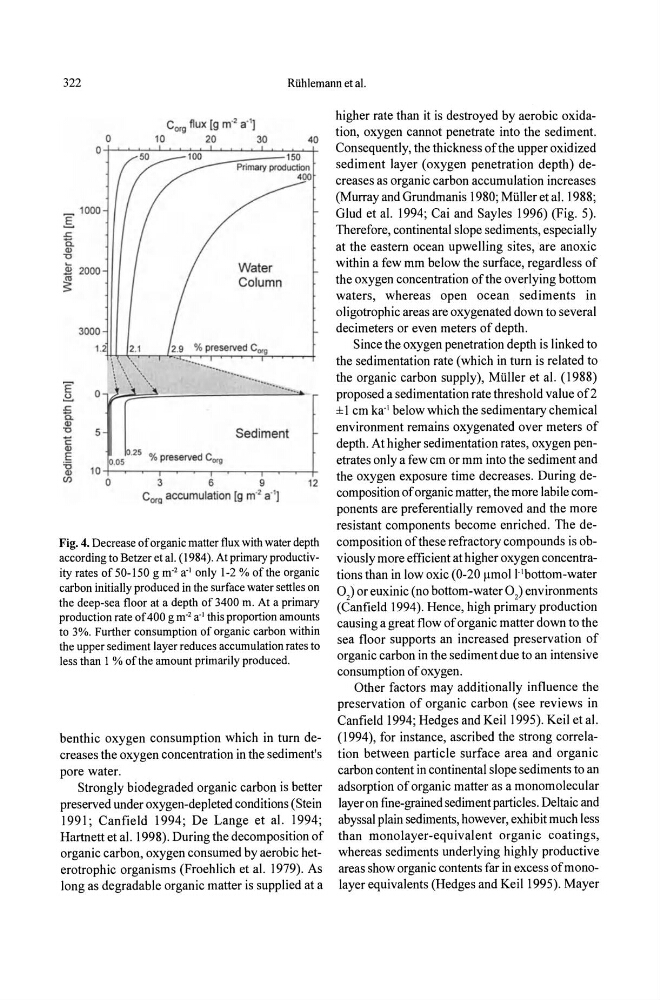
Fig. 4. Decrease of organic matter flux with water depth
according to Betzer et al. (J 984). At primary productivity rates of 50-150 g m-' a-I only 1-2 % of the organic
carbon initially produced in the surface water settles on
the deep-sea floor at a depth of 3400 m. At a primary
production rate of 400 g m-' a-I this proportion amounts
to 3%. Further consumption of organic carbon within
the upper sediment layer reduces accumulation rates to
less than I % of the amount primarily produced.
benthic oxygen consumption which in turn decreases the oxygen concentration in the sediment's
pore water.
Strongly biodegraded organic carbon is better
preserved under oxygen-depleted conditions (Stein
1991; Canfield 1994; De Lange et at. 1994;
Hartnett et at. 1998). During the decomposition of
organic carbon, oxygen consumed by aerobic heterotrophic organisms (Froehlich et al. 1979). As
long as degradable organic matter is supplied at a
higher rate than it is destroyed by aerobic oxidation, oxygen cannot penetrate into the sediment_
Consequently, the thickness of the upper oxidized
sediment layer (oxygen penetration depth) decreases as organic carbon accumulation increases
(Murray and Grundmanis 1980; MUlier et at. 1988;
Glud et al. 1994; Cai and Sayles 1996) (Fig. 5).
Therefore, continental slope sediments, especially
at the eastern ocean upwelling sites, are anoxic
within a few mm below the surface, regardless of
the oxygen concentration ofthe overlying bottom
waters, whereas open ocean sediments in
oligotrophic areas are oxygenated down to several
decimeters or even meters of depth.
Since the oxygen penetration depth is linked to
the sedimentation rate (which in turn is related to
the organic carbon supply), MUlier et at. (1988)
proposed a sedimentation rate threshold value of2
±I cm ka- I below which the sedimentary chemical
environment remains oxygenated over meters of
depth. At higher sedimentation rates, oxygen penetrates only a few cm or mm into the sediment and
the oxygen exposure time decreases. During decomposition of organic matter, the more labile components are preferentially removed and the more
resistant components become enriched. The decomposition ofthese refractory compounds is obviously more efficient at higher oxygen COncentrations than in low oxic (0-20 flmoll-Ibottom-water
0 ,) or euxinic (no bottom-water 0,) environments
(Canfield 1994). Hence, high primary production
causing a great flow of organic matter down to the
sea floor supports an increased preservation of
organic carbon in the sediment due to an intensive
consumption of oxygen.
Other factors may additionally influence the
preservation of organic carbon (see reviews in
Canfield 1994; Hedges and KeiI1995). Keil et al.
(\ 994), for instance, ascribed the strong correlation between particle surface area and organic
carbon content in continental slope sediments to an
adsorption of organic matter as a monomolecular
layer on fine-grained sediment particles. Deltaic and
abyssal plain sediments, however, exhibit much less
than monolayer-equivalent organic coatings,
whereas sediments underlying highly productive
areas show organic contents far in excess of monolayer equivalents (Hedges and KeiI1995). Mayer
Riihlemann et al.
~ 1000
§.
s::;
1i
Q)
-0
'Q) 2000
~
E
~
s::;
1i
Q)
-0
c:
Q)
E
'6 Q)
en
3000
1.2
2.1
o
5
Co
20
30
40
100
150
Primary production
400
% preserved C",g
Water
Column
..........
Sediment
3
6
9
C org accumulation [9 m- 2 a-')
12
Fig. 4. Decrease of organic matter flux with water depth
according to Betzer et al. (J 984). At primary productivity rates of 50-150 g m-' a-I only 1-2 % of the organic
carbon initially produced in the surface water settles on
the deep-sea floor at a depth of 3400 m. At a primary
production rate of 400 g m-' a-I this proportion amounts
to 3%. Further consumption of organic carbon within
the upper sediment layer reduces accumulation rates to
less than I % of the amount primarily produced.
benthic oxygen consumption which in turn decreases the oxygen concentration in the sediment's
pore water.
Strongly biodegraded organic carbon is better
preserved under oxygen-depleted conditions (Stein
1991; Canfield 1994; De Lange et at. 1994;
Hartnett et at. 1998). During the decomposition of
organic carbon, oxygen consumed by aerobic heterotrophic organisms (Froehlich et al. 1979). As
long as degradable organic matter is supplied at a
higher rate than it is destroyed by aerobic oxidation, oxygen cannot penetrate into the sediment_
Consequently, the thickness of the upper oxidized
sediment layer (oxygen penetration depth) decreases as organic carbon accumulation increases
(Murray and Grundmanis 1980; MUlier et at. 1988;
Glud et al. 1994; Cai and Sayles 1996) (Fig. 5).
Therefore, continental slope sediments, especially
at the eastern ocean upwelling sites, are anoxic
within a few mm below the surface, regardless of
the oxygen concentration ofthe overlying bottom
waters, whereas open ocean sediments in
oligotrophic areas are oxygenated down to several
decimeters or even meters of depth.
Since the oxygen penetration depth is linked to
the sedimentation rate (which in turn is related to
the organic carbon supply), MUlier et at. (1988)
proposed a sedimentation rate threshold value of2
±I cm ka- I below which the sedimentary chemical
environment remains oxygenated over meters of
depth. At higher sedimentation rates, oxygen penetrates only a few cm or mm into the sediment and
the oxygen exposure time decreases. During decomposition of organic matter, the more labile components are preferentially removed and the more
resistant components become enriched. The decomposition ofthese refractory compounds is obviously more efficient at higher oxygen COncentrations than in low oxic (0-20 flmoll-Ibottom-water
0 ,) or euxinic (no bottom-water 0,) environments
(Canfield 1994). Hence, high primary production
causing a great flow of organic matter down to the
sea floor supports an increased preservation of
organic carbon in the sediment due to an intensive
consumption of oxygen.
Other factors may additionally influence the
preservation of organic carbon (see reviews in
Canfield 1994; Hedges and KeiI1995). Keil et al.
(\ 994), for instance, ascribed the strong correlation between particle surface area and organic
carbon content in continental slope sediments to an
adsorption of organic matter as a monomolecular
layer on fine-grained sediment particles. Deltaic and
abyssal plain sediments, however, exhibit much less
than monolayer-equivalent organic coatings,
whereas sediments underlying highly productive
areas show organic contents far in excess of monolayer equivalents (Hedges and KeiI1995). Mayer