

Organic Carbon and Carbonate as Paleoproductivity Proxies
321
t c
a
:u ::l
e a.
?:'"
E
·c
Q.
'",
':'E
u
El
c:
0
'n ::J
"0
e
a..
f!ro
.~
a:
a
400
300
200
a
a
b
c
Time_
C
0
20
40
60
80
100
Export Factor [%J
ment (Reimers 1989). The proportion of organic
matter that survives depends on the quantity and
quality of organic matter settling on the sediment
surface, the total sediment accumulation rate
(Heath et at. 1977; MUller and Suess 1979), the
oxygen availability and the exposure time (Emerson
1985; Canfield 1994; Hartnett et at. 1998) as well
as the sediment grain size and surface area (Mayer
~
e...
><
::l
"" (ij
~
b
80
40
20
O ~~-+~~T----+----r----r----+
6 r 4 i 2
SI = 6 -t(1/2)
MO(lth
1 9
10
12
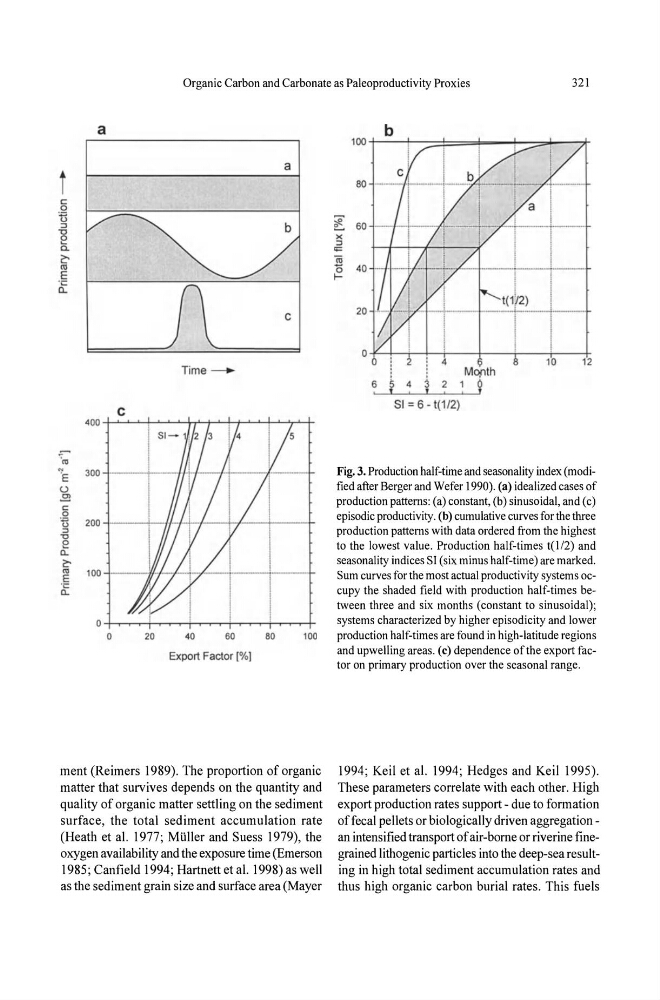
Fig. 3. Production half-time and seasonality index (modified after Berger and Wefer 1990). (a) idealized cases of
production patterns: (a) constant, (b) sinusoidal, and (c)
episodic productivity. (b) cumulative curves for the three
production patterns with data ordered from the highest
to the lowest value. Production half-times t(1/2) and
seasonality indices SI (six minus half-time) are marked.
Sum curves for the most actual productivity systems occupy the shaded field with production half-times between three and six months (constant to sinusoidal);
systems characterized by higher episodicity and lower
production half-times are found in high-latitude regions
and upwelling areas. (c) dependence of the export factor on primary production over the seasonal range.
1994; Keil et at. 1994; Hedges and Keil 1995).
These parameters correlate with each other. High
export production rates support - due to formation
offecal pellets or biologically driven aggregationan intensified transport of air-borne or riverine finegrained lithogenic particles into the deep-sea resulting in high total sediment accumulation rates and
thus high organic carbon burial rates. This fuels
321
t c
a
:u ::l
e a.
?:'"
E
·c
Q.
'",
':'E
u
El
c:
0
'n ::J
"0
e
a..
f!ro
.~
a:
a
400
300
200
a
a
b
c
Time_
C
0
20
40
60
80
100
Export Factor [%J
ment (Reimers 1989). The proportion of organic
matter that survives depends on the quantity and
quality of organic matter settling on the sediment
surface, the total sediment accumulation rate
(Heath et at. 1977; MUller and Suess 1979), the
oxygen availability and the exposure time (Emerson
1985; Canfield 1994; Hartnett et at. 1998) as well
as the sediment grain size and surface area (Mayer
~
e...
><
::l
"" (ij
~
b
80
40
20
O ~~-+~~T----+----r----r----+
6 r 4 i 2
SI = 6 -t(1/2)
MO(lth
1 9
10
12
Fig. 3. Production half-time and seasonality index (modified after Berger and Wefer 1990). (a) idealized cases of
production patterns: (a) constant, (b) sinusoidal, and (c)
episodic productivity. (b) cumulative curves for the three
production patterns with data ordered from the highest
to the lowest value. Production half-times t(1/2) and
seasonality indices SI (six minus half-time) are marked.
Sum curves for the most actual productivity systems occupy the shaded field with production half-times between three and six months (constant to sinusoidal);
systems characterized by higher episodicity and lower
production half-times are found in high-latitude regions
and upwelling areas. (c) dependence of the export factor on primary production over the seasonal range.
1994; Keil et at. 1994; Hedges and Keil 1995).
These parameters correlate with each other. High
export production rates support - due to formation
offecal pellets or biologically driven aggregationan intensified transport of air-borne or riverine finegrained lithogenic particles into the deep-sea resulting in high total sediment accumulation rates and
thus high organic carbon burial rates. This fuels