

304
Diekmann et al.
Isotope Stages
2-4
5
6
7
8
9
10
11
(12) (13)
1.1
2.5
.Q
0.9
CD
ro
0
a:::
0..
:c 0.7
3.5
~
()
-- 0
0
t1I
co
~
0.5
~
0.3
4.5
0
200
400
600
800
1000
Depth (em)
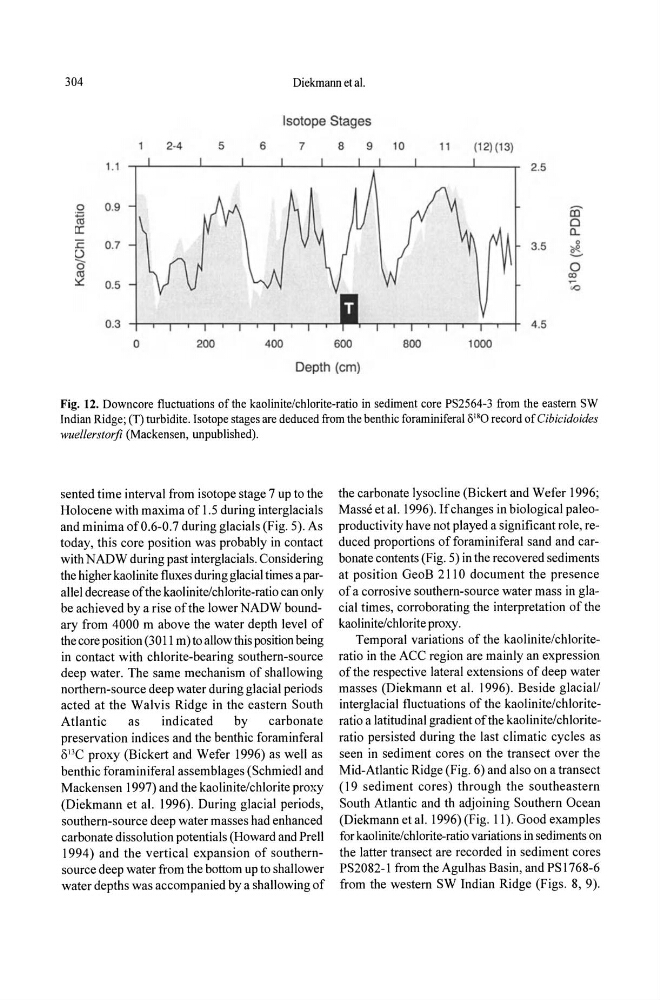
Fig. 12. Downcore fluctuations of the kaolinite/chlorite-ratio in sediment core PS2564-3 from the eastern SW
Indian Ridge; (T) turbidite. Isotope stages are deduced from the benthic foraminiferal 8"0 record of Cibicidoides
wuellerstorfi (Macken sen, unpublished).
sen ted time interval from isotope stage 7 up to the
Holocene with maxima of 1.5 during interglacials
and minima of 0.6-0. 7 during glacials (Fig. 5). As
today, this core position was probably in contact
with NADW during past interglacials. Considering
the higher kaolinite fluxes during glacial times a parallel decrease ofthe kaolinite/chlorite-ratio can only
be achieved by a rise of the lower NADW boundary from 4000 m above the water depth level of
the core position (30 II m) to allow this position being
in contact with chlorite-bearing southern-source
deep water. The same mechanism of shallowing
northern-source deep water during glacial periods
acted at the Walvis Ridge in the eastern South
Atlantic
as
indicated
by
carbonate
preservation indices and the benthic foraminferal
lil3C proxy (Bickert and Wefer 1996) as well as
benthic foraminiferal assemblages (Schmiedl and
Mackensen 1997) and the kaolinite/chlorite proxy
(Diekmann et al. 1996). During glacial periods,
southern-source deep water masses had enhanced
carbonate dissolution potentials (Howard and Prell
1994) and the vertical expansion of southernsource deep water from the bottom up to shallower
water depths was accompanied by a shallowing of
the carbonate lysocline (Bickert and Wefer 1996;
Masse et al. 1996). If changes in biological paleoproductivity have not played a significant role, reduced proportions of foraminiferal sand and carbonate contents (Fig. 5) in the recovered sediments
at position GeoB 2110 document the presence
of a corrosive southern-source water mass in glacial times, corroborating the interpretation of the
kaolinite/chlorite proxy.
Temporal variations of the kaolinite/chloriteratio in the ACC region are mainly an expression
of the respective lateral extensions of deep water
masses (Diekmann et al. 1996). Beside glacial!
interglacial fluctuations of the kaolinite/chloriteratio a latitudinal gradient ofthe kaolinite/chloriteratio persisted during the last climatic cycles as
seen in sediment cores on the transect over the
Mid-Atlantic Ridge (Fig. 6) and also on a transect
(19 sediment cores) through the southeastern
South Atlantic and th adjoining Southern Ocean
(Diekmann et al. 1996) (Fig. II). Good examples
for kaolinite/chlorite-ratio variations in sediments on
the latter transect are recorded in sediment cores
PS2082-1 from the Agulhas Basin, and PS 1768-6
from the western SW Indian Ridge (Figs. 8, 9).
Diekmann et al.
Isotope Stages
2-4
5
6
7
8
9
10
11
(12) (13)
1.1
2.5
.Q
0.9
CD
ro
0
a:::
0..
:c 0.7
3.5
~
()
-- 0
0
t1I
co
~
0.5
~
0.3
4.5
0
200
400
600
800
1000
Depth (em)
Fig. 12. Downcore fluctuations of the kaolinite/chlorite-ratio in sediment core PS2564-3 from the eastern SW
Indian Ridge; (T) turbidite. Isotope stages are deduced from the benthic foraminiferal 8"0 record of Cibicidoides
wuellerstorfi (Macken sen, unpublished).
sen ted time interval from isotope stage 7 up to the
Holocene with maxima of 1.5 during interglacials
and minima of 0.6-0. 7 during glacials (Fig. 5). As
today, this core position was probably in contact
with NADW during past interglacials. Considering
the higher kaolinite fluxes during glacial times a parallel decrease ofthe kaolinite/chlorite-ratio can only
be achieved by a rise of the lower NADW boundary from 4000 m above the water depth level of
the core position (30 II m) to allow this position being
in contact with chlorite-bearing southern-source
deep water. The same mechanism of shallowing
northern-source deep water during glacial periods
acted at the Walvis Ridge in the eastern South
Atlantic
as
indicated
by
carbonate
preservation indices and the benthic foraminferal
lil3C proxy (Bickert and Wefer 1996) as well as
benthic foraminiferal assemblages (Schmiedl and
Mackensen 1997) and the kaolinite/chlorite proxy
(Diekmann et al. 1996). During glacial periods,
southern-source deep water masses had enhanced
carbonate dissolution potentials (Howard and Prell
1994) and the vertical expansion of southernsource deep water from the bottom up to shallower
water depths was accompanied by a shallowing of
the carbonate lysocline (Bickert and Wefer 1996;
Masse et al. 1996). If changes in biological paleoproductivity have not played a significant role, reduced proportions of foraminiferal sand and carbonate contents (Fig. 5) in the recovered sediments
at position GeoB 2110 document the presence
of a corrosive southern-source water mass in glacial times, corroborating the interpretation of the
kaolinite/chlorite proxy.
Temporal variations of the kaolinite/chloriteratio in the ACC region are mainly an expression
of the respective lateral extensions of deep water
masses (Diekmann et al. 1996). Beside glacial!
interglacial fluctuations of the kaolinite/chloriteratio a latitudinal gradient ofthe kaolinite/chloriteratio persisted during the last climatic cycles as
seen in sediment cores on the transect over the
Mid-Atlantic Ridge (Fig. 6) and also on a transect
(19 sediment cores) through the southeastern
South Atlantic and th adjoining Southern Ocean
(Diekmann et al. 1996) (Fig. II). Good examples
for kaolinite/chlorite-ratio variations in sediments on
the latter transect are recorded in sediment cores
PS2082-1 from the Agulhas Basin, and PS 1768-6
from the western SW Indian Ridge (Figs. 8, 9).