

Kaolinite and Chlorite as Tracers of Modern and Late Quaternary Deep Water Circulation
303
on the kaolinite/chlorite-ratio and %-kaolinite (Fig.
8, Table 2), however, indicate that the low-latitude
precessional signal apparently has no great impact
on kaolinite proportions in water masses of the
ACC region.
High chlorite fluxes in southern-source deep
water masses during glacial periods probably originate from both enhanced dust influx from Patagonia
and uptake of chlorite-rich particle suspensions
by the bottom currents of the ACC, which are
delivered from the Antarctic Peninsula into the
Bellingshausen Sea (SE Pacific) via turbidity currents. Radiographs from sediment cores obtained
during cruise ANT-XIII4 ofRV 'Polarstern' in 1995
(Gersonde in preparation) confirm a high proportion of turbidites within Quaternary sediment sequences of the Bellingshausen Sea. The same
observations were made in the southern part of
the Drake Passage, in the South Shetland
Trench (Porebski et al. 1991), which borders the
Bellingshausen Sea to the east. Strong turbidity
current activity associated with high sediment yield
and incorporation of turbiditic sediment clouds into
permanent bottom currents are a prominent mechanism at the Antarctic continental margin, especially
along the western margin of the Antarctic Peninsula (Rebesco et al. 1996, Hillenbrand 1997) and
in the Weddell Sea (Melles 1991; Weber et al. 1994;
Diekmann and Kuhn 1997).
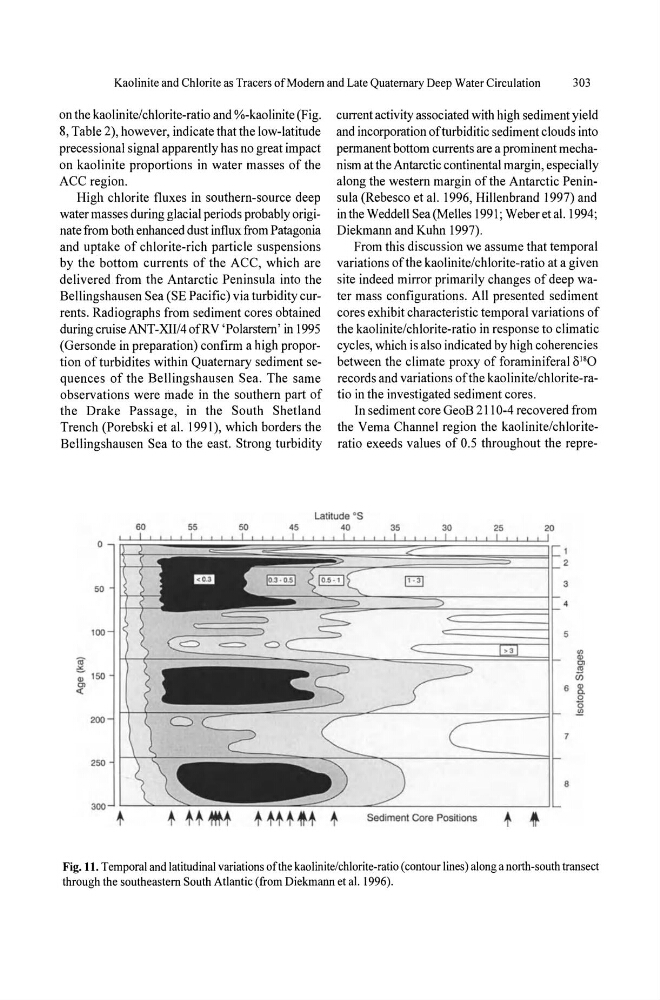
From this discussion we assume that temporal
variations of the kaolinite/chlorite-ratio at a given
site indeed mirror primarily changes of deep water mass configurations. All presented sediment
cores exhibit characteristic temporal variations of
the kaolinite/chlorite-ratio in response to climatic
cycles, which is also indicated by high coherencies
between the climate proxy of foraminiferal 8 18 0
records and variations ofthe kaolinite/chlorite-ratio in the investigated sediment cores.
In sediment core GeoB 2110-4 recovered from
the Vema Channel region the kaolinite/chloriteratio exeeds values of 0.5 throughout the repreLatitude · S
60
40
35
30
!
I !
!
,
,
I ! I
! I !
I
J !
o
50
too
200
250
300
Sediment Core Positions
25
20
, I ,
I
I
I
+ t
t
2
5
U>
.,
Ol
'"
iii
6 :!l.
8
o
a
~
Fig. 11. Temporal and latitudinal variations of the kaolinite/chlorite-ratio (contour lines) along a north-south transect
through the southeastern South Atlantic (from Diekmann et aJ. \996).
303
on the kaolinite/chlorite-ratio and %-kaolinite (Fig.
8, Table 2), however, indicate that the low-latitude
precessional signal apparently has no great impact
on kaolinite proportions in water masses of the
ACC region.
High chlorite fluxes in southern-source deep
water masses during glacial periods probably originate from both enhanced dust influx from Patagonia
and uptake of chlorite-rich particle suspensions
by the bottom currents of the ACC, which are
delivered from the Antarctic Peninsula into the
Bellingshausen Sea (SE Pacific) via turbidity currents. Radiographs from sediment cores obtained
during cruise ANT-XIII4 ofRV 'Polarstern' in 1995
(Gersonde in preparation) confirm a high proportion of turbidites within Quaternary sediment sequences of the Bellingshausen Sea. The same
observations were made in the southern part of
the Drake Passage, in the South Shetland
Trench (Porebski et al. 1991), which borders the
Bellingshausen Sea to the east. Strong turbidity
current activity associated with high sediment yield
and incorporation of turbiditic sediment clouds into
permanent bottom currents are a prominent mechanism at the Antarctic continental margin, especially
along the western margin of the Antarctic Peninsula (Rebesco et al. 1996, Hillenbrand 1997) and
in the Weddell Sea (Melles 1991; Weber et al. 1994;
Diekmann and Kuhn 1997).
From this discussion we assume that temporal
variations of the kaolinite/chlorite-ratio at a given
site indeed mirror primarily changes of deep water mass configurations. All presented sediment
cores exhibit characteristic temporal variations of
the kaolinite/chlorite-ratio in response to climatic
cycles, which is also indicated by high coherencies
between the climate proxy of foraminiferal 8 18 0
records and variations ofthe kaolinite/chlorite-ratio in the investigated sediment cores.
In sediment core GeoB 2110-4 recovered from
the Vema Channel region the kaolinite/chloriteratio exeeds values of 0.5 throughout the repreLatitude · S
60
40
35
30
!
I !
!
,
,
I ! I
! I !
I
J !
o
50
too
200
250
300
Sediment Core Positions
25
20
, I ,
I
I
I
+ t
t
2
5
U>
.,
Ol
'"
iii
6 :!l.
8
o
a
~
Fig. 11. Temporal and latitudinal variations of the kaolinite/chlorite-ratio (contour lines) along a north-south transect
through the southeastern South Atlantic (from Diekmann et aJ. \996).