

274
Dittert et al.
I
t
I~JmI Dt1'£(1 J973b $4.'ft..w lklgcr 1979)
(K-n$U OktI!.'1. lIu and Roche 11181)
(S(:ft.SU l..e.w
(!oCmIt Mi:xand
Shackk1"" 1992)
MOl<)' 1996)
~
.100
~
1.000
0
0
1.000
I,so!)
I,so!)
2.tnJ
2.000
2..100
2.500
.000
3.000
J,5ClO
J.~
.~ '.0011
!
4.000
~ 4.soo
""
4.soo
. .
. .
! 5.000
5.000
.'.100
0
0
E
G
5.500
0..1
0_'
0.5
0..1
0..1
0..1
Dis.wlulioll ... Fonminifcrlll b ctioiarill:pWnk1. Ekmhk:planltl Sumpltankt . Oi$.SOhnion "". G. Mlceul,!;!,..
cq)ljble~enl
dissohllion
foraminitera dis(orllminircn disrontnnlft'n
a:pI ibk;~W'nl
f::f:(~F~
pl. (oram.inir(~
iode-..: I~DX
solution Index R J
soIlIlion ind¢x B I
r:=, )i on
pl. foumll1lren
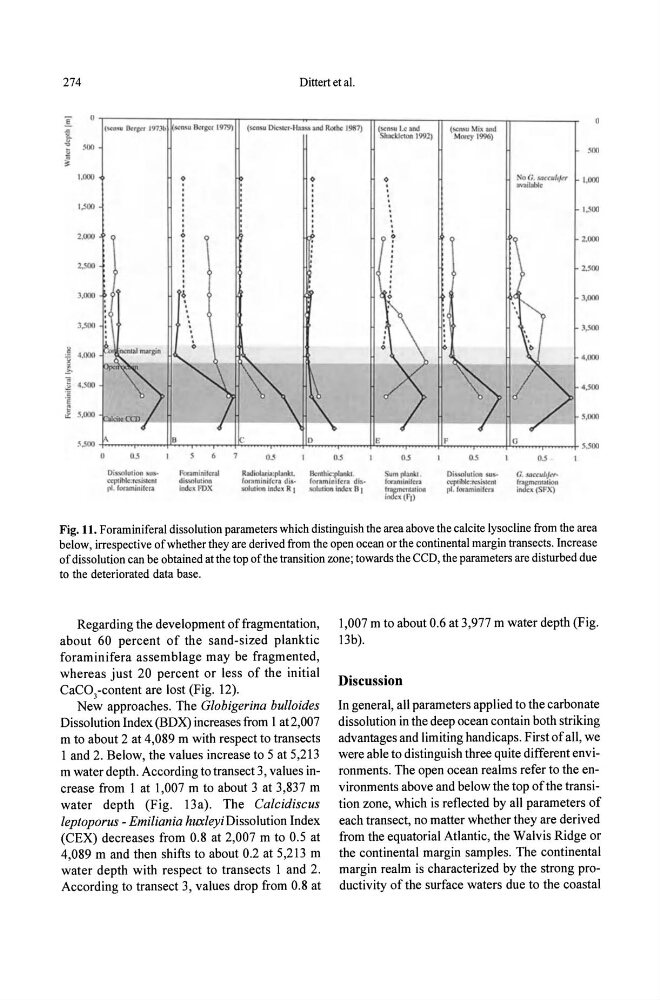
Fig. 11. Foraminiferal dissolution parameters which distinguish the area above the calcite lysocline from the area
below, irrespective of whether they are derived from the open ocean or the continental margin transects. Increase
of dissolution can be obtained at the top of the transition zone; towards the CCD, the parameters are disturbed due
to the deteriorated data base.
Regarding the development offragmentation,
about 60 percent of the sand-sized planktic
foraminifera assemblage may be fragmented ,
whereas just 20 percent or less of the initial
CaC0 3 -content are lost (Fig. 12).
New approaches. The Globigerina bulloides
Dissolution Index (BDX) increases from I at 2,007
m to about 2 at 4,089 m with respect to transects
I and 2. Below, the values increase to 5 at 5,213
m water depth. According to transect 3, values increase from 1 at 1,007 m to about 3 at 3,837 m
water depth (Fig. 13a). The Calcidiscus
leptoporus - Emiliania huxleyiDissolution Index
(CEX) decreases from 0.8 at 2,007 m to 0.5 at
4,089 m and then shifts to about 0.2 at 5,213 m
water depth with respect to transects 1 and 2.
According to transect 3, values drop from 0.8 at
1,007 m to about 0.6 at 3,977 m water depth (Fig.
13b).
Discussion
In general, al\ parameters applied to the carbonate
dissolution in the deep ocean contain both striking
advantages and limiting handicaps. First of al\, we
were able to distinguish three quite different environments. The open ocean realms refer to the environments above and below the top of the transition zone, which is reflected by al\ parameters of
each transect, no matter whether they are derived
from the equatorial Atlantic, the Walvis Ridge or
the continental margin samples. The continental
margin realm is characterized by the strong productivity of the surface waters due to the coastal
Dittert et al.
I
t
I~JmI Dt1'£(1 J973b $4.'ft..w lklgcr 1979)
(K-n$U OktI!.'1. lIu and Roche 11181)
(S(:ft.SU l..e.w
(!oCmIt Mi:xand
Shackk1"" 1992)
MOl<)' 1996)
~
.100
~
1.000
0
0
1.000
I,so!)
I,so!)
2.tnJ
2.000
2..100
2.500
.000
3.000
J,5ClO
J.~
.~ '.0011
!
4.000
~ 4.soo
""
4.soo
. .
. .
! 5.000
5.000
.'.100
0
0
E
G
5.500
0..1
0_'
0.5
0..1
0..1
0..1
Dis.wlulioll ... Fonminifcrlll b ctioiarill:pWnk1. Ekmhk:planltl Sumpltankt . Oi$.SOhnion "". G. Mlceul,!;!,..
cq)ljble~enl
dissohllion
foraminitera dis(orllminircn disrontnnlft'n
a:pI ibk;~W'nl
f::f:(~F~
pl. (oram.inir(~
iode-..: I~DX
solution Index R J
soIlIlion ind¢x B I
r:=, )i on
pl. foumll1lren
Fig. 11. Foraminiferal dissolution parameters which distinguish the area above the calcite lysocline from the area
below, irrespective of whether they are derived from the open ocean or the continental margin transects. Increase
of dissolution can be obtained at the top of the transition zone; towards the CCD, the parameters are disturbed due
to the deteriorated data base.
Regarding the development offragmentation,
about 60 percent of the sand-sized planktic
foraminifera assemblage may be fragmented ,
whereas just 20 percent or less of the initial
CaC0 3 -content are lost (Fig. 12).
New approaches. The Globigerina bulloides
Dissolution Index (BDX) increases from I at 2,007
m to about 2 at 4,089 m with respect to transects
I and 2. Below, the values increase to 5 at 5,213
m water depth. According to transect 3, values increase from 1 at 1,007 m to about 3 at 3,837 m
water depth (Fig. 13a). The Calcidiscus
leptoporus - Emiliania huxleyiDissolution Index
(CEX) decreases from 0.8 at 2,007 m to 0.5 at
4,089 m and then shifts to about 0.2 at 5,213 m
water depth with respect to transects 1 and 2.
According to transect 3, values drop from 0.8 at
1,007 m to about 0.6 at 3,977 m water depth (Fig.
13b).
Discussion
In general, al\ parameters applied to the carbonate
dissolution in the deep ocean contain both striking
advantages and limiting handicaps. First of al\, we
were able to distinguish three quite different environments. The open ocean realms refer to the environments above and below the top of the transition zone, which is reflected by al\ parameters of
each transect, no matter whether they are derived
from the equatorial Atlantic, the Walvis Ridge or
the continental margin samples. The continental
margin realm is characterized by the strong productivity of the surface waters due to the coastal