

Carbonate Dissolution in the Deep-Sea
Transect 1
Equatorial Atlantic
Modificalion of organism as emblages
o
Opal % (w/w)
o
5
10
IS
20
I 2.500 +-_...L_--'--_-'-_----'-_--;
-5
.g 3,(XlO
"
:;; J.5CMI
?;
4.000
4.500
S.(XIO
Transect 2
Walvi Ridge
o
o
5.500 +---,-----,----r---I
12.500 2.5.000 37.5CXI 50.000
o
12.500 25,000 J7"~ 50.000
umber of org"nL~ms pcr IS 150Ill'1)
Modification of planktonic foram iniferal a emblages
Shell-thickness
Thin
Thick .,:~=:;::::;;;;;;;;;;;;;;;;;;;;;;;;;;~
c=J
I 2,5110 .:===========~
"
~ 35m
4.000
4.51Ml
5,000
2.5
50
75
100
o
25
SO
75
Planklonic foraminifera
Continental margin
273
1,100 ~
i:i
1,5CKI Q.
"
'0
Z.OCXI ~
2.
2.5CKI
3.00(1
3.5m
4.000
12.500 25.000 J7.5oo 50.000
•
R..1diohuio
Bc::nlhic forJm in ifcru
o
o PIi.'mklOnic fclr.m,Inifcr'3
---<>-- Op,1 % (w/W)
so
75
•
Glohjg(!f'j/ul sp.
o GlohigtriniUl ~r.
o GI<>I>i~
•
Globororali. sp.
ItKI
o INeo·) G f
hhoquadriJl(J sp.
1.000 ~
n
1.500 ~
"
'0
2.tll!l ~
2.
2.500
3,001
3.500
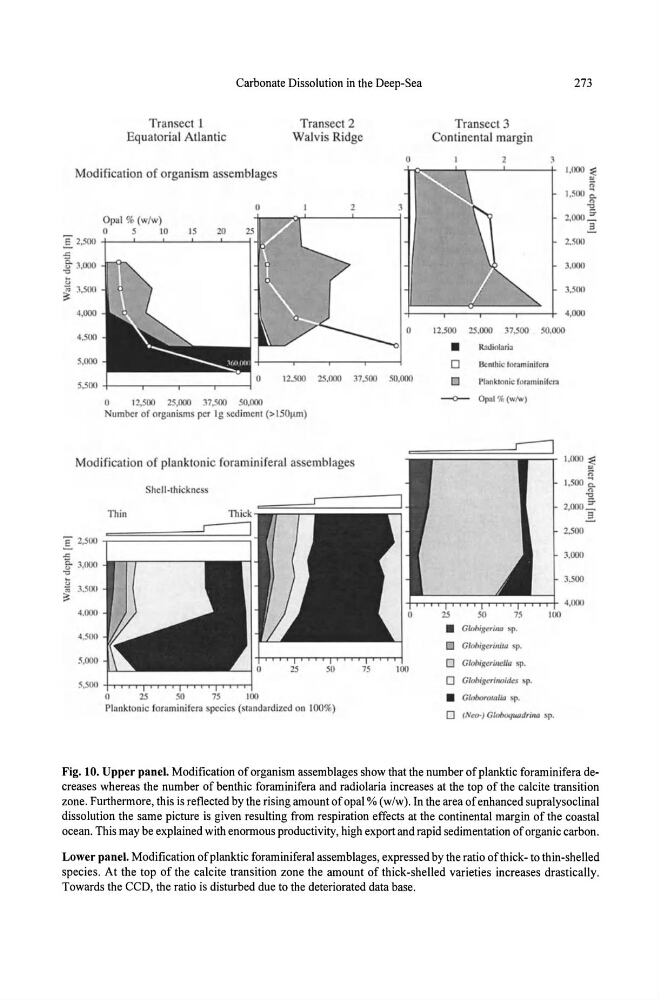
Fig. 10. Upper panel. Modification of organism assemblages show that the number of planktic foraminifera decreases whereas the number of benthic foraminifera and radiolaria increases at the top of the calcite transition
zone. Furthermore, this is reflected by the rising amount of opal % (w/w). In the area of enhanced supralysoclinal
dissolution the same picture is given resulting from respiration effects at the continental margin of the coastal
ocean. This may be explained with enormous productivity, high export and rapid sedimentation of organic carbon.
Lower panel. Modification of planktic foraminiferal assemblages, expressed by the ratio of thick- to thin-shelled
species. At the top of the calcite transition zone the amount of thick-shelled varieties increases drastically.
Towards the CCD, the ratio is disturbed due to the deteriorated data base.
Transect 1
Equatorial Atlantic
Modificalion of organism as emblages
o
Opal % (w/w)
o
5
10
IS
20
I 2.500 +-_...L_--'--_-'-_----'-_--;
-5
.g 3,(XlO
"
:;; J.5CMI
?;
4.000
4.500
S.(XIO
Transect 2
Walvi Ridge
o
o
5.500 +---,-----,----r---I
12.500 2.5.000 37.5CXI 50.000
o
12.500 25,000 J7"~ 50.000
umber of org"nL~ms pcr IS
Modification of planktonic foram iniferal a emblages
Shell-thickness
Thin
Thick .,:~=:;::::;;;;;;;;;;;;;;;;;;;;;;;;;;~
c=J
I 2,5110 .:===========~
"
~ 35m
4.000
4.51Ml
5,000
2.5
50
75
100
o
25
SO
75
Planklonic foraminifera
Continental margin
273
1,100 ~
i:i
1,5CKI Q.
"
'0
Z.OCXI ~
2.
2.5CKI
3.00(1
3.5m
4.000
12.500 25.000 J7.5oo 50.000
•
R..1diohuio
Bc::nlhic forJm in ifcru
o
o PIi.'mklOnic fclr.m,Inifcr'3
---<>-- Op,1 % (w/W)
so
75
•
Glohjg(!f'j/ul sp.
o GlohigtriniUl ~r.
o GI<>I>i~
•
Globororali. sp.
ItKI
o INeo·) G f
hhoquadriJl(J sp.
1.000 ~
n
1.500 ~
"
'0
2.tll!l ~
2.
2.500
3,001
3.500
Fig. 10. Upper panel. Modification of organism assemblages show that the number of planktic foraminifera decreases whereas the number of benthic foraminifera and radiolaria increases at the top of the calcite transition
zone. Furthermore, this is reflected by the rising amount of opal % (w/w). In the area of enhanced supralysoclinal
dissolution the same picture is given resulting from respiration effects at the continental margin of the coastal
ocean. This may be explained with enormous productivity, high export and rapid sedimentation of organic carbon.
Lower panel. Modification of planktic foraminiferal assemblages, expressed by the ratio of thick- to thin-shelled
species. At the top of the calcite transition zone the amount of thick-shelled varieties increases drastically.
Towards the CCD, the ratio is disturbed due to the deteriorated data base.