

272
Transect I
Equatorial At lantic
Modification of size fractions> 63!Am
I ~5(X)
§- 3,000
."
~ 3.500
• . 000
4,s00
5.000
S5(X)
Or)' hulk dens;ly [glcm 31
0.2
0.6
0.8
o
2.1
50
7S
100
Size (",clions (stand.rdized 011 100%)
Dittert et al.
Transect 2
Walvis Ridge
0.4
... ..
0.6
....
.. c··
..
25
so
O.R
7S
Modification of CaC~. COrg • and rain ratio
R4 1in rat io
o
0.1)4
0.04
0.08
I2,sOO ~~-T~~~r-~~~-4
"" fr 3.000
."
"
~ 3.500
4.(01)
4.501'
5.000
......... '0
o 25 SO 75 1(1(l 0
o 25 50 75 100 0 I
2
3
4
CoC0 3 % (w/ w) ~ % (w/w)
Transect 3
Continental margin
100 > I,OOO,. m
•
0
355"", . SOOtim
0
0
150~un· 212J.lm
0
•
D,y bulk density IIi
II.OS
o 25 SO 7S IOU 0
.. -0... R.1in nrin
1.000 ~
;;
1,s00 ;:;.
.g
:;.
2,1100 _
2..
2.500
4.000
SOO~un - l ,OOO}lm
2 12~.m • 355,101
63..-m· 150lA m
O.OS
1.0110 ~
;;
1.500 g.
..,
2.000~
2..
2.500
3.000
3500
4.000
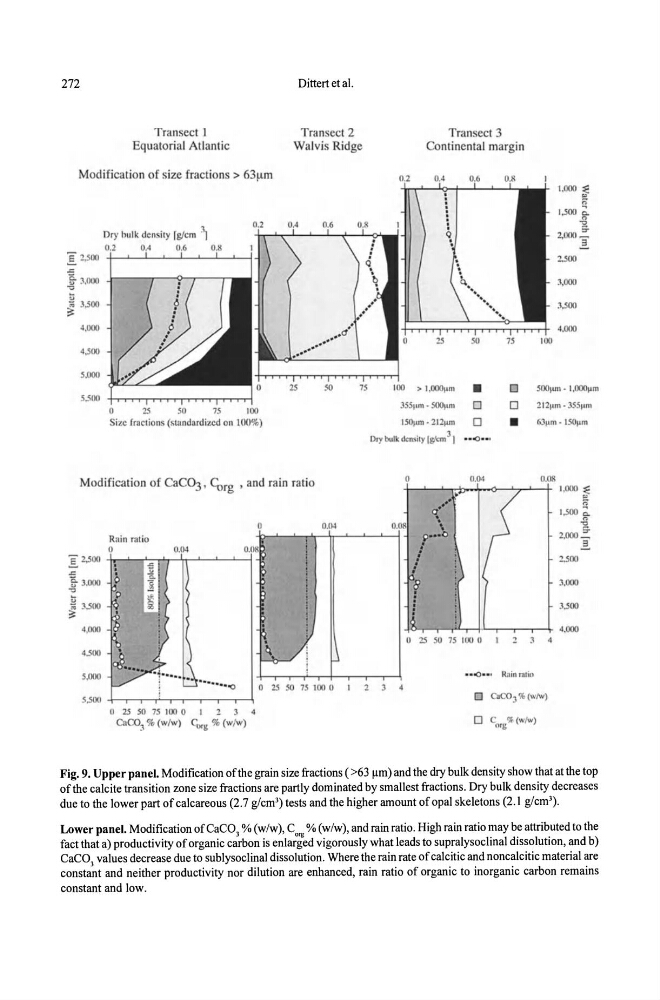
Fig. 9. Upper panel. Modification of the grain size fractions ( >63 !-1m) and the dry bulk density show that at the top
of the calcite transition zone size fractions are partly dominated by smallest fractions. Dry bulk density decreases
due to the lower part of calcareous (2.7 glcm 3 ) tests and the higher amount of opal skeletons (2.1 glcm 3 ).
Lower panel. Modification ofCaC0 3 % (w/w), Co,. % (w/w), and rain ratio. High rain ratio may be attributed to the
fact that a) productivity of organic carbon is enlarged vigorously what leads to supralysoclinal dissolution, and b)
CaC0 3 values decrease due to sublysoclinal dissolution. Where the rain rate of calcitic and noncalcitic material are
constant and neither productivity nor dilution are enhanced, rain ratio of organic to inorganic carbon remains
constant and low.
Transect I
Equatorial At lantic
Modification of size fractions> 63!Am
I ~5(X)
§- 3,000
."
~ 3.500
• . 000
4,s00
5.000
S5(X)
Or)' hulk dens;ly [glcm 31
0.2
0.6
0.8
o
2.1
50
7S
100
Size (",clions (stand.rdized 011 100%)
Dittert et al.
Transect 2
Walvis Ridge
0.4
... ..
0.6
....
.. c··
..
25
so
O.R
7S
Modification of CaC~. COrg • and rain ratio
R4 1in rat io
o
0.1)4
0.04
0.08
I2,sOO ~~-T~~~r-~~~-4
"" fr 3.000
."
"
~ 3.500
4.(01)
4.501'
5.000
......... '0
o 25 SO 75 1(1(l 0
o 25 50 75 100 0 I
2
3
4
CoC0 3 % (w/ w) ~ % (w/w)
Transect 3
Continental margin
100 > I,OOO,. m
•
0
355"", . SOOtim
0
0
150~un· 212J.lm
0
•
D,y bulk density IIi
II.OS
o 25 SO 7S IOU 0
.. -0... R.1in nrin
1.000 ~
;;
1,s00 ;:;.
.g
:;.
2,1100 _
2..
2.500
4.000
SOO~un - l ,OOO}lm
2 12~.m • 355,101
63..-m· 150lA m
O.OS
1.0110 ~
;;
1.500 g.
..,
2.000~
2..
2.500
3.000
3500
4.000
Fig. 9. Upper panel. Modification of the grain size fractions ( >63 !-1m) and the dry bulk density show that at the top
of the calcite transition zone size fractions are partly dominated by smallest fractions. Dry bulk density decreases
due to the lower part of calcareous (2.7 glcm 3 ) tests and the higher amount of opal skeletons (2.1 glcm 3 ).
Lower panel. Modification ofCaC0 3 % (w/w), Co,. % (w/w), and rain ratio. High rain ratio may be attributed to the
fact that a) productivity of organic carbon is enlarged vigorously what leads to supralysoclinal dissolution, and b)
CaC0 3 values decrease due to sublysoclinal dissolution. Where the rain rate of calcitic and noncalcitic material are
constant and neither productivity nor dilution are enhanced, rain ratio of organic to inorganic carbon remains
constant and low.