

Carbonate Dissolution in the Deep-Sea
269
Fragments are counted if at least 50 % of the single chamber is preserved. The absolute and relative frequencies of skeletal fragments, the ratio of
benthic to planktic foraminifera, and the ratio of
radiolaria to planktic foraminifera were calculated
according to Diester-Haass and Rothe (1987):
Fragmentation Index = F I(F+W)
(5.1)
Benthic to planktic foraminifera Index = B I (B+P)
(5.2)
Radiolaria to planktic foraminifera Index = RI (R+P)
T-shaped elements. In contrast, C. leptoporus is
a very solution-resistant form with heavily calcified
distal and proximal shields, where no slots between
the single elements occur and the connecting central tube is very narrow. Carbonate dissolution will
have a stronger effect on E. huxleyi than on C.
leptoporus and, therefore, the ratio of these two
species will change with increasing carbonate dissolution. This Calcidiscus leptoporus - Emiliania
huxleyi Dissolution Index (CEX) is calculated as:
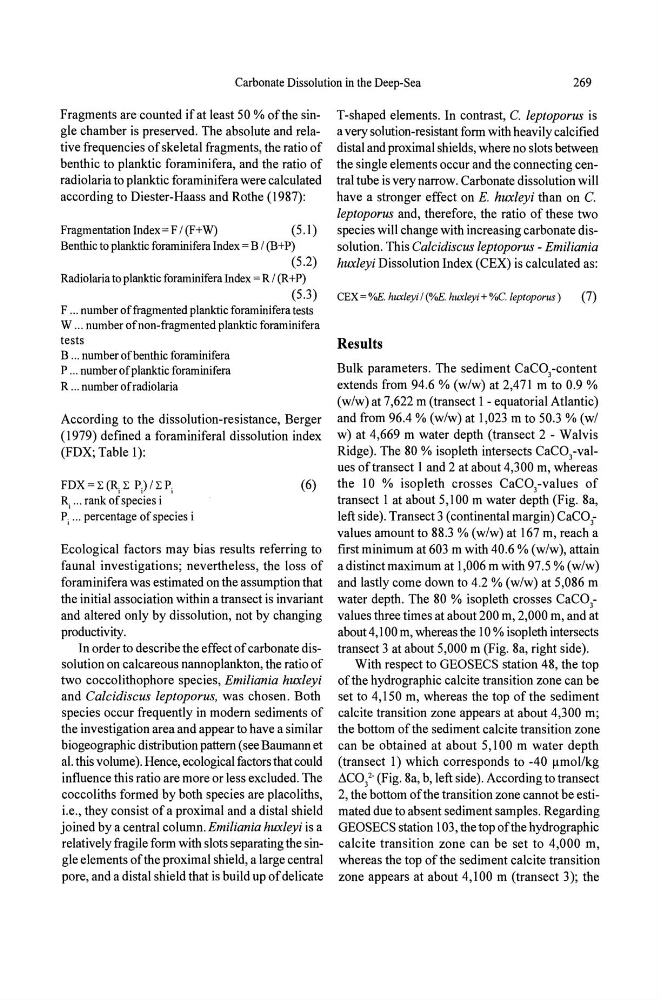
(5.3) CEX = %E. huxleyi / (%E. huxleyi + %c. leptoporus) (7)
F ... number of fragmented planktic foraminifera tests
W ... number of non-fragmented planktic foraminifera
tests
B ... number of benthic foraminifera
P ... number of planktic foraminifera
R ... number of radiolaria
According to the dissolution-resistance, Berger
(1979) defined a foraminiferal dissolution index
(FDX; Table 1):
FDX=L (R, L P)ILP i
(6)
R, ... rank of species i
Pi ... percentage of species i
Ecological factors may bias results referring to
faunal investigations; nevertheless, the loss of
foraminifera was estimated on the assumption that
the initial association within a transect is invariant
and altered only by dissolution, not by changing
productivity.
In order to describe the effect of carbonate dissolution on calcareous nannoplankton, the ratio of
two coccolithophore species, Emiliania huxleyi
and Ca/cidiscus leptoporus, was chosen. Both
species occur frequently in modem sediments of
the investigation area and appear to have a similar
biogeographic distribution pattern (see Baumann et
aI. this volume). Hence, ecological factors that could
influence this ratio are more or less excluded. The
coccoliths formed by both species are placoliths,
i.e., they consist of a proximal and a distal shield
joined by a central column. Emiliania huxleyi is a
relatively fragile form with slots separating the single elements of the proximal shield, a large central
pore, and a distal shield that is build up of delicate
Results
Bulk parameters. The sediment CaC0 3 -content
extends from 94.6 % (w/w) at 2,471 m to 0.9 %
(w/w) at 7,622 m (transect 1- equatorial Atlantic)
and from 96.4 % (w/w) at 1,023 m to 50.3 % (wi
w) at 4,669 m water depth (transect 2 - Walvis
Ridge). The 80 % isopleth intersects CaC0 3 -values oftransect 1 and 2 at about 4,300 m, whereas
the 10 % isopleth crosses CaC0 3 -values of
transect I at about 5,100 m water depth (Fig. 8a,
left side). Transect 3 (continental margin) CaCO f
values amount to 88.3 % (w/w) at 167 m, reach a
first minimum at 603 m with 40.6 % (w/w), attain
a distinct maximum at 1,006 m with 97.5 % (w/w)
and lastly come down to 4.2 % (w/w) at 5,086 m
water depth. The 80 % isopleth crosses CaC0 3 -
values three times at about 200 m, 2,000 m, and at
about 4, 1 00 m, whereas the 10% isopleth intersects
transect 3 at about 5,000 m (Fig. 8a, right side).
With respect to GEOSECS station 48, the top
ofthe hydrographic calcite transition zone can be
set to 4,150 m, whereas the top ofthe sediment
calcite transition zone appears at about 4,300 m;
the bottom of the sediment calcite transition zone
can be obtained at about 5,100 m water depth
(transect 1) which corresponds to -40 Ilmol/kg
~C03 2- (Fig. 8a, b, left side). According to transect
2, the bottom of the transition zone cannot be estimated due to absent sediment samples. Regarding
GEOSECS station 103, the top of the hydrographic
calcite transition zone can be set to 4,000 m,
whereas the top of the sediment calcite transition
zone appears at about 4,100 m (transect 3); the
269
Fragments are counted if at least 50 % of the single chamber is preserved. The absolute and relative frequencies of skeletal fragments, the ratio of
benthic to planktic foraminifera, and the ratio of
radiolaria to planktic foraminifera were calculated
according to Diester-Haass and Rothe (1987):
Fragmentation Index = F I(F+W)
(5.1)
Benthic to planktic foraminifera Index = B I (B+P)
(5.2)
Radiolaria to planktic foraminifera Index = RI (R+P)
T-shaped elements. In contrast, C. leptoporus is
a very solution-resistant form with heavily calcified
distal and proximal shields, where no slots between
the single elements occur and the connecting central tube is very narrow. Carbonate dissolution will
have a stronger effect on E. huxleyi than on C.
leptoporus and, therefore, the ratio of these two
species will change with increasing carbonate dissolution. This Calcidiscus leptoporus - Emiliania
huxleyi Dissolution Index (CEX) is calculated as:
(5.3) CEX = %E. huxleyi / (%E. huxleyi + %c. leptoporus) (7)
F ... number of fragmented planktic foraminifera tests
W ... number of non-fragmented planktic foraminifera
tests
B ... number of benthic foraminifera
P ... number of planktic foraminifera
R ... number of radiolaria
According to the dissolution-resistance, Berger
(1979) defined a foraminiferal dissolution index
(FDX; Table 1):
FDX=L (R, L P)ILP i
(6)
R, ... rank of species i
Pi ... percentage of species i
Ecological factors may bias results referring to
faunal investigations; nevertheless, the loss of
foraminifera was estimated on the assumption that
the initial association within a transect is invariant
and altered only by dissolution, not by changing
productivity.
In order to describe the effect of carbonate dissolution on calcareous nannoplankton, the ratio of
two coccolithophore species, Emiliania huxleyi
and Ca/cidiscus leptoporus, was chosen. Both
species occur frequently in modem sediments of
the investigation area and appear to have a similar
biogeographic distribution pattern (see Baumann et
aI. this volume). Hence, ecological factors that could
influence this ratio are more or less excluded. The
coccoliths formed by both species are placoliths,
i.e., they consist of a proximal and a distal shield
joined by a central column. Emiliania huxleyi is a
relatively fragile form with slots separating the single elements of the proximal shield, a large central
pore, and a distal shield that is build up of delicate
Results
Bulk parameters. The sediment CaC0 3 -content
extends from 94.6 % (w/w) at 2,471 m to 0.9 %
(w/w) at 7,622 m (transect 1- equatorial Atlantic)
and from 96.4 % (w/w) at 1,023 m to 50.3 % (wi
w) at 4,669 m water depth (transect 2 - Walvis
Ridge). The 80 % isopleth intersects CaC0 3 -values oftransect 1 and 2 at about 4,300 m, whereas
the 10 % isopleth crosses CaC0 3 -values of
transect I at about 5,100 m water depth (Fig. 8a,
left side). Transect 3 (continental margin) CaCO f
values amount to 88.3 % (w/w) at 167 m, reach a
first minimum at 603 m with 40.6 % (w/w), attain
a distinct maximum at 1,006 m with 97.5 % (w/w)
and lastly come down to 4.2 % (w/w) at 5,086 m
water depth. The 80 % isopleth crosses CaC0 3 -
values three times at about 200 m, 2,000 m, and at
about 4, 1 00 m, whereas the 10% isopleth intersects
transect 3 at about 5,000 m (Fig. 8a, right side).
With respect to GEOSECS station 48, the top
ofthe hydrographic calcite transition zone can be
set to 4,150 m, whereas the top ofthe sediment
calcite transition zone appears at about 4,300 m;
the bottom of the sediment calcite transition zone
can be obtained at about 5,100 m water depth
(transect 1) which corresponds to -40 Ilmol/kg
~C03 2- (Fig. 8a, b, left side). According to transect
2, the bottom of the transition zone cannot be estimated due to absent sediment samples. Regarding
GEOSECS station 103, the top of the hydrographic
calcite transition zone can be set to 4,000 m,
whereas the top of the sediment calcite transition
zone appears at about 4,100 m (transect 3); the