

270
Dittert et al.
Open ocean situation
GEOSECS station 48
Transect 1 . Equatorial Atlantic
Transect 2 • Walvis Ridge
CaC03 % (w/w)
Continental margin situation
GEOSECS station 103
Transect 3 . C..ontinentaJ margin
o
25
50
:§:
75
100
25
50
75
100
O~A~~~,~~~====~~~,~~_~lT~,~~t\~~~~====~~QO~~
o
.,s
0500
,til
I~
I~~
-5
i o..?" t,_
I c.
I !2-- ~
'll
500
..g 1,000
.B 1,500
~ 2,000
2,500
3.000
~ \
:..§ 0
: ~ \
1 <> 1,000
: ~ \
: ~
: ~
<>~ <> 1,500
i ,...;
\
I 00 0
: 0-1
<> ~
2,000
2,500
o 0 3,000
3,500
, <>
3,500
4,000 _C-'!I.~i.tL._ ... _
IYs(lClil1e~ ~
\
ly,:~~_I!!'.e~:<>~._... 4,000
4,500
.- "-'0"."-'<>-'-'\
<>
4,500
o
<> ~<> <>,
'.
5,000
-o':'-""ccii"'
5,000
5,500 +rTTrn-rrm--rrrnrrTTTrrT.,-t'--rrrnrrT-rrrrr-rrrn-rrTTrrT+ 5,500
~ 130
0
110
E
..:::, 90
N
70
0'"
U
50
()
30
10
·10
·30
·50
·70
·90
o 50 100 150 200 250 50 100 150 200 250
C0 3 2. [,",mol/kgl
- , - - - - - - - - - - , , - - - - - - - - - - , 130
B
Top of the lysocline = 4,3OOm
••••• w •••• · • • • • • • • • • _ • • • • • • • • • • • • • • • • • • • • • •
o
o
o
o 0
~,_~~?~._ ... _. _ .. ~_._ .. ~.~\~.Oo
($,0
Os
<> Bottom of the lysocline = 5,loom
110
90
70
50
30
10
·10
·30
·50
·70
~"""rrrrrr""or~~rrrrrr""orTT",,+·90
0
25
CaC03 % (w/w)
50
75
100
o
o
o
25
50
75
100
Water column carbonate ion content
Ollcitc saturation
Trart"tCct 1
Equatorial Atlantic
Transccl2
Walvis Ridge
Transect 3 - Continental margin
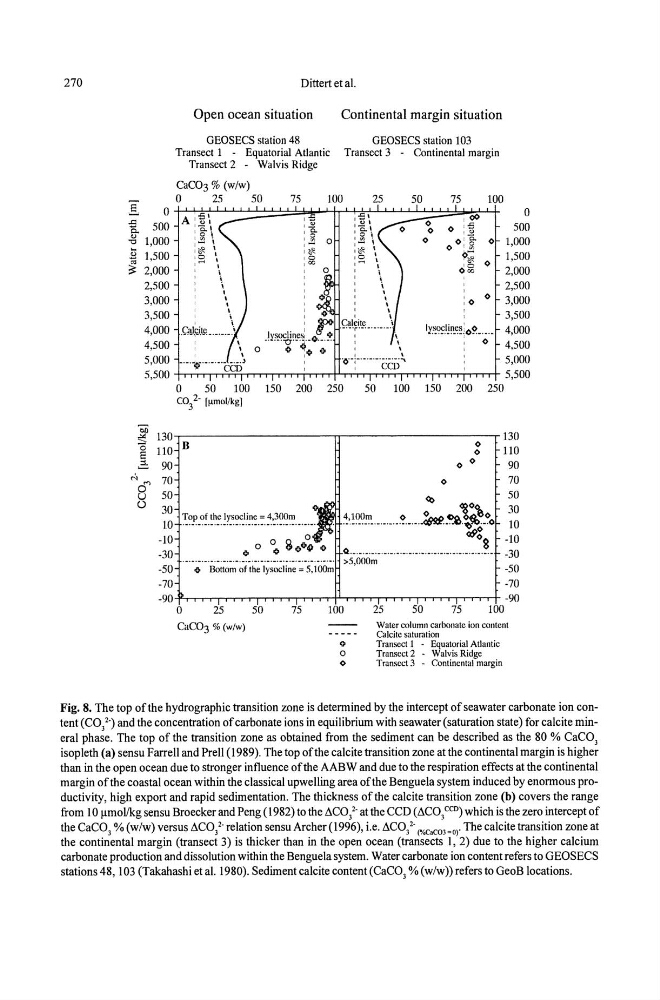
Fig. 8. The top of the hydrographic transition zone is detennined by the intercept of seawater carbonate ion content (CO,2.) and the concentration of carbonate ions in equilibrium with seawater (saturation state) for calcite minerai phase. The top of the transition zone as obtained from the sediment can be described as the 80 % CaCO,
isopleth (a) sensu Farrell and Prell (1989)- The top ofthe calcite transition zone at the continental margin is higher
than in the open ocean due to stronger influence of the AABW and due to the respiration effects at the continental
margin of the coastal ocean within the classical upwelling area of the Benguela system induced by enonnous productivity, high export and rapid sedimentation. The thickness of the calcite transition zone (b) covers the range
from I 0 ~mo1lkg sensu Broecker and Peng (1982) to the !lCO/- at the CCD (!leO, CCO) which is the zero intercept of
the CaCO, % (w/w) versus !lCO,2. relation sensu Archer (1996), i.e_ !lCO,2. (%C,CO' =0)' The calcite transition zone at
the continental margin (transect 3) is thicker than in the open ocean (transects 1,2) due to the higher calcium
carbonate production and dissolution within the Benguela system_ Water carbonate ion content refers to GEOSECS
stations 48, 103 (Takahashi et al. 1980). Sediment calcite content (CaCO, % (w/w)) refers to GeoB locations.
Dittert et al.
Open ocean situation
GEOSECS station 48
Transect 1 . Equatorial Atlantic
Transect 2 • Walvis Ridge
CaC03 % (w/w)
Continental margin situation
GEOSECS station 103
Transect 3 . C..ontinentaJ margin
o
25
50
:§:
75
100
25
50
75
100
O~A~~~,~~~====~~~,~~_~lT~,~~t\~~~~====~~QO~~
o
.,s
0500
,til
I~
I~~
-5
i o..?" t,_
I c.
I !2-- ~
'll
500
..g 1,000
.B 1,500
~ 2,000
2,500
3.000
~ \
:..§ 0
: ~ \
1 <> 1,000
: ~ \
: ~
: ~
<>~ <> 1,500
i ,...;
\
I 00 0
: 0-1
<> ~
2,000
2,500
o 0 3,000
3,500
, <>
3,500
4,000 _C-'!I.~i.tL._ ... _
IYs(lClil1e~ ~
\
ly,:~~_I!!'.e~:<>~._... 4,000
4,500
.- "-'0"."-'<>-'-'\
<>
4,500
o
<> ~<> <>,
'.
5,000
-o':'-""ccii"'
5,000
5,500 +rTTrn-rrm--rrrnrrTTTrrT.,-t'--rrrnrrT-rrrrr-rrrn-rrTTrrT+ 5,500
~ 130
0
110
E
..:::, 90
N
70
0'"
U
50
()
30
10
·10
·30
·50
·70
·90
o 50 100 150 200 250 50 100 150 200 250
C0 3 2. [,",mol/kgl
- , - - - - - - - - - - , , - - - - - - - - - - , 130
B
Top of the lysocline = 4,3OOm
••••• w •••• · • • • • • • • • • _ • • • • • • • • • • • • • • • • • • • • • •
o
o
o
o 0
~,_~~?~._ ... _. _ .. ~_._ .. ~.~\~.Oo
($,0
Os
<> Bottom of the lysocline = 5,loom
110
90
70
50
30
10
·10
·30
·50
·70
~"""rrrrrr""or~~rrrrrr""orTT",,+·90
0
25
CaC03 % (w/w)
50
75
100
o
o
o
25
50
75
100
Water column carbonate ion content
Ollcitc saturation
Trart"tCct 1
Equatorial Atlantic
Transccl2
Walvis Ridge
Transect 3 - Continental margin
Fig. 8. The top of the hydrographic transition zone is detennined by the intercept of seawater carbonate ion content (CO,2.) and the concentration of carbonate ions in equilibrium with seawater (saturation state) for calcite minerai phase. The top of the transition zone as obtained from the sediment can be described as the 80 % CaCO,
isopleth (a) sensu Farrell and Prell (1989)- The top ofthe calcite transition zone at the continental margin is higher
than in the open ocean due to stronger influence of the AABW and due to the respiration effects at the continental
margin of the coastal ocean within the classical upwelling area of the Benguela system induced by enonnous productivity, high export and rapid sedimentation. The thickness of the calcite transition zone (b) covers the range
from I 0 ~mo1lkg sensu Broecker and Peng (1982) to the !lCO/- at the CCD (!leO, CCO) which is the zero intercept of
the CaCO, % (w/w) versus !lCO,2. relation sensu Archer (1996), i.e_ !lCO,2. (%C,CO' =0)' The calcite transition zone at
the continental margin (transect 3) is thicker than in the open ocean (transects 1,2) due to the higher calcium
carbonate production and dissolution within the Benguela system_ Water carbonate ion content refers to GEOSECS
stations 48, 103 (Takahashi et al. 1980). Sediment calcite content (CaCO, % (w/w)) refers to GeoB locations.