

268
Dittert et al.
100Nr-----------------------------------____ ~
~/:
(j Ocea" _ l/~O'
.:
GEOSECS 48
• • • •
South
Transect 1
America .
Brazil
Basin
Guinea
Basin
Africa
Angola
Ba in
GEOSECS 103
. 0
.". Transect 3
Transect 2
Cape
Basin
400S ' - - - - - - - - - - - - '
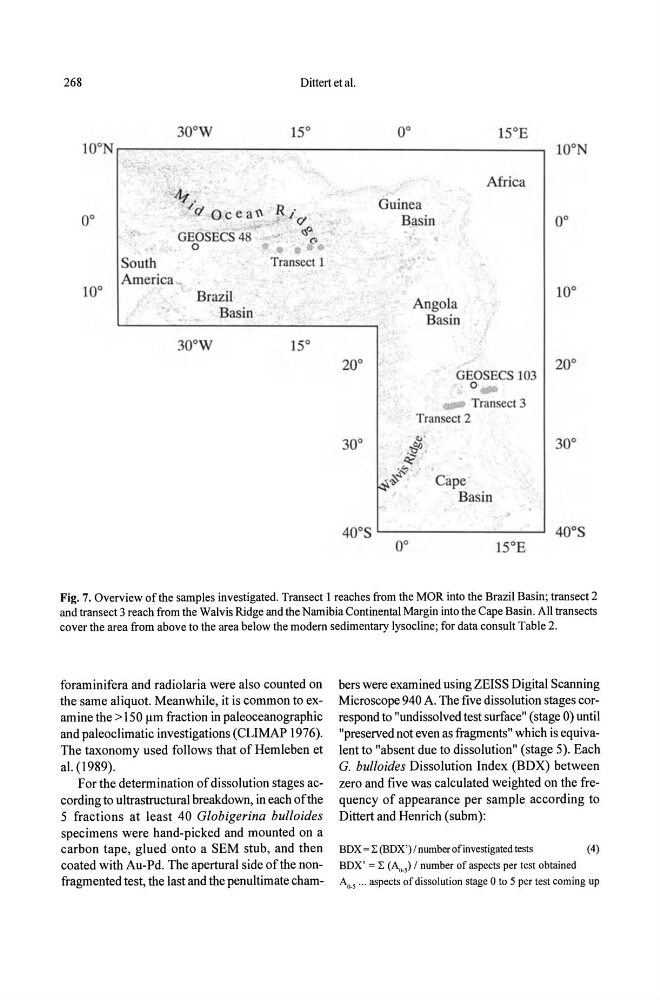
Fig. 7. Overview of the samples investigated. Transect 1 reaches from the MOR into the Brazil Basin; transect 2
and transect 3 reach from the Walvis Ridge and the Namibia Continental Margin into the Cape Basin. All transects
cover the area from above to the area below the modem sedimentary lysocline; for data consult Table 2.
foraminifera and radiolaria were also counted on
the same aliquot. Meanwhile, it is common to examine the> 150 ~m fraction in paleoceanographic
and paleoclimatic investigations (CLIMAP 1976).
The taxonomy used follows that of Hemleben et
al. (1989).
For the determination of dissolution stages according to ultrastructural breakdown, in each of the
5 fractions at least 40 Globigerina bulloides
specimens were hand-picked and mounted on a
carbon tape, glued onto a SEM stub, and then
coated with Au-Pd. The apertural side ofthe nonfragmented test, the last and the penultimate chambers were examined using ZEISS Digital Scanning
Microscope 940 A. The five dissolution stages correspond to "undissolved test surface" (stage 0) until
"preserved not even as fragments" which is equivalent to "absent due to dissolution" (stage 5). Each
G. bulloides Dissolution Index (BDX) between
zero and five was calculated weighted on the frequency of appearance per sample according to
Dittert and Henrich (subm):
BOX ~ L (BOX') / number of investigated tests
(4)
BOX' ~ L (A",) / number of aspects per test obtained
A o ., ... aspects of dissolution stage 0 to 5 per test coming up
Dittert et al.
100Nr-----------------------------------____ ~
~/:
(j Ocea" _ l/~O'
.:
GEOSECS 48
• • • •
South
Transect 1
America .
Brazil
Basin
Guinea
Basin
Africa
Angola
Ba in
GEOSECS 103
. 0
.". Transect 3
Transect 2
Cape
Basin
400S ' - - - - - - - - - - - - '
Fig. 7. Overview of the samples investigated. Transect 1 reaches from the MOR into the Brazil Basin; transect 2
and transect 3 reach from the Walvis Ridge and the Namibia Continental Margin into the Cape Basin. All transects
cover the area from above to the area below the modem sedimentary lysocline; for data consult Table 2.
foraminifera and radiolaria were also counted on
the same aliquot. Meanwhile, it is common to examine the> 150 ~m fraction in paleoceanographic
and paleoclimatic investigations (CLIMAP 1976).
The taxonomy used follows that of Hemleben et
al. (1989).
For the determination of dissolution stages according to ultrastructural breakdown, in each of the
5 fractions at least 40 Globigerina bulloides
specimens were hand-picked and mounted on a
carbon tape, glued onto a SEM stub, and then
coated with Au-Pd. The apertural side ofthe nonfragmented test, the last and the penultimate chambers were examined using ZEISS Digital Scanning
Microscope 940 A. The five dissolution stages correspond to "undissolved test surface" (stage 0) until
"preserved not even as fragments" which is equivalent to "absent due to dissolution" (stage 5). Each
G. bulloides Dissolution Index (BDX) between
zero and five was calculated weighted on the frequency of appearance per sample according to
Dittert and Henrich (subm):
BOX ~ L (BOX') / number of investigated tests
(4)
BOX' ~ L (A",) / number of aspects per test obtained
A o ., ... aspects of dissolution stage 0 to 5 per test coming up