

264
Dittert et al.
CaC0 3 % (w/w)
. . . . . . . . .
l()()
80
60
40
20
o
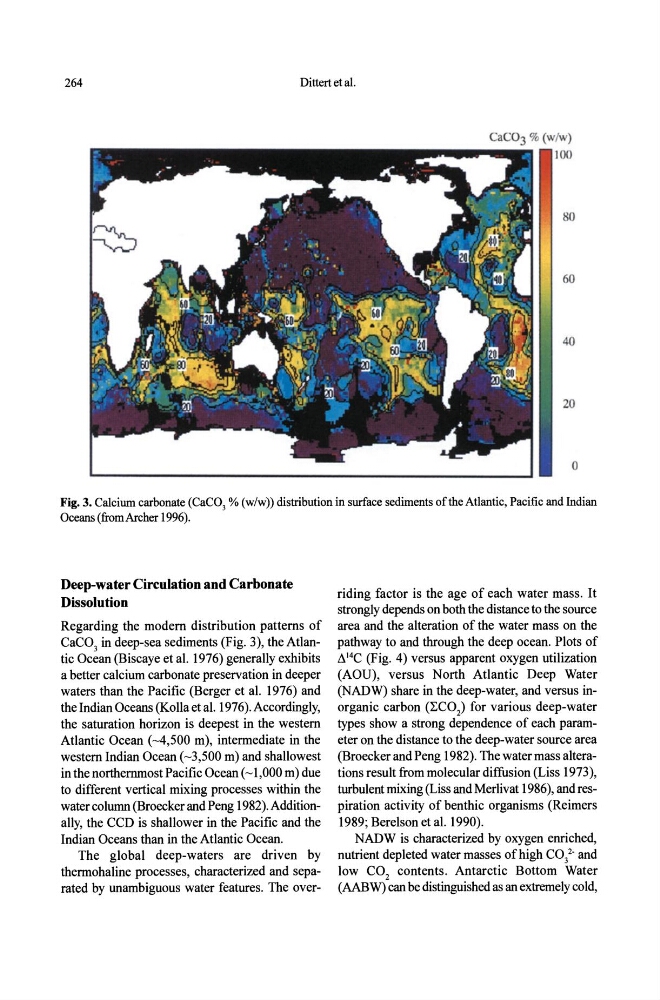
Fig. 3. Calcium carbonate (CaCO J % (w/w» distribution in surface sediments of the Atlantic, Pacific and Indian
Oceans (from Archer 1996).
Deep-water Circulation and Carbonate
Dissolution
Regarding the modern distribution patterns of
CaC0 3 in deep-sea sediments (Fig. 3), the Atlantic Ocean (Biscaye et al. 1976) generally exhibits
a better calcium carbonate preservation in deeper
waters than the Pacific (Berger et al. 1976) and
the Indian Oceans (Kolla et al. 1976). Accordingly,
the saturation horizon is deepest in the western
Atlantic Ocean (-4,500 m), intermediate in the
western Indian Ocean (-3,500 m) and shallowest
in the northernmost Pacific Ocean (-1,000 m) due
to different vertical mixing processes within the
water column (Broecker and Peng 1982). Additionally, the CCD is shallower in the Pacific and the
Indian Oceans than in the Atlantic Ocean.
The global deep-waters are driven by
thermohaline processes, characterized and separated by unambiguous water features. The overriding factor is the age of each water mass. It
strongly depends on both the distance to the source
area and the alteration of the water mass on the
pathway to and through the deep ocean. Plots of
~14C (Fig. 4) versus apparent oxygen utilization
(AOU), versus North Atlantic Deep Water
(NADW) share in the deep-water, and versus inorganic carbon (LC0 2 ) for various deep-water
types show a strong dependence of each parameter on the distance to the deep-water source area
(Broecker and Peng 1982). The water mass alterations result from molecular diffusion (Liss 1973),
turbulent mixing (Liss and Merlivat 1986), and respiration activity of benthic organisms (Reimers
1989; Berelson et al. 1990).
NADW is characterized by oxygen enriched,
nutrient depleted water masses of high cot and
low CO 2 contents. Antarctic Bottom Water
(AABW) can be distinguished as an extremely cold,
Dittert et al.
CaC0 3 % (w/w)
. . . . . . . . .
l()()
80
60
40
20
o
Fig. 3. Calcium carbonate (CaCO J % (w/w» distribution in surface sediments of the Atlantic, Pacific and Indian
Oceans (from Archer 1996).
Deep-water Circulation and Carbonate
Dissolution
Regarding the modern distribution patterns of
CaC0 3 in deep-sea sediments (Fig. 3), the Atlantic Ocean (Biscaye et al. 1976) generally exhibits
a better calcium carbonate preservation in deeper
waters than the Pacific (Berger et al. 1976) and
the Indian Oceans (Kolla et al. 1976). Accordingly,
the saturation horizon is deepest in the western
Atlantic Ocean (-4,500 m), intermediate in the
western Indian Ocean (-3,500 m) and shallowest
in the northernmost Pacific Ocean (-1,000 m) due
to different vertical mixing processes within the
water column (Broecker and Peng 1982). Additionally, the CCD is shallower in the Pacific and the
Indian Oceans than in the Atlantic Ocean.
The global deep-waters are driven by
thermohaline processes, characterized and separated by unambiguous water features. The overriding factor is the age of each water mass. It
strongly depends on both the distance to the source
area and the alteration of the water mass on the
pathway to and through the deep ocean. Plots of
~14C (Fig. 4) versus apparent oxygen utilization
(AOU), versus North Atlantic Deep Water
(NADW) share in the deep-water, and versus inorganic carbon (LC0 2 ) for various deep-water
types show a strong dependence of each parameter on the distance to the deep-water source area
(Broecker and Peng 1982). The water mass alterations result from molecular diffusion (Liss 1973),
turbulent mixing (Liss and Merlivat 1986), and respiration activity of benthic organisms (Reimers
1989; Berelson et al. 1990).
NADW is characterized by oxygen enriched,
nutrient depleted water masses of high cot and
low CO 2 contents. Antarctic Bottom Water
(AABW) can be distinguished as an extremely cold,