

Carbonate Dissolution in the Deep-Sea
263
tive chemosorptive coatings (Chave and Suess
1970) or organic membranes (McIntyre and
McIntyre 1971). Fecal pellet transport is the most
likely explanation for this phenomenon (Honjo
1975). Moreover, transport by fecal pellets is the
most important process in transferring small
phytoplankton skeletons from the photic zone to the
ocean floor and therefore is a major component in
the global carbon, carbonate, and silica cycles
(Honjo 1976; Honjo eta!' 1982). On the other hand,
almost no information is available whether and how
digestion processes in the guts of copepods or other
zooplankton could lead to the dissolution of calcium
carbonate after incorporation (Nejstgaard et a1.
1994). Investigations on living coccolithophore communities have shown that malformation is a common feature in the biomineralization of coccoliths
(Kleijne 1990; Giraudeau eta1. 1993).
This incomplete formation of coccoliths already
influences their preservation within the water column. In addition, heavily corroded specimens often occurred as well (Young 1994; Baumann et a1.
1997).
Roth and Coulbourn (1982) explained the problems of defining a coccolith lysocline via the composition of a coccolith assemblage with the predominance of solution resistant species in both well and
badly preserved coccolith assemblages. This is in
contrast to foraminiferal assemblages that are usually predominated by more fragile forms should they
be well preserved. All studies on coccolith dissolution are based on visual examination or ranking of
the coccolith assemblages according to their preservation state. More recently Matsouoka et al.
(1991) tried to use the disintegration of the distal
and proximal shields of Calcidiscus leptoporus to
establish a dissolution index.
The South Atlantic Dissolution Experiment
In the following, several of the methods presented
in the first part of this publication were applied on
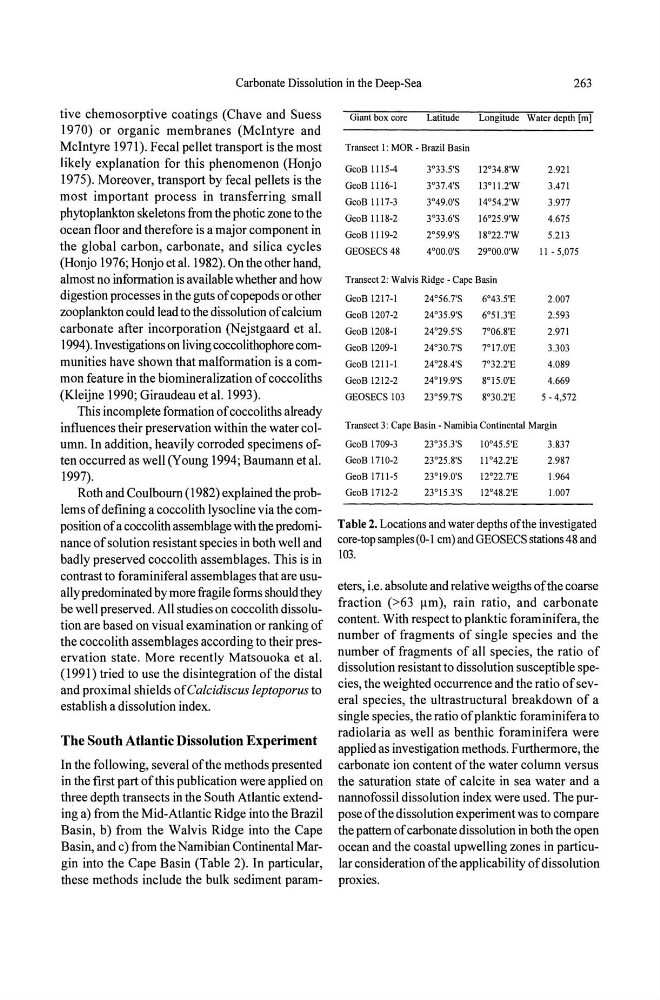
three depth transects in the South Atlantic extending a) from the Mid-Atlantic Ridge into the Brazil
Basin, b) from the Walvis Ridge into the Cape
Basin, and c) from the Namibian Continental Margin into the Cape Basin (Table 2). In particular,
these methods include the bulk sediment paramGiant box core
Latitude
Longitude Water depth [m]
Transect I: MOR - Brazil Basin
GeoB 1115-4
3°33.5'S
12°34.8'W
2.921
GeoB 1116-1
3°37.4'S
13°11.2'W
3.471
GeoB 1117-3
3°49.0'S
W54.2'W
3.977
GeoB 1118-2
3°33.6'S
16°25.9'W
4.675
GeoB 1119-2
2°59.9'S
18°22.7'W
5.213
GEOSECS48
4°00.0'S
29°00.0'W
II - 5,075
Transect 2: Walvis Ridge - Cape Basin
GeoB 1217-1
24°56.7'S
6°43.5'E
2.007
GeoB 1207-2
24°35.9'S
6°51.3'E
2.593
GeoB 1208-1
24°29.5'S
7°06.8'E
2.971
GeoB 1209-1
24°30.7'S
7°17.0'E
3.303
GeoB 1211-1
24°28.4'S
7°32.2'E
4.089
GeoB 1212-2
24°19.9'S
8°15.0'E
4.669
GEOSECS 103
23°59.7'S
8°30.2'E
5 - 4,572
Transect 3: Cape Basin - Namibia Continental Margin
GeoB 1709-3
23°35.3'S
10045.5'E
3.837
GeoB 1710-2
23°25.8'S
11°42.2'E
2.987
GeoB 1711-5
23°19.0'S
12°22.7'E
1.964
GeoB 1712-2
23°15.3'S
12°48.2'E
1.007
Table 2. Locations and water depths of the investigated
core-top samples (0-1 cm) and GEOSECS stations 48 and
103.
eters, i.e. absolute and relative weigths of the coarse
fraction (>63 11m), rain ratio, and carbonate
content. With respect to planktic foraminifera, the
number of fragments of single species and the
number of fragments of all species, the ratio of
dissolution resistant to dissolution susceptible species, the weighted occurrence and the ratio of several species, the ultrastructural breakdown of a
single species, the ratio of planktic foraminifera to
radiolaria as well as benthic foraminifera were
applied as investigation methods. Furthermore, the
carbonate ion content of the water column versus
the saturation state of calcite in sea water and a
nannofossil dissolution index were used. The purpose of the dissolution experiment was to compare
the pattern of carbonate dissolution in both the open
ocean and the coastal upwelling zones in particular consideration ofthe applicability of dissolution
proxies.
263
tive chemosorptive coatings (Chave and Suess
1970) or organic membranes (McIntyre and
McIntyre 1971). Fecal pellet transport is the most
likely explanation for this phenomenon (Honjo
1975). Moreover, transport by fecal pellets is the
most important process in transferring small
phytoplankton skeletons from the photic zone to the
ocean floor and therefore is a major component in
the global carbon, carbonate, and silica cycles
(Honjo 1976; Honjo eta!' 1982). On the other hand,
almost no information is available whether and how
digestion processes in the guts of copepods or other
zooplankton could lead to the dissolution of calcium
carbonate after incorporation (Nejstgaard et a1.
1994). Investigations on living coccolithophore communities have shown that malformation is a common feature in the biomineralization of coccoliths
(Kleijne 1990; Giraudeau eta1. 1993).
This incomplete formation of coccoliths already
influences their preservation within the water column. In addition, heavily corroded specimens often occurred as well (Young 1994; Baumann et a1.
1997).
Roth and Coulbourn (1982) explained the problems of defining a coccolith lysocline via the composition of a coccolith assemblage with the predominance of solution resistant species in both well and
badly preserved coccolith assemblages. This is in
contrast to foraminiferal assemblages that are usually predominated by more fragile forms should they
be well preserved. All studies on coccolith dissolution are based on visual examination or ranking of
the coccolith assemblages according to their preservation state. More recently Matsouoka et al.
(1991) tried to use the disintegration of the distal
and proximal shields of Calcidiscus leptoporus to
establish a dissolution index.
The South Atlantic Dissolution Experiment
In the following, several of the methods presented
in the first part of this publication were applied on
three depth transects in the South Atlantic extending a) from the Mid-Atlantic Ridge into the Brazil
Basin, b) from the Walvis Ridge into the Cape
Basin, and c) from the Namibian Continental Margin into the Cape Basin (Table 2). In particular,
these methods include the bulk sediment paramGiant box core
Latitude
Longitude Water depth [m]
Transect I: MOR - Brazil Basin
GeoB 1115-4
3°33.5'S
12°34.8'W
2.921
GeoB 1116-1
3°37.4'S
13°11.2'W
3.471
GeoB 1117-3
3°49.0'S
W54.2'W
3.977
GeoB 1118-2
3°33.6'S
16°25.9'W
4.675
GeoB 1119-2
2°59.9'S
18°22.7'W
5.213
GEOSECS48
4°00.0'S
29°00.0'W
II - 5,075
Transect 2: Walvis Ridge - Cape Basin
GeoB 1217-1
24°56.7'S
6°43.5'E
2.007
GeoB 1207-2
24°35.9'S
6°51.3'E
2.593
GeoB 1208-1
24°29.5'S
7°06.8'E
2.971
GeoB 1209-1
24°30.7'S
7°17.0'E
3.303
GeoB 1211-1
24°28.4'S
7°32.2'E
4.089
GeoB 1212-2
24°19.9'S
8°15.0'E
4.669
GEOSECS 103
23°59.7'S
8°30.2'E
5 - 4,572
Transect 3: Cape Basin - Namibia Continental Margin
GeoB 1709-3
23°35.3'S
10045.5'E
3.837
GeoB 1710-2
23°25.8'S
11°42.2'E
2.987
GeoB 1711-5
23°19.0'S
12°22.7'E
1.964
GeoB 1712-2
23°15.3'S
12°48.2'E
1.007
Table 2. Locations and water depths of the investigated
core-top samples (0-1 cm) and GEOSECS stations 48 and
103.
eters, i.e. absolute and relative weigths of the coarse
fraction (>63 11m), rain ratio, and carbonate
content. With respect to planktic foraminifera, the
number of fragments of single species and the
number of fragments of all species, the ratio of
dissolution resistant to dissolution susceptible species, the weighted occurrence and the ratio of several species, the ultrastructural breakdown of a
single species, the ratio of planktic foraminifera to
radiolaria as well as benthic foraminifera were
applied as investigation methods. Furthermore, the
carbonate ion content of the water column versus
the saturation state of calcite in sea water and a
nannofossil dissolution index were used. The purpose of the dissolution experiment was to compare
the pattern of carbonate dissolution in both the open
ocean and the coastal upwelling zones in particular consideration ofthe applicability of dissolution
proxies.