

250
Mackensen and Bickert
hanced surface productivity (Oberhansli 1991). A
mean Southern Ocean glacial/interglacial shift of
0.81 %0 (Curry et al. 1988) and 0.99 %0
(Macken sen et al. 1993) was calculated on the
basis of three and six Southern Ocean cores, respectively. This shift is greater than in all other
regions. It implies that during the last glacial maximum Southern Ocean nutrient contents were
higher than e.g. in the eastern equatorial Pacific
Ocean (Curry et al. 1988; Duplessy et al. 1988;
Oppo et al. 1990; Raymo et al. 1990). However,
most of the cores used for this calculation may
have been substantially influenced by a northward
migration and meandering ofthe Polar Front and/
or Subantarctic Front system (Hays et al. 1976;
() Be (%0 PDB)
-1.5 -1
-0.5
0
0 .5
1 .5
0
2
4
100
~
6
2S
CD
200
E
8
300
10
400
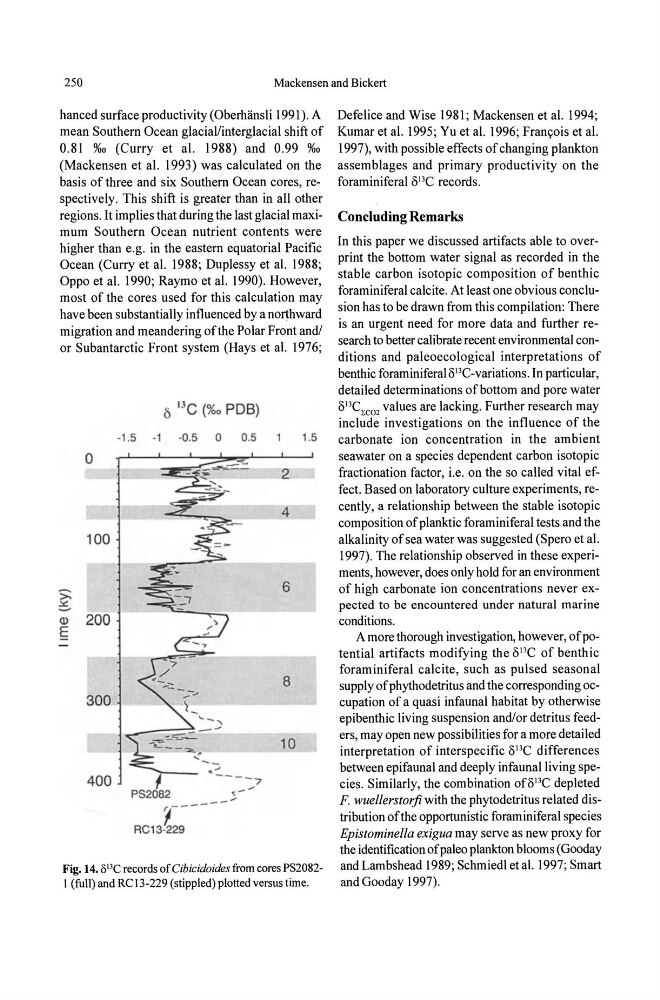
Fig. 14. al3C records of Cibicidoides from cores PS20821 (full) and RC 13-229 (stippled) plotted versus time.
Defelice and Wise 1981; Mackensen et al. 1994;
Kumar et al. 1995; Yu et al. 1996; Franyois et al.
1997), with possible effects of changing plankton
assemblages and primary productivity on the
foraminiferal Ol3C records.
Concluding Remarks
In this paper we discussed artifacts able to overprint the bottom water signal as recorded in the
stable carbon isotopic composition of benthic
foraminiferal calcite. At least one obvious conclusion has to be drawn from this compilation: There
is an urgent need for more data and further research to better calibrate recent environmental conditions and paleoecological interpretations of
benthic foraminiferalo 13 C-variations. In particular,
detailed determinations of bottom and pore water
013C~C02 values are lacking. Further research may
include investigations on the influence of the
carbonate ion concentration in the ambient
seawater on a species dependent carbon isotopic
fractionation factor, i.e. on the so called vital effect. Based on laboratory culture experiments, recently, a relationship between the stable isotopic
composition of planktic foraminiferal tests and the
alkalinity of sea water was suggested (Spero et al.
1997). The relationship observed in these experiments, however, does only hold for an environment
of high carbonate ion concentrations never expected to be encountered under natural marine
conditions.
A more thorough investigation, however, of potential artifacts modifying the Ol3C of benthic
foraminiferal calcite, such as pulsed seasonal
supply of phythodetritus and the corresponding occupation of a quasi infaunal habitat by otherwise
epibenthic living suspension and/or detritus feeders, may open new possibilities for a more detailed
interpretation of interspecific Ol3C differences
between epifaunal and deeply infaunalliving species. Similarly, the combination ofol3C depleted
F. wuellerstorfi with the phytodetritus related distribution of the opportunistic foraminiferal species
Epistominella exigua may serve as new proxy for
the identification of paleo plankton blooms (Gooday
and Lambshead 1989; Schmiedl et al. 1997; Smart
and Gooday 1997).
Mackensen and Bickert
hanced surface productivity (Oberhansli 1991). A
mean Southern Ocean glacial/interglacial shift of
0.81 %0 (Curry et al. 1988) and 0.99 %0
(Macken sen et al. 1993) was calculated on the
basis of three and six Southern Ocean cores, respectively. This shift is greater than in all other
regions. It implies that during the last glacial maximum Southern Ocean nutrient contents were
higher than e.g. in the eastern equatorial Pacific
Ocean (Curry et al. 1988; Duplessy et al. 1988;
Oppo et al. 1990; Raymo et al. 1990). However,
most of the cores used for this calculation may
have been substantially influenced by a northward
migration and meandering ofthe Polar Front and/
or Subantarctic Front system (Hays et al. 1976;
() Be (%0 PDB)
-1.5 -1
-0.5
0
0 .5
1 .5
0
2
4
100
~
6
2S
CD
200
E
8
300
10
400
Fig. 14. al3C records of Cibicidoides from cores PS20821 (full) and RC 13-229 (stippled) plotted versus time.
Defelice and Wise 1981; Mackensen et al. 1994;
Kumar et al. 1995; Yu et al. 1996; Franyois et al.
1997), with possible effects of changing plankton
assemblages and primary productivity on the
foraminiferal Ol3C records.
Concluding Remarks
In this paper we discussed artifacts able to overprint the bottom water signal as recorded in the
stable carbon isotopic composition of benthic
foraminiferal calcite. At least one obvious conclusion has to be drawn from this compilation: There
is an urgent need for more data and further research to better calibrate recent environmental conditions and paleoecological interpretations of
benthic foraminiferalo 13 C-variations. In particular,
detailed determinations of bottom and pore water
013C~C02 values are lacking. Further research may
include investigations on the influence of the
carbonate ion concentration in the ambient
seawater on a species dependent carbon isotopic
fractionation factor, i.e. on the so called vital effect. Based on laboratory culture experiments, recently, a relationship between the stable isotopic
composition of planktic foraminiferal tests and the
alkalinity of sea water was suggested (Spero et al.
1997). The relationship observed in these experiments, however, does only hold for an environment
of high carbonate ion concentrations never expected to be encountered under natural marine
conditions.
A more thorough investigation, however, of potential artifacts modifying the Ol3C of benthic
foraminiferal calcite, such as pulsed seasonal
supply of phythodetritus and the corresponding occupation of a quasi infaunal habitat by otherwise
epibenthic living suspension and/or detritus feeders, may open new possibilities for a more detailed
interpretation of interspecific Ol3C differences
between epifaunal and deeply infaunalliving species. Similarly, the combination ofol3C depleted
F. wuellerstorfi with the phytodetritus related distribution of the opportunistic foraminiferal species
Epistominella exigua may serve as new proxy for
the identification of paleo plankton blooms (Gooday
and Lambshead 1989; Schmiedl et al. 1997; Smart
and Gooday 1997).