

Stable Carbon Isotopes in Benthic Foraminifera
249
PS2082
o
PP (9 C rrr2y'~
40
80
120
160
tivity south of the Front, where present-day productivity reaches a maximum. On the other hand,
benthic faunas indicate that the present-day situation where the site is bathed in LCDW is comparable only with peak warm interglacial periods 5.5,
703, 7.5 and 9. During stages 3, 5.1 through 503, 7.1
and 7.4. (probably not in stage 9) the Agulhas Basin
was filled with NADW or an equivalent water mass
(Mackensen et al. 1994). This micropaleontological
evidence is further supported by slightly increasing Ol3C values during interglacial periods that also
may reflect increasing NADW fluxes, or more
likely, decreasing AABW production, after the climatic optima.
Comparison with Core RC 13-229 from the
northernmost Cape Basin (Fig.14) reveals similar
Ol3C curves during the last 400,000 years (Oppo
et al. 1990), although Core PS2082-1 seems to
exhibit a trend towards lower values down to stages
8 and 10; Agulhas Basin values are consistently
lower in stages 2, 8, and 10 than values in the Cape
Basin (Fig. 14).
Core-top values in the Cape and in the Agulhas
Basin are 0039 and 0031 %0, respectively. Both sites
2
4
6
8
10
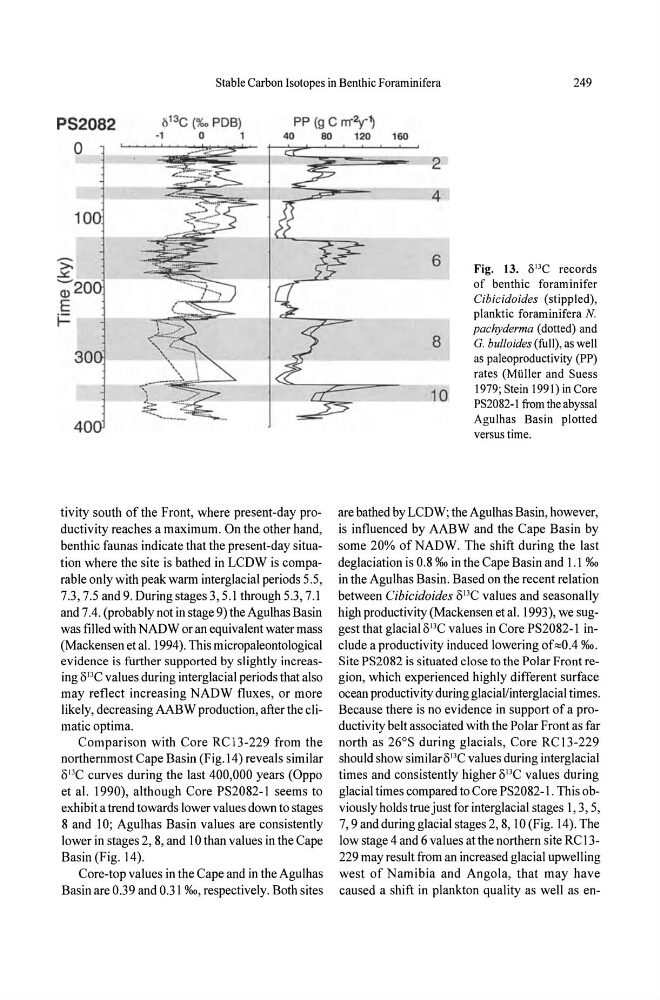
Fig. 13. S"C records
of benthic foraminifer
Cibicidoides (stippled),
planktic foraminifera N.
pachyderma (dotted) and
G. bulloides (full), as well
as paleoproductivity (PP)
rates (MUller and Suess
1979; Stein 1991) in Core
PS2082-1 from the abyssal
Agulhas Basin plotted
versus time.
are bathed by LCDW; the Agulhas Basin, however,
is influenced by AABW and the Cape Basin by
some 20% ofNADW. The shift during the last
deglaciation is 0.8 %0 in the Cape Basin and 1.1 0/00
in the Agulhas Basin. Based on the recent relation
between Cibicidoides Ol3C values and seasonally
high productivity (Mackensen et al. 1993), we suggest that glacialo 13 C values in Core PS2082-1 include a productivity induced lowering of",O.4 %0.
Site PS2082 is situated close to the Polar Front region, which experienced highly different surface
ocean productivity during glacial/interglacial times.
Because there is no evidence in support of a productivity belt associated with the Polar Front as far
north as 26°S during glacials, Core RC13-229
should show similaro 13 C values during interglacial
times and consistently higher Ol3C values during
glacial times compared to Core PS2082-1 . This obviously holds true just for interglacial stages 1, 3,5,
7,9 and during glacial stages 2, 8, IO (Fig. 14). The
low stage 4 and 6 values at the northern site RCI3229 may result from an increased glacial upwelling
west of Namibia and Angola, that may have
caused a shift in plankton quality as well as en-
249
PS2082
o
PP (9 C rrr2y'~
40
80
120
160
tivity south of the Front, where present-day productivity reaches a maximum. On the other hand,
benthic faunas indicate that the present-day situation where the site is bathed in LCDW is comparable only with peak warm interglacial periods 5.5,
703, 7.5 and 9. During stages 3, 5.1 through 503, 7.1
and 7.4. (probably not in stage 9) the Agulhas Basin
was filled with NADW or an equivalent water mass
(Mackensen et al. 1994). This micropaleontological
evidence is further supported by slightly increasing Ol3C values during interglacial periods that also
may reflect increasing NADW fluxes, or more
likely, decreasing AABW production, after the climatic optima.
Comparison with Core RC 13-229 from the
northernmost Cape Basin (Fig.14) reveals similar
Ol3C curves during the last 400,000 years (Oppo
et al. 1990), although Core PS2082-1 seems to
exhibit a trend towards lower values down to stages
8 and 10; Agulhas Basin values are consistently
lower in stages 2, 8, and 10 than values in the Cape
Basin (Fig. 14).
Core-top values in the Cape and in the Agulhas
Basin are 0039 and 0031 %0, respectively. Both sites
2
4
6
8
10
Fig. 13. S"C records
of benthic foraminifer
Cibicidoides (stippled),
planktic foraminifera N.
pachyderma (dotted) and
G. bulloides (full), as well
as paleoproductivity (PP)
rates (MUller and Suess
1979; Stein 1991) in Core
PS2082-1 from the abyssal
Agulhas Basin plotted
versus time.
are bathed by LCDW; the Agulhas Basin, however,
is influenced by AABW and the Cape Basin by
some 20% ofNADW. The shift during the last
deglaciation is 0.8 %0 in the Cape Basin and 1.1 0/00
in the Agulhas Basin. Based on the recent relation
between Cibicidoides Ol3C values and seasonally
high productivity (Mackensen et al. 1993), we suggest that glacialo 13 C values in Core PS2082-1 include a productivity induced lowering of",O.4 %0.
Site PS2082 is situated close to the Polar Front region, which experienced highly different surface
ocean productivity during glacial/interglacial times.
Because there is no evidence in support of a productivity belt associated with the Polar Front as far
north as 26°S during glacials, Core RC13-229
should show similaro 13 C values during interglacial
times and consistently higher Ol3C values during
glacial times compared to Core PS2082-1 . This obviously holds true just for interglacial stages 1, 3,5,
7,9 and during glacial stages 2, 8, IO (Fig. 14). The
low stage 4 and 6 values at the northern site RCI3229 may result from an increased glacial upwelling
west of Namibia and Angola, that may have
caused a shift in plankton quality as well as en-