

212
Wolffetal.
Species
Region
Reference
bul, pal
rub
rub, sac
N. At!., South. Oc.
lndic
Duplessy et a!. 1991
Duplessy 1982
Mulitza 1994
Niebler 1995
Equ. At!., South. At!.
bul, pal, sac, rub
sac
pal
sac
South.Oc.
lndic
South.Oc.
NW. At!.
Vincent and Shackleton 1980
Charles and Fairbanks 1990
Showers and Margolis 1985
sac,rub
rub, sacc
rub, sacc
sac
pal
sac
N.At!.
lndic
Pacific
global
South.Oc.
Durazzi 1981
Williams and Healy-Williams 1980
Savin and Douglas 1973
Hecht and Savin 1972
Melles 1991
bul, pal
Pacific
South.Oc.
Wu and Berger 1989
Grobe et a!. 1990
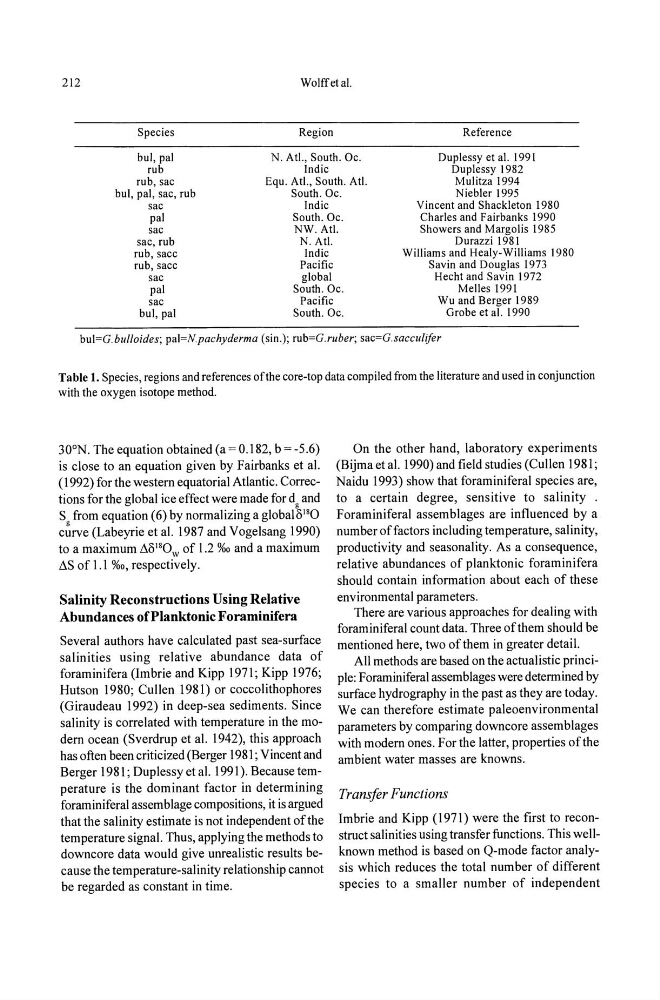
bul=G.bulloides; pal=N.pachyderma (sin.); rub=G.ruber; sac=G.sacculifer
Table 1. Species, regions and references of the core-top data compiled from the literature and used in conjunction
with the oxygen isotope method.
30 0 N. The equation obtained (a = 0.182, b = -5.6)
is close to an equation given by Fairbanks et al.
(1992) for the western equatorial Atlantic. Corrections for the global ice effect were made for d g and
Sg from equation (6) by normalizing a global 8 18 0
curve (Labeyrie et al. 1987 and Vogelsang 1990)
to a maximum L' l.8 18 0 w of 1.2 %0 and a maximum
L' l.S of 1.1 %0, respectively.
Salinity Reconstructions Using Relative
Abundances of Planktonic Foraminifera
Several authors have calculated past sea-surface
salinities using relative abundance data of
foraminifera (Imbrie and Kipp 1971; Kipp 1976;
Hutson 1980; Cullen 1981) or coccolithophores
(Giraudeau 1992) in deep-sea sediments. Since
salinity is correlated with temperature in the modern ocean (Sverdrup et al. 1942), this approach
has often been criticized (Berger 1981; Vincent and
Berger 1981; Duplessy et al. 1991). Because temperature is the dominant factor in determining
foraminiferal assemblage compositions, it is argued
that the salinity estimate is not independent of the
temperature signal. Thus, applying the methods to
downcore data would give unrealistic results because the temperature-salinity relationship cannot
be regarded as constant in time.
On the other hand, laboratory experiments
(Bijma et al. 1990) and field studies (Cullen 1981;
Naidu 1993) show that foraminiferal species are,
to a certain degree, sensitive to salinity .
Foraminiferal assemblages are influenced by a
number offactors including temperature, salinity,
productivity and seasonality. As a consequence,
relative abundances of planktonic foraminifera
should contain information about each of these
environmental parameters.
There are various approaches for dealing with
foraminiferal count data. Three of them should be
mentioned here, two of them in greater detail.
All methods are based on the actualistic principle: Foraminiferal assemblages were determined by
surface hydrography in the past as they are today.
We can therefore estimate paleoenvironmental
parameters by comparing downcore assemblages
with modern ones. For the latter, properties of the
ambient water masses are knowns.
Transfer Functions
Imbrie and Kipp (1971) were the first to reconstruct salinities using transfer functions. This wellknown method is based on Q-mode factor analysis which reduces the total number of different
species to a smaller number of independent
Wolffetal.
Species
Region
Reference
bul, pal
rub
rub, sac
N. At!., South. Oc.
lndic
Duplessy et a!. 1991
Duplessy 1982
Mulitza 1994
Niebler 1995
Equ. At!., South. At!.
bul, pal, sac, rub
sac
pal
sac
South.Oc.
lndic
South.Oc.
NW. At!.
Vincent and Shackleton 1980
Charles and Fairbanks 1990
Showers and Margolis 1985
sac,rub
rub, sacc
rub, sacc
sac
pal
sac
N.At!.
lndic
Pacific
global
South.Oc.
Durazzi 1981
Williams and Healy-Williams 1980
Savin and Douglas 1973
Hecht and Savin 1972
Melles 1991
bul, pal
Pacific
South.Oc.
Wu and Berger 1989
Grobe et a!. 1990
bul=G.bulloides; pal=N.pachyderma (sin.); rub=G.ruber; sac=G.sacculifer
Table 1. Species, regions and references of the core-top data compiled from the literature and used in conjunction
with the oxygen isotope method.
30 0 N. The equation obtained (a = 0.182, b = -5.6)
is close to an equation given by Fairbanks et al.
(1992) for the western equatorial Atlantic. Corrections for the global ice effect were made for d g and
Sg from equation (6) by normalizing a global 8 18 0
curve (Labeyrie et al. 1987 and Vogelsang 1990)
to a maximum L' l.8 18 0 w of 1.2 %0 and a maximum
L' l.S of 1.1 %0, respectively.
Salinity Reconstructions Using Relative
Abundances of Planktonic Foraminifera
Several authors have calculated past sea-surface
salinities using relative abundance data of
foraminifera (Imbrie and Kipp 1971; Kipp 1976;
Hutson 1980; Cullen 1981) or coccolithophores
(Giraudeau 1992) in deep-sea sediments. Since
salinity is correlated with temperature in the modern ocean (Sverdrup et al. 1942), this approach
has often been criticized (Berger 1981; Vincent and
Berger 1981; Duplessy et al. 1991). Because temperature is the dominant factor in determining
foraminiferal assemblage compositions, it is argued
that the salinity estimate is not independent of the
temperature signal. Thus, applying the methods to
downcore data would give unrealistic results because the temperature-salinity relationship cannot
be regarded as constant in time.
On the other hand, laboratory experiments
(Bijma et al. 1990) and field studies (Cullen 1981;
Naidu 1993) show that foraminiferal species are,
to a certain degree, sensitive to salinity .
Foraminiferal assemblages are influenced by a
number offactors including temperature, salinity,
productivity and seasonality. As a consequence,
relative abundances of planktonic foraminifera
should contain information about each of these
environmental parameters.
There are various approaches for dealing with
foraminiferal count data. Three of them should be
mentioned here, two of them in greater detail.
All methods are based on the actualistic principle: Foraminiferal assemblages were determined by
surface hydrography in the past as they are today.
We can therefore estimate paleoenvironmental
parameters by comparing downcore assemblages
with modern ones. For the latter, properties of the
ambient water masses are knowns.
Transfer Functions
Imbrie and Kipp (1971) were the first to reconstruct salinities using transfer functions. This wellknown method is based on Q-mode factor analysis which reduces the total number of different
species to a smaller number of independent