

Oxygen Isotope Values of Planktic Foraminifera
179
- Tempe''',,,e rC)
0
5
'0
0
100
.)
( PS1654-1)
200
§:300
\
a 400
~500
size fraction
!!
~600
1 : > 400 ~ m
~2 : 315·400 I, m 0
700
3 : 250·315 ~ m
800
4 : 200·250 I' m
5 : 125·200 I, m
900
34
3S
2- ~!i~'Y.~~!.··5 432 ··
2
l
L..L.L.J
5 4 3 ===,,==
~ 3 ... ~. ~ ... \ . , . .. ~ .. ~ .. 3
o
e
c
o
~
4 ........................... . ........... 4
.!Q
~
:l2
~
0
:a
~
:§
::.
:l2 c-a
!!!
~= ~~
g gJ :l)1 i3~ <:!::
::.
~
Ol rn 2 ·~
.0
<>
.S
Q."C _c
(!j (!j
(!j
<::$ (!j:§.
10 m
50 m
250 m
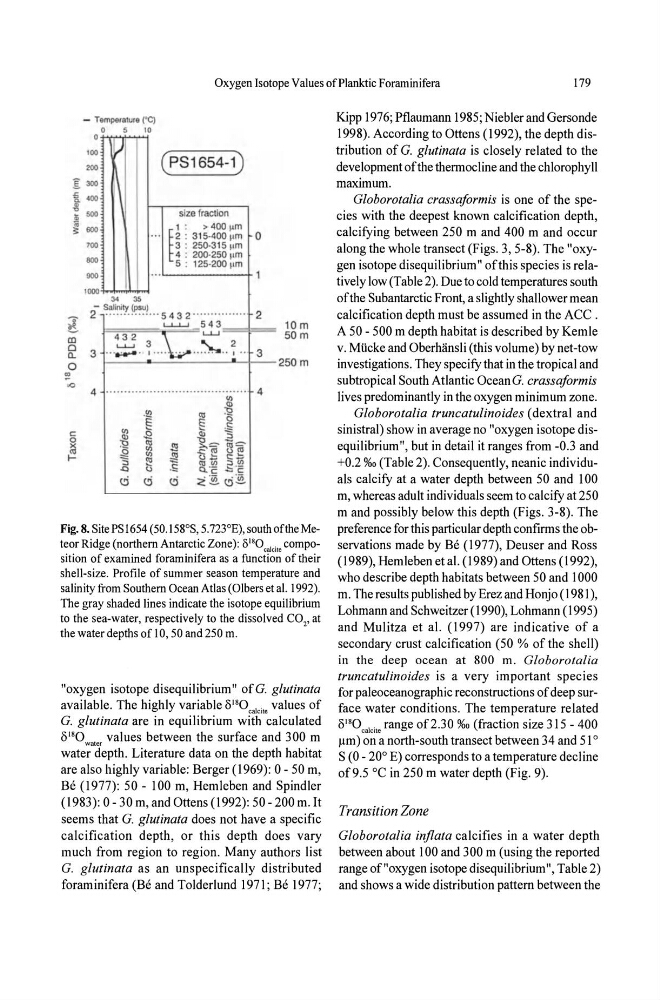
Fig. 8. Site PSI654 (50.158°S, 5.723°E), south of the Meteor Ridge (northern Antarctic Zone): 8"0talCife composition of examined foraminifera as a f unction of their
shell-size. Profile of summer season temperature and
salinity from Southern Ocean Atlas (Olbers et al. 1992).
The gray shaded lines indicate the isotope equilibrium
to the sea-water, respectively to the dissolved CO" at
the water depths of 10,50 and 250 m.
"oxygen isotope disequilibrium" of G. glutinata
available. The highly variable 8"0 calci'e values of
G. glutinata are in equilibrium with calculated
8 18 0
values between the surface and 300 m
wate;ar depth. Literature data on the depth habitat
are also highly variable: Berger (1969): 0 -50 m,
Be (1977): 50 - 100 m, Hemleben and Spindler
(1983): 0 -30 m, and Ottens (1992): 50 - 200 m. It
seems that G. glutinata does not have a specific
calcification depth, or this depth does vary
much from region to region . Many authors list
G. glutinata as an unspecifically distributed
foraminifera (Be and Tolderlund 1971 ; Be 1977;
Kipp 1976; Ptlaumann 1985; Niebler and Gersonde
1998). According to Ottens (1992), the depth distribution of G. glutinata is closely related to the
development of the thermocline and the chlorophyll
maximum.
Globorotalia crassa/ormis is one of the species with the deepest known calcification depth,
calcifying between 250 m and 400 m and occur
along the whole transect (Figs. 3, 5-8). The "oxygen isotope disequilibrium" of this species is relatively low (Table 2). Due to cold temperatures south
of the Subantarctic Front, a slightly shallower mean
calcification depth must be assumed in the ACC .
A 50 - 500 m depth habitat is described by Kemle
v. Miicke and Oberhansli (this volume) by net-tow
investigations. They specify that in the tropical and
subtropical South Atlantic Ocean G. crassa/ormis
lives predominantly in the oxygen minimum zone.
Globorotalia truncatulinoides (dextral and
sinistral) show in average no "oxygen isotope disequilibrium", but in detail it ranges from -0.3 and
+0.2 %0 (Table 2). Consequently, neanic individuals calcify at a water depth between 50 and 100
m, whereas adult individuals seem to calcify at 250
m and possibly below this depth (Figs. 3-8). The
preference for this particular depth confirms the observations made by Be (1977), Deuser and Ross
(1989), Hemleben et al. (1989) and Ottens (1992),
who describe depth habitats between 50 and 1000
m. The results published by Erezand Honjo (1981),
Lohmann and Schweitzer (1990), Lohmann (1995)
and Mulitza et al. (1997) are indicative of a
secondary crust calcification (50 % of the shell)
in the deep ocean at 800 m . Globorotalia
truncatulinoides is a very important species
for paleoceanographic reconstructions of deep surface water conditions. The temperature related
8 18 0 I ' range of2.30 %0 (fraction size 315 - 400
11m) ~~t~ north-south transect between 34 and 51 °
S (0 - 20° E) corresponds to a temperature decline
of9.5 °C in 250 m water depth (Fig. 9).
Transition Zone
Globorotalia inflata calcifies in a water depth
between about 100 and 300 m (using the reported
range of "oxygen isotope disequilibrium", Table 2)
and shows a wide distribution pattern between the
179
- Tempe''',,,e rC)
0
5
'0
0
100
.)
( PS1654-1)
200
§:300
\
a 400
~500
size fraction
!!
~600
1 : > 400 ~ m
~2 : 315·400 I, m 0
700
3 : 250·315 ~ m
800
4 : 200·250 I' m
5 : 125·200 I, m
900
34
3S
2- ~!i~'Y.~~!.··5 432 ··
2
l
L..L.L.J
5 4 3 ===,,==
~ 3 ... ~. ~ ... \ . , . .. ~ .. ~ .. 3
o
e
c
o
~
4 ........................... . ........... 4
.!Q
~
:l2
~
0
:a
~
:§
::.
:l2 c-a
!!!
~= ~~
g gJ :l)1 i3~ <:!::
::.
~
Ol rn 2 ·~
.0
<>
.S
Q."C _c
(!j (!j
(!j
<::$ (!j:§.
10 m
50 m
250 m
Fig. 8. Site PSI654 (50.158°S, 5.723°E), south of the Meteor Ridge (northern Antarctic Zone): 8"0talCife composition of examined foraminifera as a f unction of their
shell-size. Profile of summer season temperature and
salinity from Southern Ocean Atlas (Olbers et al. 1992).
The gray shaded lines indicate the isotope equilibrium
to the sea-water, respectively to the dissolved CO" at
the water depths of 10,50 and 250 m.
"oxygen isotope disequilibrium" of G. glutinata
available. The highly variable 8"0 calci'e values of
G. glutinata are in equilibrium with calculated
8 18 0
values between the surface and 300 m
wate;ar depth. Literature data on the depth habitat
are also highly variable: Berger (1969): 0 -50 m,
Be (1977): 50 - 100 m, Hemleben and Spindler
(1983): 0 -30 m, and Ottens (1992): 50 - 200 m. It
seems that G. glutinata does not have a specific
calcification depth, or this depth does vary
much from region to region . Many authors list
G. glutinata as an unspecifically distributed
foraminifera (Be and Tolderlund 1971 ; Be 1977;
Kipp 1976; Ptlaumann 1985; Niebler and Gersonde
1998). According to Ottens (1992), the depth distribution of G. glutinata is closely related to the
development of the thermocline and the chlorophyll
maximum.
Globorotalia crassa/ormis is one of the species with the deepest known calcification depth,
calcifying between 250 m and 400 m and occur
along the whole transect (Figs. 3, 5-8). The "oxygen isotope disequilibrium" of this species is relatively low (Table 2). Due to cold temperatures south
of the Subantarctic Front, a slightly shallower mean
calcification depth must be assumed in the ACC .
A 50 - 500 m depth habitat is described by Kemle
v. Miicke and Oberhansli (this volume) by net-tow
investigations. They specify that in the tropical and
subtropical South Atlantic Ocean G. crassa/ormis
lives predominantly in the oxygen minimum zone.
Globorotalia truncatulinoides (dextral and
sinistral) show in average no "oxygen isotope disequilibrium", but in detail it ranges from -0.3 and
+0.2 %0 (Table 2). Consequently, neanic individuals calcify at a water depth between 50 and 100
m, whereas adult individuals seem to calcify at 250
m and possibly below this depth (Figs. 3-8). The
preference for this particular depth confirms the observations made by Be (1977), Deuser and Ross
(1989), Hemleben et al. (1989) and Ottens (1992),
who describe depth habitats between 50 and 1000
m. The results published by Erezand Honjo (1981),
Lohmann and Schweitzer (1990), Lohmann (1995)
and Mulitza et al. (1997) are indicative of a
secondary crust calcification (50 % of the shell)
in the deep ocean at 800 m . Globorotalia
truncatulinoides is a very important species
for paleoceanographic reconstructions of deep surface water conditions. The temperature related
8 18 0 I ' range of2.30 %0 (fraction size 315 - 400
11m) ~~t~ north-south transect between 34 and 51 °
S (0 - 20° E) corresponds to a temperature decline
of9.5 °C in 250 m water depth (Fig. 9).
Transition Zone
Globorotalia inflata calcifies in a water depth
between about 100 and 300 m (using the reported
range of "oxygen isotope disequilibrium", Table 2)
and shows a wide distribution pattern between the