

178
- Temper,lure r C)
O S l O
o t"'1i""tt""t"'1
100 ~ I
:§:300
'" 400
!soo
~600
700
800
900
Niebler et al.
( PS2086-3)
size fraction
1 :
> 400 I'm
~
2 : 315-400 flm 0
3 : 250-315 I'm
4 : 200-250 I'ffi
5 : 125-200 I'ffi
IOOO +--+ 3. --l\..,j, 3S -.I ·········· ···· ···················· '-------+
~
aJ
Cl
DO
~
<0
- Salinily (psu)
2
3
2_ 10m
- 50m
4 ... .... ................ .... .. .... .. ... .......... .. .................... 4
~
.\!l
E
c
0
11' l
t~
.2
m
g
'"
::.
~
~
'-'
(!j
(!j
.'l!
<1\
.'l!
,§
~
..:::!
Ol
.S;
(!j
(!j
<1\
~ § "8,§
't>
~
Q; ~
::.,-::.,
,,<1\.<::
Cl. ·c Cl. ~ g. ~ 'c
:c: :§. :c::g. . . . . : (!j:§.
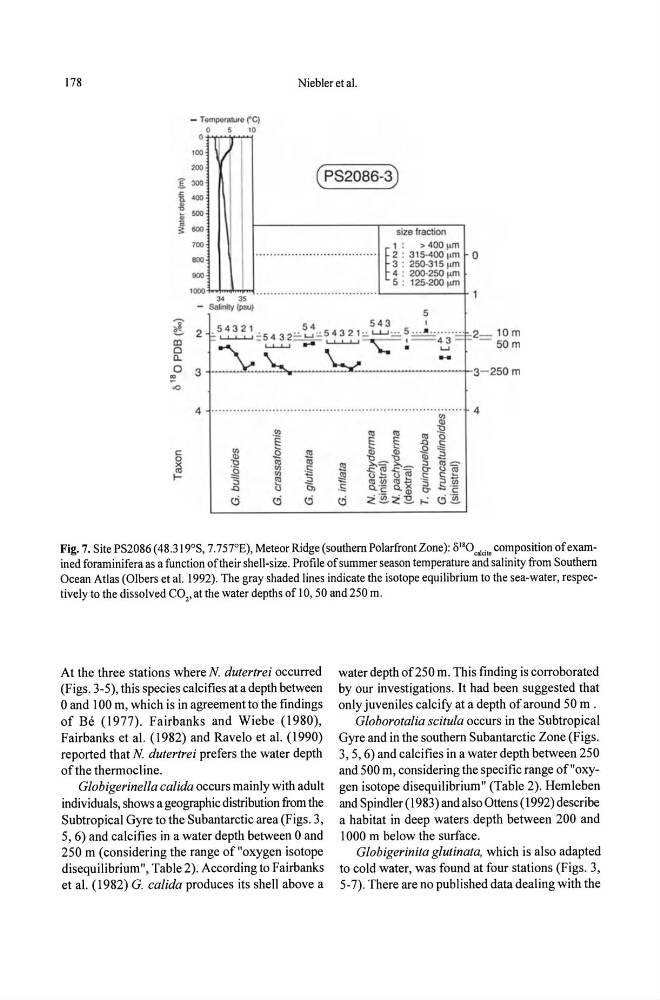
Fig. 7. Site PS2086 (48.319°S, 7.757°£), Meteor Ridge (southern Polarfront Zone): OI80"Ic'" composition of examined foraminifera as a function of their shell-size. Profile of summer season temperature and salinity from Southern
Ocean Atlas (Olbers et al. 1992). The gray shaded lines indicate the isotope equilibrium to the sea-water, respectively to the dissolved CO" at the water depths of 10, 50 and 250 m.
At the three stations whereN. dutertrei occurred
(Figs. 3-5), this species calcifies at a depth between
o and 100 m, which is in agreement to the findings
of Be (1977). Fairbanks and Wiebe (1980),
Fairbanks et al. (1982) and Ravelo et al. (1990)
reported that N. dutertrei prefers the water depth
ofthe thermocline.
Globigerinella calida occurs mainly with adult
individuals, shows a geographic distribution from the
Subtropical Gyre to the Subantarctic area (Figs. 3,
5,6) and calcifies in a water depth between 0 and
250 m (considering the range of "oxygen isotope
disequilibrium", Table 2). According to Fairbanks
et al. (1982) G. calida produces its shell above a
water depth of250 m. This finding is corroborated
by our investigations. It had been suggested that
only juveniles calcify at a depth of around 50 m .
Globorotalia scitula occurs in the Subtropical
Gyre and in the southern Subantarctic Zone (Figs.
3,5,6) and calcifies in a water depth between 250
and 500 m, considering the specific range of "oxygen isotope disequilibrium" (Table 2). Hemleben
and Spindler (1983) and also Ottens (1992) describe
a habitat in deep waters depth between 200 and
1000 m below the surface.
Globigerinita glutinata, which is also adapted
to cold water, was found at four stations (Figs. 3,
5-7). There are no published data dealing with the
- Temper,lure r C)
O S l O
o t"'1i""tt""t"'1
100 ~ I
:§:300
'" 400
!soo
~600
700
800
900
Niebler et al.
( PS2086-3)
size fraction
1 :
> 400 I'm
~
2 : 315-400 flm 0
3 : 250-315 I'm
4 : 200-250 I'ffi
5 : 125-200 I'ffi
IOOO +--+ 3. --l\..,j, 3S -.I ·········· ···· ···················· '-------+
~
aJ
Cl
DO
~
<0
- Salinily (psu)
2
3
2_ 10m
- 50m
4 ... .... ................ .... .. .... .. ... .......... .. .................... 4
~
.\!l
E
c
0
11' l
t~
.2
m
g
'"
::.
~
~
'-'
(!j
(!j
.'l!
<1\
.'l!
,§
~
..:::!
Ol
.S;
(!j
(!j
<1\
~ § "8,§
't>
~
Q; ~
::.,-::.,
,,<1\.<::
Cl. ·c Cl. ~ g. ~ 'c
:c: :§. :c::g. . . . . : (!j:§.
Fig. 7. Site PS2086 (48.319°S, 7.757°£), Meteor Ridge (southern Polarfront Zone): OI80"Ic'" composition of examined foraminifera as a function of their shell-size. Profile of summer season temperature and salinity from Southern
Ocean Atlas (Olbers et al. 1992). The gray shaded lines indicate the isotope equilibrium to the sea-water, respectively to the dissolved CO" at the water depths of 10, 50 and 250 m.
At the three stations whereN. dutertrei occurred
(Figs. 3-5), this species calcifies at a depth between
o and 100 m, which is in agreement to the findings
of Be (1977). Fairbanks and Wiebe (1980),
Fairbanks et al. (1982) and Ravelo et al. (1990)
reported that N. dutertrei prefers the water depth
ofthe thermocline.
Globigerinella calida occurs mainly with adult
individuals, shows a geographic distribution from the
Subtropical Gyre to the Subantarctic area (Figs. 3,
5,6) and calcifies in a water depth between 0 and
250 m (considering the range of "oxygen isotope
disequilibrium", Table 2). According to Fairbanks
et al. (1982) G. calida produces its shell above a
water depth of250 m. This finding is corroborated
by our investigations. It had been suggested that
only juveniles calcify at a depth of around 50 m .
Globorotalia scitula occurs in the Subtropical
Gyre and in the southern Subantarctic Zone (Figs.
3,5,6) and calcifies in a water depth between 250
and 500 m, considering the specific range of "oxygen isotope disequilibrium" (Table 2). Hemleben
and Spindler (1983) and also Ottens (1992) describe
a habitat in deep waters depth between 200 and
1000 m below the surface.
Globigerinita glutinata, which is also adapted
to cold water, was found at four stations (Figs. 3,
5-7). There are no published data dealing with the