

Oxygen Isotope Values of Planktic Foraminifera
177
- Temperature (.C)
o 5 10
0 :Hr,"",+,"""t"'"1
100
I 1 /
200
( PS2083-1)
800
900
34
:l5
size fraction
1 :
> 400 ~m
~
2 : 315·400 ~m 0
3 : 250-315 1,m
4 : 200-250 1, m
1- ~!~Iry. !~~! ................ ... ........ ............. ..... .
5 : 125·200 I, m
54-5
10m
54321
543
543 = u _ ,
50m
'--'-'-'-'
L..JL..J
54321 L...1..J . . . .
4321
~ 2
co
CI
c..
? 3
"~" T~ .~ . . \ . . '\····· ·,.···· . . ~·~ . . ~ ~250 m
............... ~ .... y. ............. ~ ..... \ ............ ~ ............. 3
00
4 ........... .............................................. .... .... .... ............. 4
c
o
~
....
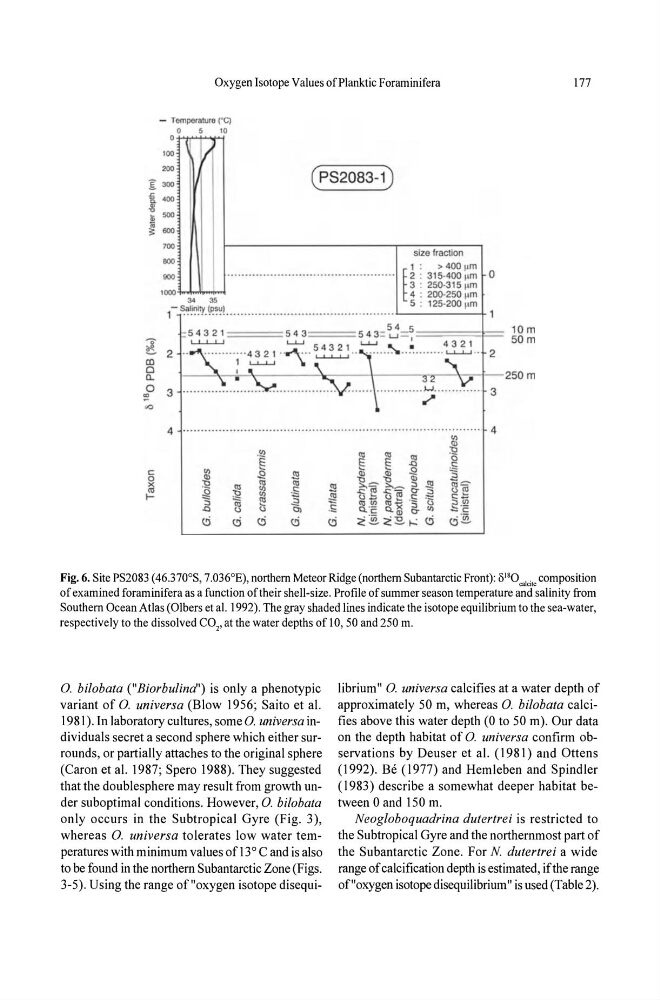
Fig. 6. Site PS2083 (46.370 0 S, 7.036°E), northern Meteor Ridge (northern Subantarctic Front): 1)"0 '; ' composition
of examined foraminifera as a function of their shell-size. Profile of summer season temperature ;nd'salinity from
Southern Ocean Atlas (Olbers et al. 1992). The gray shaded lines indicate the isotope equilibrium to the sea-water,
respectively to the dissolved CO" at the water depths of 10, 50 and 250 m.
0. bilobata ("Biorbulind') is only a phenotypic
variant of 0. universa (Blow 1956; Saito et al.
1981). In laboratory cultures, some 0. universa individuals secret a second sphere which either surrounds, or partially attaches to the original sphere
(Caron et al. 1987; Spero 1988). They suggested
that the doublesphere may result from growth under suboptimal conditions. However, 0. bilobata
only occurs in the Subtropical Gyre (Fig. 3),
whereas 0. universa tolerates low water temperatures with minimum values of 13° C and is also
to be found in the northern Subantarctic Zone (Figs.
3-5). Using the range of "oxygen isotope disequilibrium" 0. universa calcifies at a water depth of
approximately 50 m, whereas 0. bilobata calcifies above this water depth (0 to 50 m). Our data
on the depth habitat of 0. universa confirm observations by Deuser et al. (1981) and Ottens
(1992). Be (1977) and Hemleben and Spindler
(1983) describe a somewhat deeper habitat between 0 and 150 m.
Neogloboquadrina dutertrei is restricted to
the Subtropical Gyre and the northernmost part of
the Subantarctic Zone. For N dutertrei a wide
range of calcification depth is estimated, if the range
of "oxygen isotope disequilibrium" is used (Table 2).
177
- Temperature (.C)
o 5 10
0 :Hr,"",+,"""t"'"1
100
I 1 /
200
( PS2083-1)
800
900
34
:l5
size fraction
1 :
> 400 ~m
~
2 : 315·400 ~m 0
3 : 250-315 1,m
4 : 200-250 1, m
1- ~!~Iry. !~~! ................ ... ........ ............. ..... .
5 : 125·200 I, m
54-5
10m
54321
543
543 = u _ ,
50m
'--'-'-'-'
L..JL..J
54321 L...1..J . . . .
4321
~ 2
co
CI
c..
? 3
"~" T~ .~ . . \ . . '\····· ·,.···· . . ~·~ . . ~ ~250 m
............... ~ .... y. ............. ~ ..... \ ............ ~ ............. 3
00
4 ........... .............................................. .... .... .... ............. 4
c
o
~
....
Fig. 6. Site PS2083 (46.370 0 S, 7.036°E), northern Meteor Ridge (northern Subantarctic Front): 1)"0 '; ' composition
of examined foraminifera as a function of their shell-size. Profile of summer season temperature ;nd'salinity from
Southern Ocean Atlas (Olbers et al. 1992). The gray shaded lines indicate the isotope equilibrium to the sea-water,
respectively to the dissolved CO" at the water depths of 10, 50 and 250 m.
0. bilobata ("Biorbulind') is only a phenotypic
variant of 0. universa (Blow 1956; Saito et al.
1981). In laboratory cultures, some 0. universa individuals secret a second sphere which either surrounds, or partially attaches to the original sphere
(Caron et al. 1987; Spero 1988). They suggested
that the doublesphere may result from growth under suboptimal conditions. However, 0. bilobata
only occurs in the Subtropical Gyre (Fig. 3),
whereas 0. universa tolerates low water temperatures with minimum values of 13° C and is also
to be found in the northern Subantarctic Zone (Figs.
3-5). Using the range of "oxygen isotope disequilibrium" 0. universa calcifies at a water depth of
approximately 50 m, whereas 0. bilobata calcifies above this water depth (0 to 50 m). Our data
on the depth habitat of 0. universa confirm observations by Deuser et al. (1981) and Ottens
(1992). Be (1977) and Hemleben and Spindler
(1983) describe a somewhat deeper habitat between 0 and 150 m.
Neogloboquadrina dutertrei is restricted to
the Subtropical Gyre and the northernmost part of
the Subantarctic Zone. For N dutertrei a wide
range of calcification depth is estimated, if the range
of "oxygen isotope disequilibrium" is used (Table 2).