

180
Niebler et al.
APF
SAF
STF
AZ
PFZ
SAZ
SG
~ I
III
' 0
c: II)
'55 ~
O-m
-crI
I I
-~
I
*
.!2l.$?
.c- o ::J 2
_.c
~
i!
3
0
(l)
~
0
!!!1Il 0 -
a.. - I l l
0:;::
0 :Sl .S 2
co
~
~
<>0
3
I
~
cO Co
c
I~c ~ooc
0 [J"[Sl
c u
o
~
c
0
I:l
I
I I
I
~
250m
tf
- 0
C'
OO~D
oc c 13,1:90 n
o iJ c?
0
"
.....
0
e (/)
Q)
::J
ro
>
......
0
u
Q)
OJ
c
ro
'0
0
co
~
~:g
III 0
a .S
o-S 2
.c.$?~
~§ 3
.l:;
;
I
c
rr--- 250m 1i"'"""2.
t:.
o~~o
0
c
___ I c : sinistral I
-~
t:. : dextral I
<>0
l~
50
48
46
44
42
40
38
36
34
southern latitude (O S)
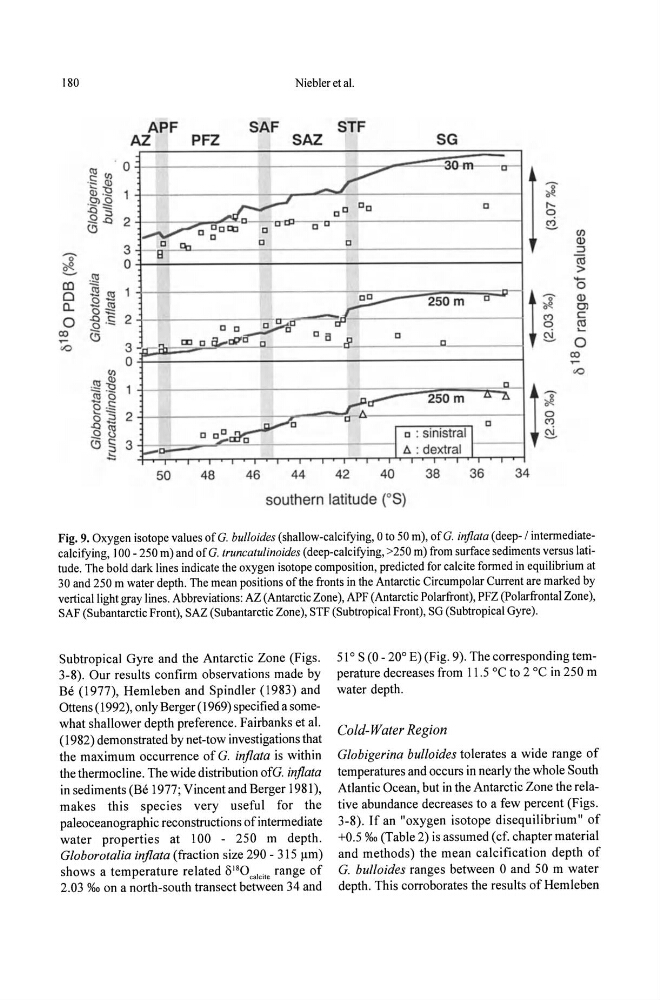
Fig. 9_ Oxygen isotope values of G. bulloides (shallow-calcifying, 0 to 50 m), of G. infiata (deep- / intermediatecalcifying, 100 - 250 m) and of G. truncatulinoides (deep-calcifying, >250 m) from surface sediments versus latitude. The bold dark lines indicate the oxygen isotope composition, predicted for calcite formed in equilibrium at
30 and 250 m water depth. The mean positions of the fronts in the Antarctic Circumpolar Current are marked by
vertical light gray lines. Abbreviations: AZ (Antarctic Zone), APF (Antarctic Polarfront), PFZ (Polarfrontal Zone),
SAF (Subantarctic Front), SAZ (Subantarctic Zone), STF (Subtropical Front), SG (Subtropical Gyre).
Subtropical Gyre and the Antarctic Zone (Figs.
3-8). Our results confirm observations made by
Be (1977), Hemleben and Spindler (1983) and
Ottens (1992), only Berger (1969) specified a somewhat shallower depth preference. Fairbanks et al.
(1982) demonstrated by net-tow investigations that
the maximum occurrence of G. inflata is within
the thermocline. The wide distribution ofG. inflata
in sediments (Be 1977; Vincent and Berger 1981),
makes this species very useful for the
paleoceanographic reconstructions of intermediate
water properties at 100 - 250 m depth.
Globorotalia inflata (fraction size 290 - 315 flm)
shows a temperature related 8 18 ° 0.10;" range of
2.03 %0 on a north-south transect between 34 and
51 ° S (0 - 20° E) (Fig. 9). The corresponding temperature decreases from 11.5 °C to 2 °C in 250 m
water depth.
Cold-Water Region
Globigerina bulloides tolerates a w i de range of
temperatures and occurs in nearly the whole South
Atlantic Ocean, but in the Antarctic Zone the relative abundance decreases to a few percent (Figs .
3-8). If an "oxygen isoto pe disequilibrium" of
+0.5 %0 (Table 2) is assumed (cf. chapter material
and methods) the mean calcification depth of
G. bulloides ranges between 0 and 50 m water
depth. This corroborates the results of Hemleben
Niebler et al.
APF
SAF
STF
AZ
PFZ
SAZ
SG
~ I
III
' 0
c: II)
'55 ~
O-m
-crI
I I
-~
I
*
.!2l.$?
.c- o ::J 2
_.c
~
i!
3
0
(l)
~
0
!!!1Il 0 -
a.. - I l l
0:;::
0 :Sl .S 2
co
~
~
<>0
3
I
~
cO Co
c
I~c ~ooc
0 [J"[Sl
c u
o
~
c
0
I:l
I
I I
I
~
250m
tf
- 0
C'
OO~D
oc c 13,1:90 n
o iJ c?
0
"
.....
0
e (/)
Q)
::J
ro
>
......
0
u
Q)
OJ
c
ro
'0
0
co
~
~:g
III 0
a .S
o-S 2
.c.$?~
~§ 3
.l:;
;
I
c
rr--- 250m 1i"'"""2.
t:.
o~~o
0
c
___ I c : sinistral I
-~
t:. : dextral I
<>0
l~
50
48
46
44
42
40
38
36
34
southern latitude (O S)
Fig. 9_ Oxygen isotope values of G. bulloides (shallow-calcifying, 0 to 50 m), of G. infiata (deep- / intermediatecalcifying, 100 - 250 m) and of G. truncatulinoides (deep-calcifying, >250 m) from surface sediments versus latitude. The bold dark lines indicate the oxygen isotope composition, predicted for calcite formed in equilibrium at
30 and 250 m water depth. The mean positions of the fronts in the Antarctic Circumpolar Current are marked by
vertical light gray lines. Abbreviations: AZ (Antarctic Zone), APF (Antarctic Polarfront), PFZ (Polarfrontal Zone),
SAF (Subantarctic Front), SAZ (Subantarctic Zone), STF (Subtropical Front), SG (Subtropical Gyre).
Subtropical Gyre and the Antarctic Zone (Figs.
3-8). Our results confirm observations made by
Be (1977), Hemleben and Spindler (1983) and
Ottens (1992), only Berger (1969) specified a somewhat shallower depth preference. Fairbanks et al.
(1982) demonstrated by net-tow investigations that
the maximum occurrence of G. inflata is within
the thermocline. The wide distribution ofG. inflata
in sediments (Be 1977; Vincent and Berger 1981),
makes this species very useful for the
paleoceanographic reconstructions of intermediate
water properties at 100 - 250 m depth.
Globorotalia inflata (fraction size 290 - 315 flm)
shows a temperature related 8 18 ° 0.10;" range of
2.03 %0 on a north-south transect between 34 and
51 ° S (0 - 20° E) (Fig. 9). The corresponding temperature decreases from 11.5 °C to 2 °C in 250 m
water depth.
Cold-Water Region
Globigerina bulloides tolerates a w i de range of
temperatures and occurs in nearly the whole South
Atlantic Ocean, but in the Antarctic Zone the relative abundance decreases to a few percent (Figs .
3-8). If an "oxygen isoto pe disequilibrium" of
+0.5 %0 (Table 2) is assumed (cf. chapter material
and methods) the mean calcification depth of
G. bulloides ranges between 0 and 50 m water
depth. This corroborates the results of Hemleben