

158
Zonneveld et al.
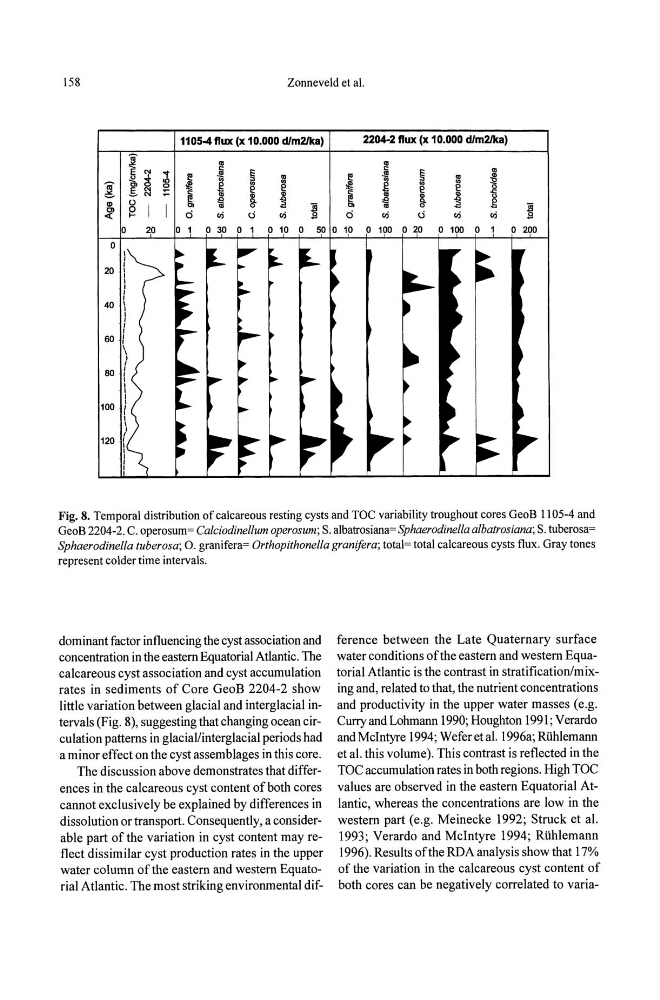
Fig. 8. Temporal distribution of calcareous resting cysts and TOe variability troughout cores GeoB 1105-4 and
GeoB 2204-2. e. operosum= Calciodinellum operosum; S. albatrosiana= Sphaerodinella albatrosiana; S. tuberosa=
Sphaerodinella tuberosa; O. granifera= Orthopithonella granifera; total= total calcareous cysts flux. Gray tones
represent colder time intervals.
dominant factor influencing the cyst association and
concentration in the eastern Equatorial Atlantic. The
calcareous cyst association and cyst accumulation
rates in sediments of Core GeoB 2204-2 show
little variation between glacial and interglacial intervals (Fig. 8), suggesting that changing ocean circulation patterns in glacial/interglacial periods had
a minor effect on the cyst assemblages in this core.
The discussion above demonstrates that differences in the calcareous cyst content of both cores
cannot exclusively be explained by differences in
dissolution or transport. Consequently, a considerable part of the variation in cyst content may reflect dissimilar cyst production rates in the upper
water column of the eastern and western Equatorial Atlantic. The most striking environmental difference between the Late Quaternary surface
water conditions ofthe eastern and western Equatorial Atlantic is the contrast in stratification/mixing and, related to that, the nutrient concentrations
and productivity in the upper water masses (e.g.
Curry and Lohmann 1990; Houghton 1991; Verardo
and Mcintyre 1994; Wefer et aL 1996a; Rlihlemann
et aL this volume). This contrast is reflected in the
TOC accumulation rates in both regions. High TOe
values are observed in the eastern Equatorial Atlantic, whereas the concentrations are low in the
western part (e.g. Meinecke 1992; Struck et aL
1993; Verardo and McIntyre 1994; Rlihlemann
1996). Results ofthe RDA analysis show that 17%
of the variation in the calcareous cyst content of
both cores can be negatively correlated to varia-
Zonneveld et al.
Fig. 8. Temporal distribution of calcareous resting cysts and TOe variability troughout cores GeoB 1105-4 and
GeoB 2204-2. e. operosum= Calciodinellum operosum; S. albatrosiana= Sphaerodinella albatrosiana; S. tuberosa=
Sphaerodinella tuberosa; O. granifera= Orthopithonella granifera; total= total calcareous cysts flux. Gray tones
represent colder time intervals.
dominant factor influencing the cyst association and
concentration in the eastern Equatorial Atlantic. The
calcareous cyst association and cyst accumulation
rates in sediments of Core GeoB 2204-2 show
little variation between glacial and interglacial intervals (Fig. 8), suggesting that changing ocean circulation patterns in glacial/interglacial periods had
a minor effect on the cyst assemblages in this core.
The discussion above demonstrates that differences in the calcareous cyst content of both cores
cannot exclusively be explained by differences in
dissolution or transport. Consequently, a considerable part of the variation in cyst content may reflect dissimilar cyst production rates in the upper
water column of the eastern and western Equatorial Atlantic. The most striking environmental difference between the Late Quaternary surface
water conditions ofthe eastern and western Equatorial Atlantic is the contrast in stratification/mixing and, related to that, the nutrient concentrations
and productivity in the upper water masses (e.g.
Curry and Lohmann 1990; Houghton 1991; Verardo
and Mcintyre 1994; Wefer et aL 1996a; Rlihlemann
et aL this volume). This contrast is reflected in the
TOC accumulation rates in both regions. High TOe
values are observed in the eastern Equatorial Atlantic, whereas the concentrations are low in the
western part (e.g. Meinecke 1992; Struck et aL
1993; Verardo and McIntyre 1994; Rlihlemann
1996). Results ofthe RDA analysis show that 17%
of the variation in the calcareous cyst content of
both cores can be negatively correlated to varia-