

Calcareous Dinoflagellate Cysts as Paleo-Environmental Tools
157
~
i'f"
"
~
s!
<~
\
I *.
\.,."
'*
/(
, *"
(
I~
. _
\ J?a
(}(j? ..
•
, ~
j
"
I
If
J
.'
--"
'S.< .
r~
r,
j)..d
•
?a
~(};'L
"
lr
," 1<
/
(1 Cr" J'
-::
'r.l
S"~
~
1;0' *~
",1 '*2
3.4.5
'"
f
\)rJ
i(
~.
paleoproductivity. High accumulation rates might
be the result of a relatively increased production
of cysts. However, apart from variation in cyst production, the cyst accumulation may also have been
influenced by transport and dissolution.
For the eastern Equatorial Atlantic
(GeoB 1105-4) it has been shown that the calcareous cyst assemblages were not significantly affected by dissolution (Holl et a!. 1998). Furthermore,
it is assumed that the core position was situated
above the lysocline for the last360 ka providing the
conditions for good preservation of calcareous
\ '~
~
b
""
----LV:
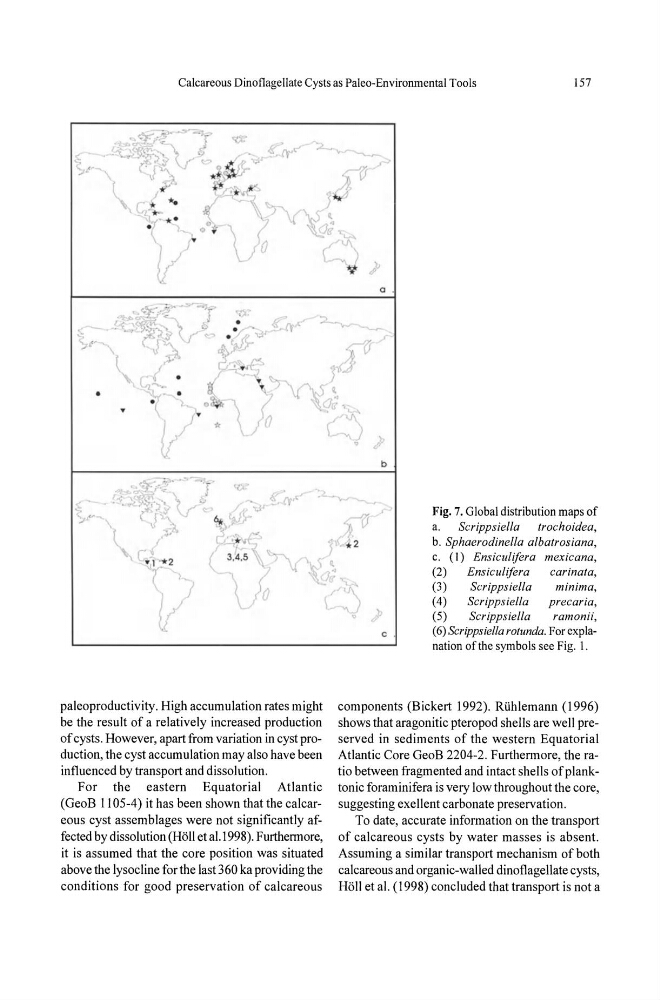
Fig. 7. Global distribution maps of
a.
Scrippsiella
trochoidea,
A
~ *2
b. Sphaerodinella albatrosiana,
L
c. (I) Ensiculifera mexicana,
(2)
Ensiculifera
carinata,
(3)
Scrippsiella
minima,
(4)
Scrippsiella
precaria,
(5)
Scripp siella
ramonii,
c
(6) Scrippsiella rotunda. For explanation of the symbols see Fig. l.
components (Bickert 1992). Rlihlemann (1996)
shows that aragonitic pteropod shells are well preserved in sediments of the western Equatorial
Atlantic Core GeoB 2204-2. Furthermore, the ratio between fragmented and intact shells of planktonic foraminifera is very low throughout the core,
suggesting exellent carbonate preservation.
To date, accurate information on the transport
of calcareous cysts by water masses is absent.
Assuming a similar transport mechanism of both
calcareous and organic-walled dinoflagellate cysts,
Holl et a!. (1998) concluded that transport is not a
157
~
i'f"
"
~
s!
<~
\
I *.
\.,."
'*
/(
, *"
(
I~
. _
\ J?a
(}(j? ..
•
, ~
j
"
I
If
J
.'
--"
'S.< .
r~
r,
j)..d
•
?a
~(};'L
"
lr
," 1<
/
(1 Cr" J'
-::
'r.l
S"~
~
1;0' *~
",1 '*2
3.4.5
'"
f
\)rJ
i(
~.
paleoproductivity. High accumulation rates might
be the result of a relatively increased production
of cysts. However, apart from variation in cyst production, the cyst accumulation may also have been
influenced by transport and dissolution.
For the eastern Equatorial Atlantic
(GeoB 1105-4) it has been shown that the calcareous cyst assemblages were not significantly affected by dissolution (Holl et a!. 1998). Furthermore,
it is assumed that the core position was situated
above the lysocline for the last360 ka providing the
conditions for good preservation of calcareous
\ '~
~
b
""
----LV:
Fig. 7. Global distribution maps of
a.
Scrippsiella
trochoidea,
A
~ *2
b. Sphaerodinella albatrosiana,
L
c. (I) Ensiculifera mexicana,
(2)
Ensiculifera
carinata,
(3)
Scrippsiella
minima,
(4)
Scrippsiella
precaria,
(5)
Scripp siella
ramonii,
c
(6) Scrippsiella rotunda. For explanation of the symbols see Fig. l.
components (Bickert 1992). Rlihlemann (1996)
shows that aragonitic pteropod shells are well preserved in sediments of the western Equatorial
Atlantic Core GeoB 2204-2. Furthermore, the ratio between fragmented and intact shells of planktonic foraminifera is very low throughout the core,
suggesting exellent carbonate preservation.
To date, accurate information on the transport
of calcareous cysts by water masses is absent.
Assuming a similar transport mechanism of both
calcareous and organic-walled dinoflagellate cysts,
Holl et a!. (1998) concluded that transport is not a