

128
Baumann et al.
20'
25'
30'
20'
25'
5'
Emiliania huxleyi
5'
0 ,·",
.'0-""
10'
15'
1 0'
15'
5'
10'
15'
20'
25'
30'
20'
25'
30'
D~''''
5'
10'
15'
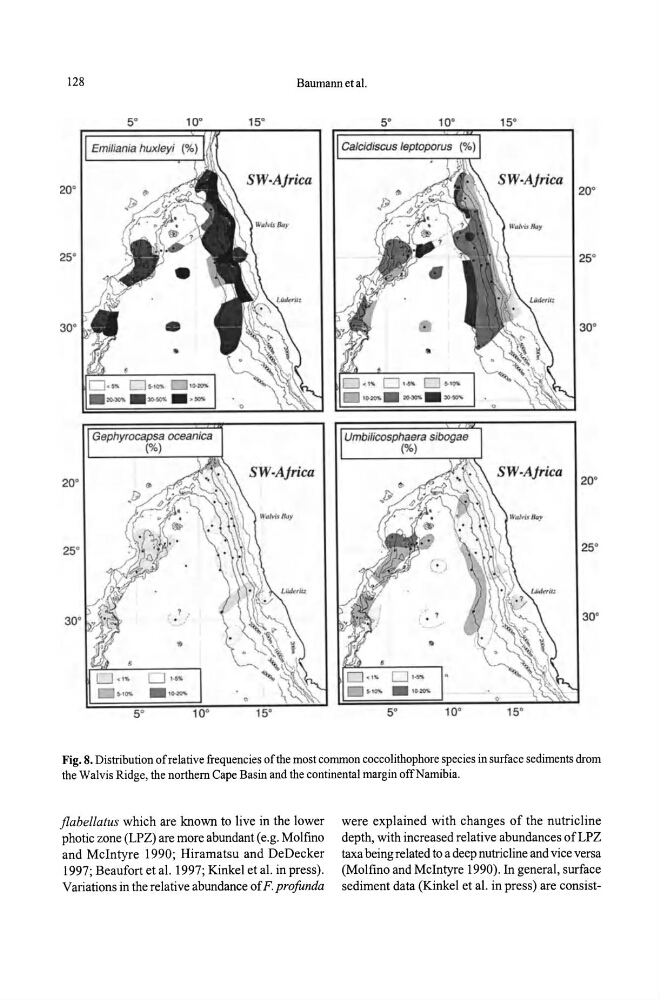
Fig. 8. Distribution of relative frequencies of the most common coccolithophore species in surface sediments drom
the Walvis Ridge, the northern Cape Basin and the continental margin off Namibia.
flabellatus which are known to live in the lower
photic zone (LPZ) are more abundant (e.g. Molfino
and McIntyre 1990; Hiramatsu and DeDecker
1997; Beaufort et al. 1997; Kinkel et al. in press).
Variations in the relative abundance of F. profunda
were explained with changes of the nutricline
depth, with increased relative abundances ofLPZ
taxa being related to a deep nutricline and vice versa
(Mol fino and McIntyre 1990). In general, surface
sediment data (Kinkel et al. in press) are consist-
Baumann et al.
20'
25'
30'
20'
25'
5'
Emiliania huxleyi
5'
0 ,·",
.'0-""
10'
15'
1 0'
15'
5'
10'
15'
20'
25'
30'
20'
25'
30'
D~''''
5'
10'
15'
Fig. 8. Distribution of relative frequencies of the most common coccolithophore species in surface sediments drom
the Walvis Ridge, the northern Cape Basin and the continental margin off Namibia.
flabellatus which are known to live in the lower
photic zone (LPZ) are more abundant (e.g. Molfino
and McIntyre 1990; Hiramatsu and DeDecker
1997; Beaufort et al. 1997; Kinkel et al. in press).
Variations in the relative abundance of F. profunda
were explained with changes of the nutricline
depth, with increased relative abundances ofLPZ
taxa being related to a deep nutricline and vice versa
(Mol fino and McIntyre 1990). In general, surface
sediment data (Kinkel et al. in press) are consist-