

Coccolithophores as Indicators of Ocean Water Masses
129
GeoB 1028-5
Coccoliths
absolute abundance
% Abundances of coccoliths (based on the total assemblage)
('10 9 /g sediment) E. huxleyi
G. oceOllica G. muellerae G. ericsonii C ieploponlS
U. sibogae ~
9
o 10 20 0 25 50 o 30 60 0 IS 30 0 15 30 0 20 40 0 5 10 ~
I " I I I
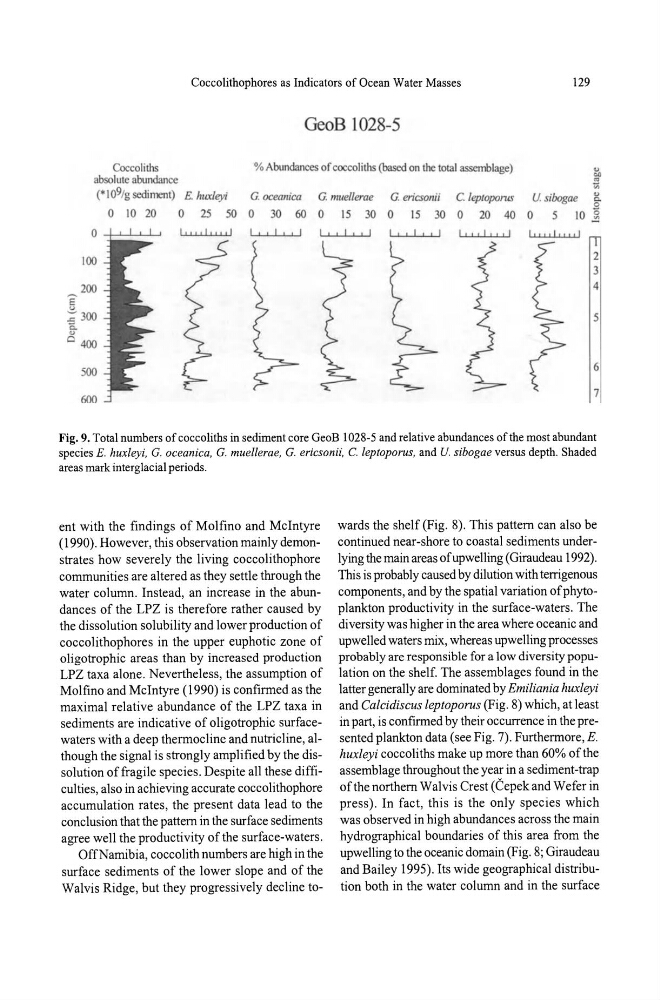
Fig. 9. Total numbers of coccoliths in sediment core GeoB 1028-5 and relative abundances of the most abundant
species E. huxleyi, G. oceanica, G. muellerae, G. ericson ii, C. leptoporllS, and U. sibogae versus depth. Shaded
areas mark interglacial periods.
ent with the findings of Molfino and Mcintyre
(1990). However, this observation mainly demonstrates how severely the living coccolithophore
communities are altered as they settle through the
water column. Instead, an increase in the abundances of the LPZ is therefore rather caused by
the dissolution solubility and lower production of
coccolithophores in the upper euphotic zone of
oligotrophic areas than by increased production
LPZ taxa alone. Nevertheless, the assumption of
Molfino and Mcintyre (1990) is confirmed as the
maximal relative abundance of the LPZ taxa in
sediments are indicative of oligotrophic surfacewaters with a deep thermocline and nutricline, although the signal is strongly amplified by the dissolution of fragile species. Despite all these difficulties, also in achieving accurate coccolithophore
accumulation rates, the present data lead to the
conclusion that the pattern in the surface sediments
agree well the productivity of the surface-waters.
Off Namibia, coccolith numbers are high in the
surface sediments of the lower slope and of the
Walvis Ridge, but they progressively decline towards the shelf (Fig. 8). This pattern can also be
continued near-shore to coastal sediments underlying the main areas of upwelling (Giraudeau 1992).
This is probably caused by dilution with terrigenous
components, and by the spatial variation of phytoplankton productivity in the surface-waters. The
diversity was higher in the area where oceanic and
upwelled waters mix, whereas upwelling processes
probably are responsible for a low diversity population on the shelf. The assemblages found in the
latter generally are dominated by Emiliania huxleyi
and Calcidiscus [eptapams (Fig. 8) which, at least
in part, is confirmed by their occurrence in the presented plankton data (see Fig. 7). Furthermore, E.
huxleyi coccoliths make up more than 60% ofthe
assemblage throughout the year in a sediment-trap
of the northern Walvis Crest (Cepekand Wefer in
press). In fact, this is the only species which
was observed in high abundances across the main
hydrographical boundaries of this area from the
upwelling to the oceanic domain (Fig. 8; Giraudeau
and Bailey 1995). Its wide geographical distribution both in the water column and in the surface
129
GeoB 1028-5
Coccoliths
absolute abundance
% Abundances of coccoliths (based on the total assemblage)
('10 9 /g sediment) E. huxleyi
G. oceOllica G. muellerae G. ericsonii C ieploponlS
U. sibogae ~
9
o 10 20 0 25 50 o 30 60 0 IS 30 0 15 30 0 20 40 0 5 10 ~
I " I I I
Fig. 9. Total numbers of coccoliths in sediment core GeoB 1028-5 and relative abundances of the most abundant
species E. huxleyi, G. oceanica, G. muellerae, G. ericson ii, C. leptoporllS, and U. sibogae versus depth. Shaded
areas mark interglacial periods.
ent with the findings of Molfino and Mcintyre
(1990). However, this observation mainly demonstrates how severely the living coccolithophore
communities are altered as they settle through the
water column. Instead, an increase in the abundances of the LPZ is therefore rather caused by
the dissolution solubility and lower production of
coccolithophores in the upper euphotic zone of
oligotrophic areas than by increased production
LPZ taxa alone. Nevertheless, the assumption of
Molfino and Mcintyre (1990) is confirmed as the
maximal relative abundance of the LPZ taxa in
sediments are indicative of oligotrophic surfacewaters with a deep thermocline and nutricline, although the signal is strongly amplified by the dissolution of fragile species. Despite all these difficulties, also in achieving accurate coccolithophore
accumulation rates, the present data lead to the
conclusion that the pattern in the surface sediments
agree well the productivity of the surface-waters.
Off Namibia, coccolith numbers are high in the
surface sediments of the lower slope and of the
Walvis Ridge, but they progressively decline towards the shelf (Fig. 8). This pattern can also be
continued near-shore to coastal sediments underlying the main areas of upwelling (Giraudeau 1992).
This is probably caused by dilution with terrigenous
components, and by the spatial variation of phytoplankton productivity in the surface-waters. The
diversity was higher in the area where oceanic and
upwelled waters mix, whereas upwelling processes
probably are responsible for a low diversity population on the shelf. The assemblages found in the
latter generally are dominated by Emiliania huxleyi
and Calcidiscus [eptapams (Fig. 8) which, at least
in part, is confirmed by their occurrence in the presented plankton data (see Fig. 7). Furthermore, E.
huxleyi coccoliths make up more than 60% ofthe
assemblage throughout the year in a sediment-trap
of the northern Walvis Crest (Cepekand Wefer in
press). In fact, this is the only species which
was observed in high abundances across the main
hydrographical boundaries of this area from the
upwelling to the oceanic domain (Fig. 8; Giraudeau
and Bailey 1995). Its wide geographical distribution both in the water column and in the surface