

126
Baumann et al.
total standing crop
Emiliania huxleyi
• 0 0
I 60
~
---.
J S 0
I • 0
§
S
J 0 0
I 1 0
§
~
lSO
I 0 0
8
i5.. ..,
200
'0
,....,
-0
*
'60
-
2
I .0
~
• 0
'"
I 00
R
~
20
100
.0
~
longitude ("E)
longitude (aE)
'--'
Gephyrocapsa oceanica
Calcidiscus leptoporns
'"
03..
3D
§
E
J _0
20
·
,. §
'-'
I _s
~
2.
8
i5..
,-a
I •
".....,
..,
*
-0
I . S
-
....
I _.
I.
~
ILl
' iU
0 . '
R
~
0 . 0
100
~
longitude ("E)
longitude (aE)
'--'
Umbilicosphaera sibogae
Oolithotus fragilis
'"
••
<:T
'E' 20
,
J 6
~
.
20
·
:::l
'--'
I •
J'
a.
-5
' s
§
fr
14
0
~
]
60
2.
'""'
I 6
*
80
I'
~
~
80
·
• [
10
15
I~ 5
10
15
~
longitude(aE)SG : BC
longitudc("E)SG : BC
c:
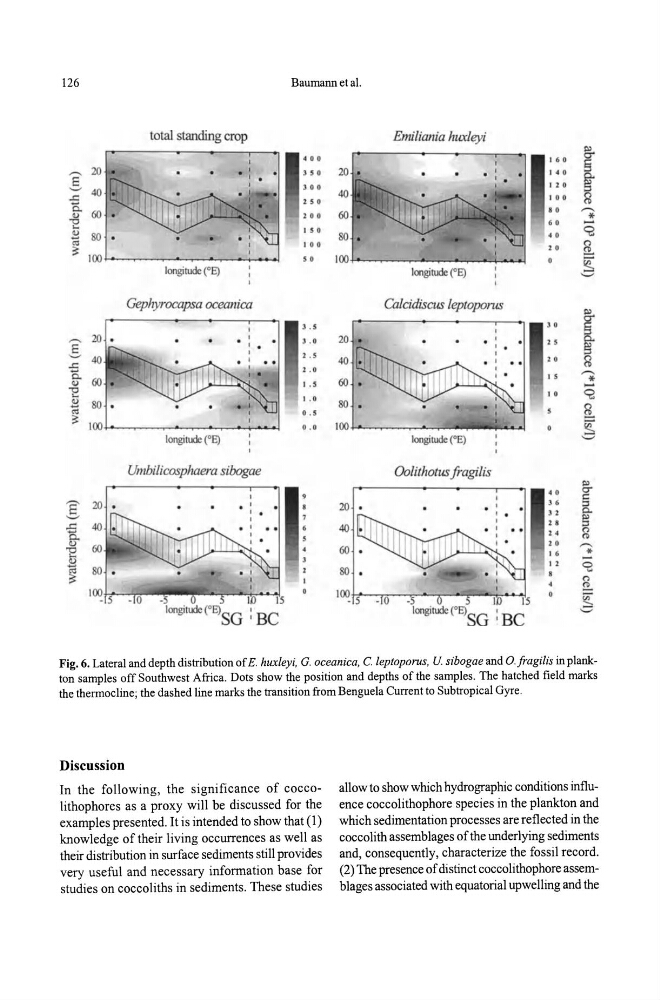
Fig. 6. Lateral and depth distribution of E. huxleyi, G. oceanica, C. leptoporus, U. sibogae and 0. fragilis in plankton samples off Southwest Africa. Dots show the position and depths of the samples. The hatched field marks
the thermocline; the dashed line marks the transition from Benguela Current to Subtropical Gyre.
Discussion
In the following , the significance of coccolithophores as a proxy will be discussed for the
examples presented. It is intended to show that (1)
knowledge of their living occurrences as well as
their distribution in surface sediments still provides
very useful and necessary information base for
studies on coccoliths in sediments. These studies
allow to show which hydrographic conditions influence coccolithophore species in the plankton and
which sedimentation processes are reflected in the
coccolith assemblages of the underlying sediments
and, consequently, characterize the fossil record.
(2) The presence of distinct coccolithophore assemblages associated with equatorial upwelling and the
Baumann et al.
total standing crop
Emiliania huxleyi
• 0 0
I 60
~
---.
J S 0
I • 0
§
S
J 0 0
I 1 0
§
~
lSO
I 0 0
8
i5.. ..,
200
'0
,....,
-0
*
'60
-
2
I .0
~
• 0
'"
I 00
R
~
20
100
.0
~
longitude ("E)
longitude (aE)
'--'
Gephyrocapsa oceanica
Calcidiscus leptoporns
'"
03..
3D
§
E
J _0
20
·
,. §
'-'
I _s
~
2.
8
i5..
,-a
I •
".....,
..,
*
-0
I . S
-
....
I _.
I.
~
ILl
' iU
0 . '
R
~
0 . 0
100
~
longitude ("E)
longitude (aE)
'--'
Umbilicosphaera sibogae
Oolithotus fragilis
'"
••
<:T
'E' 20
,
J 6
~
.
20
·
:::l
'--'
I •
J'
a.
-5
' s
§
fr
14
0
~
]
60
2.
'""'
I 6
*
80
I'
~
~
80
·
• [
10
15
I~ 5
10
15
~
longitude(aE)SG : BC
longitudc("E)SG : BC
c:
Fig. 6. Lateral and depth distribution of E. huxleyi, G. oceanica, C. leptoporus, U. sibogae and 0. fragilis in plankton samples off Southwest Africa. Dots show the position and depths of the samples. The hatched field marks
the thermocline; the dashed line marks the transition from Benguela Current to Subtropical Gyre.
Discussion
In the following , the significance of coccolithophores as a proxy will be discussed for the
examples presented. It is intended to show that (1)
knowledge of their living occurrences as well as
their distribution in surface sediments still provides
very useful and necessary information base for
studies on coccoliths in sediments. These studies
allow to show which hydrographic conditions influence coccolithophore species in the plankton and
which sedimentation processes are reflected in the
coccolith assemblages of the underlying sediments
and, consequently, characterize the fossil record.
(2) The presence of distinct coccolithophore assemblages associated with equatorial upwelling and the