

Coccolithophores as Indicators of Ocean Water Masses
125
E
~
..c:
C- O)
Cl
GeoB 1117-2
Total Coccoliths
(x 1 06/g Sediment)
200
400
600
800
1:\ ,,~",,#.:;,~
1:\ .,~ ,# . . . .
.,~
Cocc.-AR
[10 9 /m2/a]
Calcidiscus
I(:p/oporus
20
40
Emiliania
huxleyi
20 40
Flori!,phaera
profunda
20 40 60
~
G(:ph. Gfphyrocapsa en
ericSOllii
oceallica
& o
204060
20
40% ]j
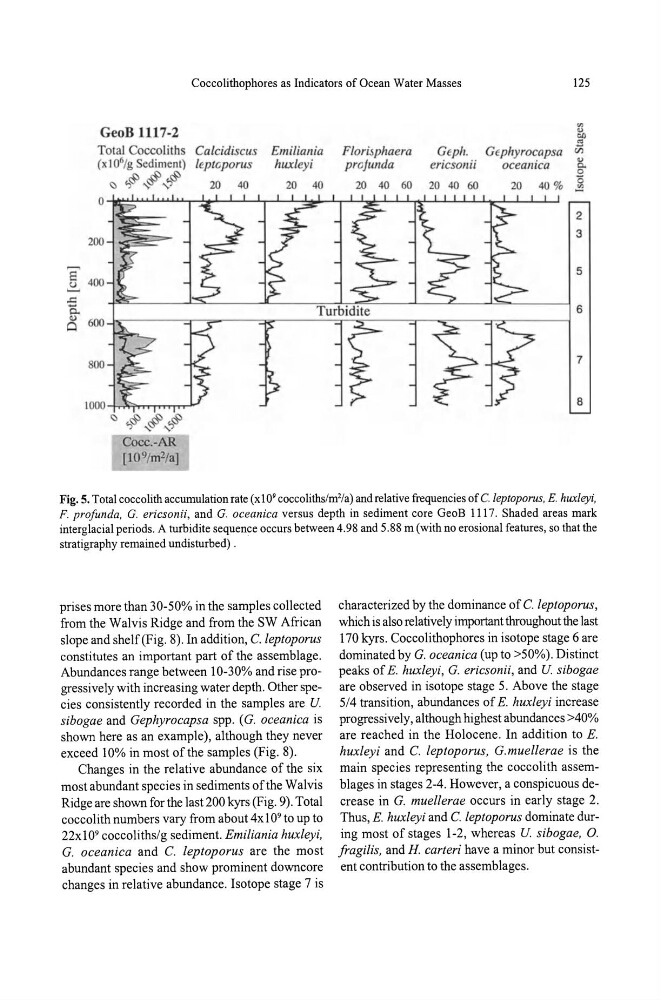
Fig. 5. Total coccolith accumulation rate (xl 0 9 coccoliths/m'/a) and relative frequencies of C. leptoporus, E. huxleyi,
F. profunda, G. ericson ii, and G. oceanica versus depth in sediment core GeoB 1117. Shaded areas mark
interglacial periods. A turbidite sequence occurs between 4.98 and 5.88 m (with no erosional features, so that the
stratigraphy remained undisturbed) .
prises more than 30-50% in the samples collected
from the Walvis Ridge and from the SW African
slope and shelf (Fig. 8). In addition, C. leptoporus
constitutes an important part of the assemblage.
Abundances range between 10-30% and rise progressively with increasing water depth. Other species consistently recorded in the samples are U
sibogae and Gephyrocapsa spp. (G. oceanica is
shown here as an example), although they never
exceed 10% in most of the samples (Fig. 8).
Changes in the relative abundance of the six
most abundant species in sediments of the Walvis
Ridge are shown for the last 200 kyrs{Fig. 9). Total
coccolith numbers vary from about 4xl0 9 to up to
22x10 9 coccoliths/g sediment. Emiliania huxleyi,
G. oceanica and C. leptoporus are the most
abundant species and show prominent downcore
changes in relative abundance. Isotope stage 7 is
characterized by the dominance of C. leptoporus,
which is also relatively important throughout the last
170 kyrs. Coccolithophores in isotope stage 6 are
dominated by G. oceanica (up to >50%). Distinct
peaks of E. huxleyi, G. ericsonii, and U sibogae
are observed in isotope stage 5. Above the stage
5/4 transition, abundances of E. huxleyi increase
progressively, although highest abundances >40%
are reached in the Holocene. In addition to E .
huxleyi and C. leptoporus, G.muellerae is the
main species representing the coccolith assemblages in stages 2-4. However, a conspicuous decrease in G. muellerae occurs in early stage 2.
Thus, E. huxleyi and C. leptoporus dominate during most of stages 1-2, whereas U sibogae, 0.
fragilis, and H. carteri have a minor but consistent contribution to the assemblages.
125
E
~
..c:
C- O)
Cl
GeoB 1117-2
Total Coccoliths
(x 1 06/g Sediment)
200
400
600
800
1:\ ,,~",,#.:;,~
1:\ .,~ ,# . . . .
.,~
Cocc.-AR
[10 9 /m2/a]
Calcidiscus
I(:p/oporus
20
40
Emiliania
huxleyi
20 40
Flori!,phaera
profunda
20 40 60
~
G(:ph. Gfphyrocapsa en
ericSOllii
oceallica
& o
204060
20
40% ]j
Fig. 5. Total coccolith accumulation rate (xl 0 9 coccoliths/m'/a) and relative frequencies of C. leptoporus, E. huxleyi,
F. profunda, G. ericson ii, and G. oceanica versus depth in sediment core GeoB 1117. Shaded areas mark
interglacial periods. A turbidite sequence occurs between 4.98 and 5.88 m (with no erosional features, so that the
stratigraphy remained undisturbed) .
prises more than 30-50% in the samples collected
from the Walvis Ridge and from the SW African
slope and shelf (Fig. 8). In addition, C. leptoporus
constitutes an important part of the assemblage.
Abundances range between 10-30% and rise progressively with increasing water depth. Other species consistently recorded in the samples are U
sibogae and Gephyrocapsa spp. (G. oceanica is
shown here as an example), although they never
exceed 10% in most of the samples (Fig. 8).
Changes in the relative abundance of the six
most abundant species in sediments of the Walvis
Ridge are shown for the last 200 kyrs{Fig. 9). Total
coccolith numbers vary from about 4xl0 9 to up to
22x10 9 coccoliths/g sediment. Emiliania huxleyi,
G. oceanica and C. leptoporus are the most
abundant species and show prominent downcore
changes in relative abundance. Isotope stage 7 is
characterized by the dominance of C. leptoporus,
which is also relatively important throughout the last
170 kyrs. Coccolithophores in isotope stage 6 are
dominated by G. oceanica (up to >50%). Distinct
peaks of E. huxleyi, G. ericsonii, and U sibogae
are observed in isotope stage 5. Above the stage
5/4 transition, abundances of E. huxleyi increase
progressively, although highest abundances >40%
are reached in the Holocene. In addition to E .
huxleyi and C. leptoporus, G.muellerae is the
main species representing the coccolith assemblages in stages 2-4. However, a conspicuous decrease in G. muellerae occurs in early stage 2.
Thus, E. huxleyi and C. leptoporus dominate during most of stages 1-2, whereas U sibogae, 0.
fragilis, and H. carteri have a minor but consistent contribution to the assemblages.