

The Distribution of Living Planktic Foraminifera in Relation to Southeast Atlantic Oceanography
103
oxygen (mill)
I
.c
a.
...
Q)
600
"t:l
3.0
800
1000
4°S
2°
0°
2°
1 r 1 r
~
~
~
~
z
z
z z
~
... ...
... ...
0
0
0
0
.....
r->
... '"
I
.c
a.
Q)
"t:l
4°N
r
;:
z
... 0
C>
% M.F. G crassaformis
0 -
. ' 8 0
0E2~~Ja~~~
400
600
800
1000 40 S
2°
0°
2°
4°N
r 1 r
r
~
~
;: ~
~
z
z
z z
z
~
~
...
A
... ...
...
0
0
0
0
0
.....
r->
... '"
C>
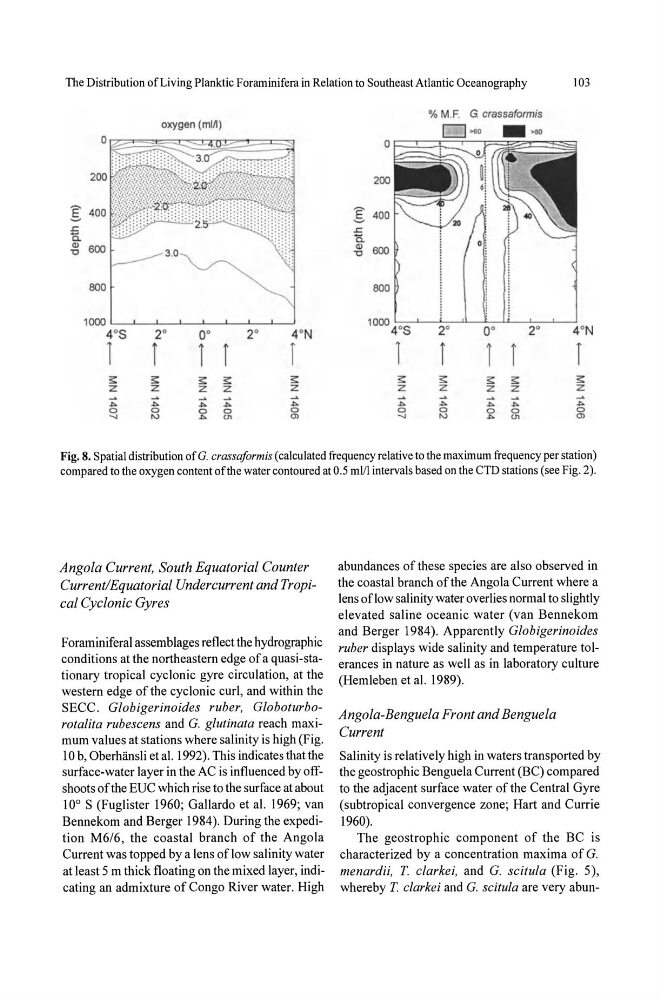
Fig. 8. Spatial distribution of G. crassaformis (calculated frequency relative to the maximum frequency per station)
compared to the oxygen content of the water contoured at 0.5 mVI intervals based on the CTD stations (see Fig. 2).
Angola Current, South Equatorial Counter
Current/Equatorial Undercurrent and Tropical Cyclonic Gyres
Foraminiferal assemblages reflect the hydrographic
conditions at the northeastern edge of a quasi-stationary tropical cyclonic gyre circulation, at the
western edge of the cyclonic curi, and within the
SECC . Globigerinoides ruber, Globoturborotalita rubescens and G. glutinata reach maximum values at stations where salinity is high (Fig.
lOb, Oberhansli et al. 1992). This indicates that the
surface-water layer in the AC is influenced by offshoots of the EUC which rise to the surface at about
10° S (Fuglister 1960; Gallardo et al. 1969; van
Bennekom and Berger 1984). During the expedition M6/6, the coastal branch of the Angola
Current was topped by a lens of low salinity water
at least 5 m thick floating on the mixed layer, indicating an admixture of Congo River water. High
abundances of these species are also observed in
the coastal branch of the Angola Current where a
lens oflow salinity water overlies normal to slightly
elevated saline oceanic water (van Bennekom
and Berger 1984). Apparently Globigerinoides
ruber displays wide salinity and temperature tolerances in nature as well as in laboratory culture
(Hemleben et al. 1989).
Angola-Benguela Front and Benguela
Current
Salinity is relatively high in waters transported by
the geostrophic Benguela Current (BC) compared
to the adjacent surface water of the Central Gyre
(subtropical convergence zone; Hart and Currie
1960).
The geostrophic component of the BC is
characterized by a concentration maxima of G.
menardii, T clarkei, and G. scitula (Fig. 5),
whereby T clarkei and G. scitula are very abun-
103
oxygen (mill)
I
.c
a.
...
Q)
600
"t:l
3.0
800
1000
4°S
2°
0°
2°
1 r 1 r
~
~
~
~
z
z
z z
~
... ...
... ...
0
0
0
0
.....
r->
... '"
I
.c
a.
Q)
"t:l
4°N
r
;:
z
... 0
C>
% M.F. G crassaformis
0 -
. ' 8 0
0E2~~Ja~~~
400
600
800
1000 40 S
2°
0°
2°
4°N
r 1 r
r
~
~
;: ~
~
z
z
z z
z
~
~
...
A
... ...
...
0
0
0
0
0
.....
r->
... '"
C>
Fig. 8. Spatial distribution of G. crassaformis (calculated frequency relative to the maximum frequency per station)
compared to the oxygen content of the water contoured at 0.5 mVI intervals based on the CTD stations (see Fig. 2).
Angola Current, South Equatorial Counter
Current/Equatorial Undercurrent and Tropical Cyclonic Gyres
Foraminiferal assemblages reflect the hydrographic
conditions at the northeastern edge of a quasi-stationary tropical cyclonic gyre circulation, at the
western edge of the cyclonic curi, and within the
SECC . Globigerinoides ruber, Globoturborotalita rubescens and G. glutinata reach maximum values at stations where salinity is high (Fig.
lOb, Oberhansli et al. 1992). This indicates that the
surface-water layer in the AC is influenced by offshoots of the EUC which rise to the surface at about
10° S (Fuglister 1960; Gallardo et al. 1969; van
Bennekom and Berger 1984). During the expedition M6/6, the coastal branch of the Angola
Current was topped by a lens of low salinity water
at least 5 m thick floating on the mixed layer, indicating an admixture of Congo River water. High
abundances of these species are also observed in
the coastal branch of the Angola Current where a
lens oflow salinity water overlies normal to slightly
elevated saline oceanic water (van Bennekom
and Berger 1984). Apparently Globigerinoides
ruber displays wide salinity and temperature tolerances in nature as well as in laboratory culture
(Hemleben et al. 1989).
Angola-Benguela Front and Benguela
Current
Salinity is relatively high in waters transported by
the geostrophic Benguela Current (BC) compared
to the adjacent surface water of the Central Gyre
(subtropical convergence zone; Hart and Currie
1960).
The geostrophic component of the BC is
characterized by a concentration maxima of G.
menardii, T clarkei, and G. scitula (Fig. 5),
whereby T clarkei and G. scitula are very abun-