

104
Kemle-von Milcke and Oberhansli
dant in the uppermost 25 m. G. menardii becomes
the dominant species between 50 and 100 m water depth. Although Boltovskoy (1981) considered
G. menardii and G. sacculifer to be the most reliable tropical surface-water indicators, abundant
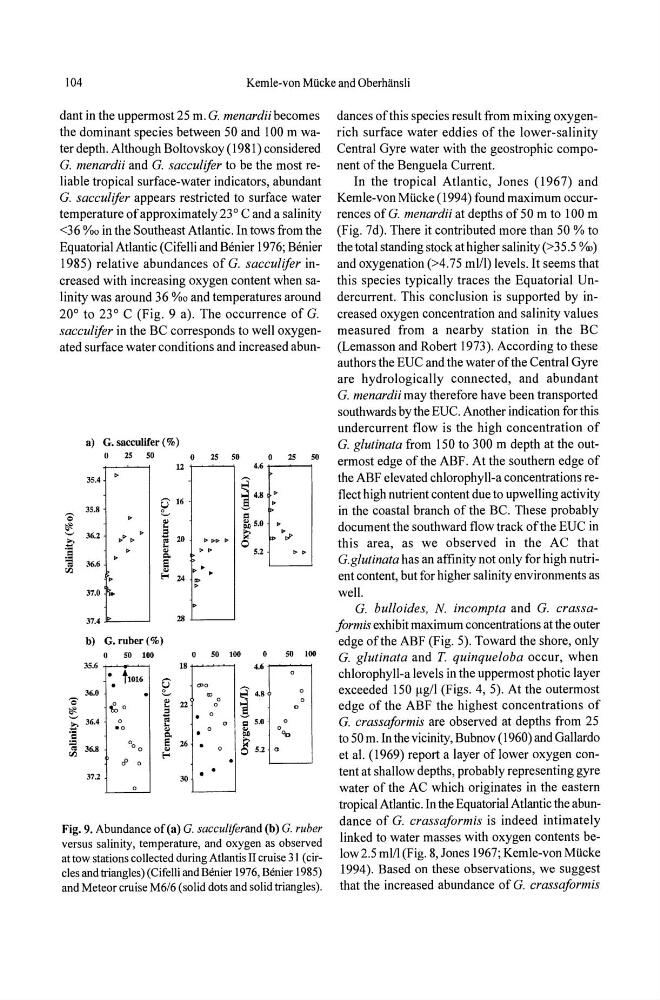
G. sacculifer appears restricted to surface water
temperature of approximately 23 ° C and a salinity
<36 %0 in the Southeast Atlantic. In tows from the
Equatorial Atlantic (Cifelli and Benier 1976; Benier
1985) relative abundances of G. sacculifer increased with increasing oxygen content when salinity was around 36 %0 and temperatures around
20° to 23° C (Fig. 9 a). The occurrence of G.
sacculifer in the BC corresponds to well oxygenated surface water conditions and increased abuna) G. saccullfer (%)
2550
02550
0 2 5 5 0
35.4
~
~
37.0 tr.
37.4 .lI<-_--'
b) G.ruber(%)
50 100
35.6 "1-' ...... -'-1
• tl0l6
.
cf> 0
37.2
12
4.6
1>>> I>
~ ~
~ ..
. .
~
28L-_--'
~ 4.8 ~
.s ~
= ~5.o ~
o
~",.
5.2
I> po
SO 100
0
so 100
4.6 -r--'"~-'-I
30
Fig. 9. Abundance of (a) G. sacculiferand (b) G. ruber
versus salinity, temperature, and oxygen as observed
at tow stations collected during Atlantis II cruise 31 (circles and triangles ) (Cifelli and Benier 1976, Benier 1985)
and Meteor cruise M6/6 (solid dots and solid triangles).
dances of this species result from mixing oxygenrich surface water eddies of the lower-salinity
Central Gyre water with the geostrophic component of the Benguela Current.
In the tropical Atlantic, Jones (1967) and
Kemle-von Miicke (1994) found maximum occurrences of G. menardii at depths of 50 m to 100 m
(Fig. 7d). There it contributed more than 50 % to
the total standing stock at higher salinity (>35.5 o/ro)
and oxygenation (>4.75 mill) levels. It seems that
this species typically traces the Equatorial Undercurrent. This conclusion is supported by increased oxygen concentration and salinity values
measured from a nearby station in the BC
(Lemasson and Robert 1973). According to these
authors the EVC and the water of the Central Gyre
are hydrologically connected, and abundant
G. menardii may therefore have been transported
southwards by the EVC. Another indication for this
undercurrent flow is the high concentration of
G. glutinata from 150 to 300 m depth at the outermost edge of the ABF. At the southern edge of
the ABF elevated chlorophyll-a concentrations reflect high nutrient content due to upwelling activity
in the coastal branch of the BC. These probably
document the southward flow track of the EVC in
this area, as we observed in the AC that
G.glutinata has an affinity not only for high nutrient content, but for higher salinity environments as
well.
G. bulloides, N. incompta and G. crass aformis exhibit maximum concentrations at the outer
edge of the ABF (Fig. 5). Toward the shore, only
G. glutinata and T. quinqueloba occur, when
chlorophyll-a levels in the uppermost photic layer
exceeded 150 Ilg/l (Figs. 4, 5). At the outermost
edge of the ABF the highest concentrations of
G. crassaformis are observed at depths from 25
to 50 m. In the vicinity, Bubnov (1960) and Gallardo
et al. (1969) report a layer of lower oxygen content at shallow depths, probably representing gyre
water of the AC which originates in the eastern
tropical Atlantic. In the Equatorial Atlantic the abundance of G. crassaformis is indeed intimately
linked to water masses with oxygen contents below 2.5 mlll (Fig. 8, Jones 1967; Kemle-von Miicke
1994). Based on these observations, we suggest
that the increased abundance of G. crassaformis
Kemle-von Milcke and Oberhansli
dant in the uppermost 25 m. G. menardii becomes
the dominant species between 50 and 100 m water depth. Although Boltovskoy (1981) considered
G. menardii and G. sacculifer to be the most reliable tropical surface-water indicators, abundant
G. sacculifer appears restricted to surface water
temperature of approximately 23 ° C and a salinity
<36 %0 in the Southeast Atlantic. In tows from the
Equatorial Atlantic (Cifelli and Benier 1976; Benier
1985) relative abundances of G. sacculifer increased with increasing oxygen content when salinity was around 36 %0 and temperatures around
20° to 23° C (Fig. 9 a). The occurrence of G.
sacculifer in the BC corresponds to well oxygenated surface water conditions and increased abuna) G. saccullfer (%)
2550
02550
0 2 5 5 0
35.4
~
~
37.0 tr.
37.4 .lI<-_--'
b) G.ruber(%)
50 100
35.6 "1-' ...... -'-1
• tl0l6
.
cf> 0
37.2
12
4.6
1>>> I>
~ ~
~ ..
. .
~
28L-_--'
~ 4.8 ~
.s ~
= ~5.o ~
o
~",.
5.2
I> po
SO 100
0
so 100
4.6 -r--'"~-'-I
30
Fig. 9. Abundance of (a) G. sacculiferand (b) G. ruber
versus salinity, temperature, and oxygen as observed
at tow stations collected during Atlantis II cruise 31 (circles and triangles ) (Cifelli and Benier 1976, Benier 1985)
and Meteor cruise M6/6 (solid dots and solid triangles).
dances of this species result from mixing oxygenrich surface water eddies of the lower-salinity
Central Gyre water with the geostrophic component of the Benguela Current.
In the tropical Atlantic, Jones (1967) and
Kemle-von Miicke (1994) found maximum occurrences of G. menardii at depths of 50 m to 100 m
(Fig. 7d). There it contributed more than 50 % to
the total standing stock at higher salinity (>35.5 o/ro)
and oxygenation (>4.75 mill) levels. It seems that
this species typically traces the Equatorial Undercurrent. This conclusion is supported by increased oxygen concentration and salinity values
measured from a nearby station in the BC
(Lemasson and Robert 1973). According to these
authors the EVC and the water of the Central Gyre
are hydrologically connected, and abundant
G. menardii may therefore have been transported
southwards by the EVC. Another indication for this
undercurrent flow is the high concentration of
G. glutinata from 150 to 300 m depth at the outermost edge of the ABF. At the southern edge of
the ABF elevated chlorophyll-a concentrations reflect high nutrient content due to upwelling activity
in the coastal branch of the BC. These probably
document the southward flow track of the EVC in
this area, as we observed in the AC that
G.glutinata has an affinity not only for high nutrient content, but for higher salinity environments as
well.
G. bulloides, N. incompta and G. crass aformis exhibit maximum concentrations at the outer
edge of the ABF (Fig. 5). Toward the shore, only
G. glutinata and T. quinqueloba occur, when
chlorophyll-a levels in the uppermost photic layer
exceeded 150 Ilg/l (Figs. 4, 5). At the outermost
edge of the ABF the highest concentrations of
G. crassaformis are observed at depths from 25
to 50 m. In the vicinity, Bubnov (1960) and Gallardo
et al. (1969) report a layer of lower oxygen content at shallow depths, probably representing gyre
water of the AC which originates in the eastern
tropical Atlantic. In the Equatorial Atlantic the abundance of G. crassaformis is indeed intimately
linked to water masses with oxygen contents below 2.5 mlll (Fig. 8, Jones 1967; Kemle-von Miicke
1994). Based on these observations, we suggest
that the increased abundance of G. crassaformis