

Marine Outfalls 32.3 Predicting Near-Field Dilutions 719
Part C | 32.3
CORJET
PLOOM
OSPLM
IMPULSE
JETLAG
CORJET
PLOOM
OSPLM
IMPULSE
JETLAG
0
50
100
150
Dilution
F = 10, k = 4
F = 20, k = 12
Nondimensional downstream distance
100
10
1
0
50
100
150
Nondimensional height of rise
Nondimensional downstream distance
30
20
10
0
50
40
30
20
10
0
0
50
100
Dilution
Nondimensional downstream distance
100
10
1
0
50
100
Nondimensional height of rise
Nondimensional downstream distance
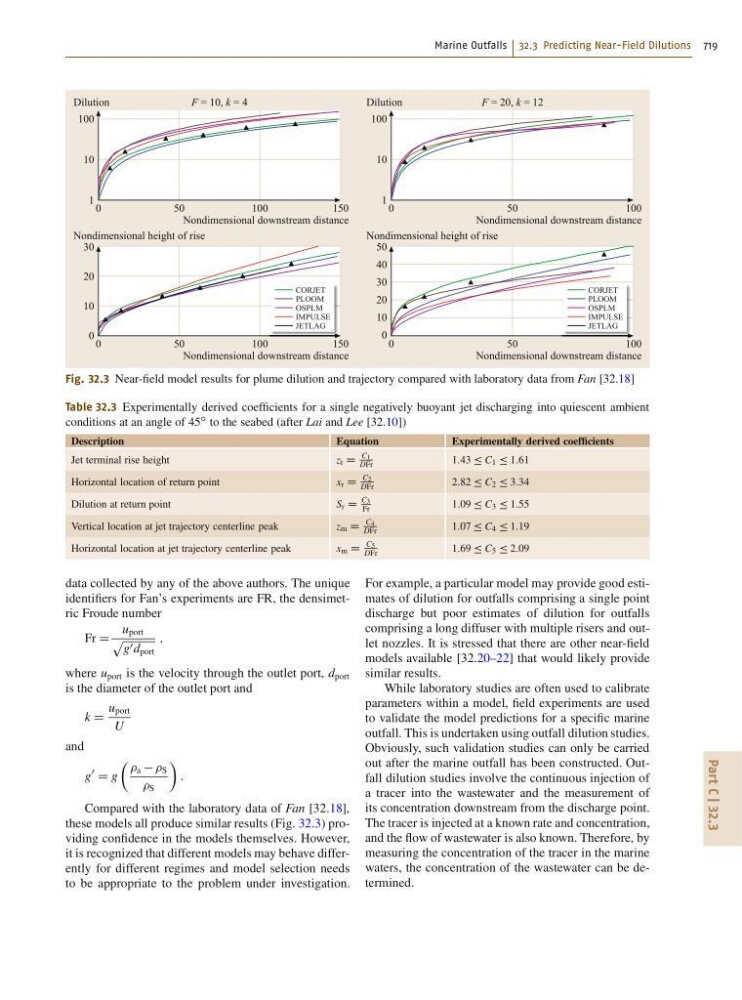
Fig. 32.3 Near-field model results for plume dilution and trajectory compared with laboratory data from Fan [32.18]
Table 32.3 Experimentally derived coefficients for a single negatively buoyant jet discharging into quiescent ambient
conditions at an angle of 45
ı to the seabed (after Lai and Lee [32.10])
Description
Equation
Experimentally derived coefficients
Jet terminal rise height
z t D
C1
DFr
1:43 Ä C 1 Ä 1:61
Horizontal location of return point
x r D
C2
DFr
2:82 Ä C 2 Ä 3:34
Dilution at return point
S r D
C3
Fr
1:09 Ä C 3 Ä 1:55
Vertical location at jet trajectory centerline peak
z m D
C4
DFr
1:07 Ä C 4 Ä 1:19
Horizontal location at jet trajectory centerline peak
x m D
C5
DFr
1:69 Ä C 5 Ä 2:09
data collected by any of the above authors. The unique
identifiers for Fan’s experiments are FR, the densimetric Froude number
Fr D
u port
p
g 0 d port
;
where u port is the velocity through the outlet port, d port
is the diameter of the outlet port and
k D
u port
U
and
g
0
D g
 a S
S
Ã
:
Compared with the laboratory data of Fan [32.18],
these models all produce similar results (Fig. 32.3) providing confidence in the models themselves. However,
it is recognized that different models may behave differently for different regimes and model selection needs
to be appropriate to the problem under investigation.
For example, a particular model may provide good estimates of dilution for outfalls comprising a single point
discharge but poor estimates of dilution for outfalls
comprising a long diffuser with multiple risers and outlet nozzles. It is stressed that there are other near-field
models available [32.20–22] that would likely provide
similar results.
While laboratory studies are often used to calibrate
parameters within a model, field experiments are used
to validate the model predictions for a specific marine
outfall. This is undertaken using outfall dilution studies.
Obviously, such validation studies can only be carried
out after the marine outfall has been constructed. Outfall dilution studies involve the continuous injection of
a tracer into the wastewater and the measurement of
its concentration downstream from the discharge point.
The tracer is injected at a known rate and concentration,
and the flow of wastewater is also known. Therefore, by
measuring the concentration of the tracer in the marine
waters, the concentration of the wastewater can be determined.