

Part C | 32.3
720 Part C Coastal Design
Many tracers are available, for example: rhodamine
water tracing (WT), fluorescein and the isotopes gold198, technetium-99m, and tritium. Natural tracers such
as salinity have also been used, but the variability in the
data is usually too large to produce meaningful results.
Preference is given to use a tracer that has little or no
background signal; hence contact with the tracer will result in unambiguous readings. The tracer sensing device
(such as a fluorometer or scintillation counter) may be
towed behind a vessel and/or profiled through the water
column to build a three-dimensional picture of the location and size of the plume. A critical element of the
work is accurate position fixing, now usually done with
differential GPS (global positioning system).
Simultaneously, the wastewater flow, ambient current speed and direction, and the density of the water
column are measured. These data are used as input to
the model. A direct comparison between the observations and model results can then be made. However,
models are only approximations to the real world and
there will be uncertainty associated with the results.
Based on the results from many such experiments, predicted dilutions within a factor of two of actual dilutions
are generally acceptable.
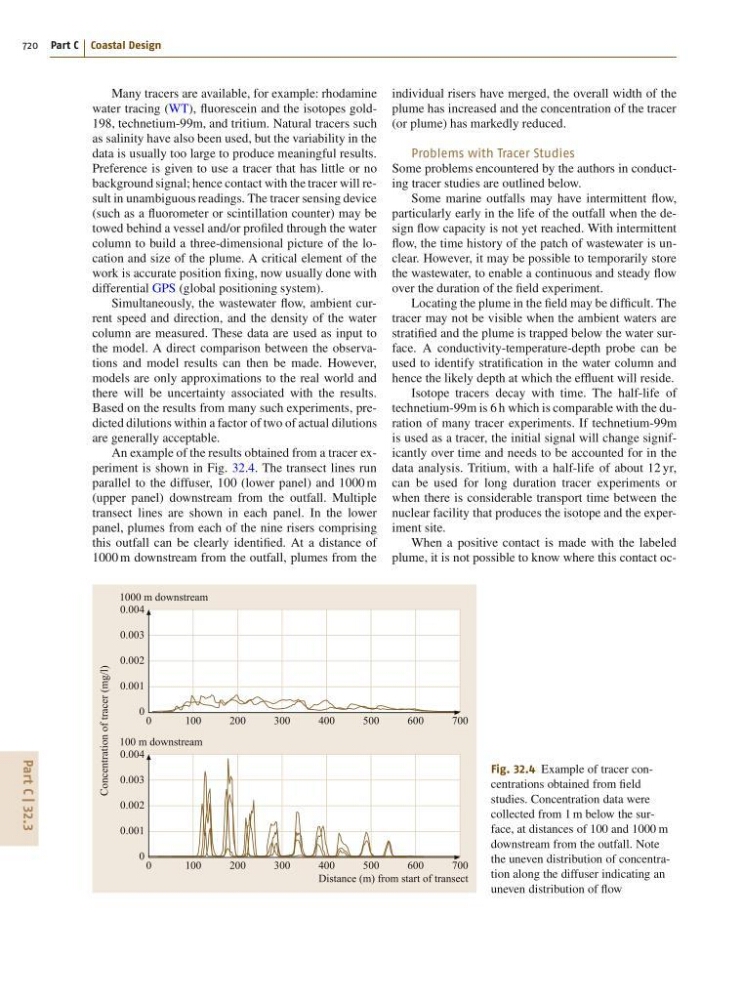
An example of the results obtained from a tracer experiment is shown in Fig. 32.4. The transect lines run
parallel to the diffuser, 100 (lower panel) and 1000 m
(upper panel) downstream from the outfall. Multiple
transect lines are shown in each panel. In the lower
panel, plumes from each of the nine risers comprising
this outfall can be clearly identified. At a distance of
1000 m downstream from the outfall, plumes from the
0
700
Concentration of tracer (mg/l)
1000 m downstream
0.004
0.003
0.002
0.001
0
100
200
300
400
500
600
0
100
200
300
400
500
600
700
100 m downstream
Distance (m) from start of transect
0.004
0.003
0.002
0.001
0
Fig. 32.4 Example of tracer concentrations obtained from field
studies. Concentration data were
collected from 1 m below the surface, at distances of 100 and 1000 m
downstream from the outfall. Note
the uneven distribution of concentration along the diffuser indicating an
uneven distribution of flow
individual risers have merged, the overall width of the
plume has increased and the concentration of the tracer
(or plume) has markedly reduced.
Problems with Tracer Studies
Some problems encountered by the authors in conducting tracer studies are outlined below.
Some marine outfalls may have intermittent flow,
particularly early in the life of the outfall when the design flow capacity is not yet reached. With intermittent
flow, the time history of the patch of wastewater is unclear. However, it may be possible to temporarily store
the wastewater, to enable a continuous and steady flow
over the duration of the field experiment.
Locating the plume in the field may be difficult. The
tracer may not be visible when the ambient waters are
stratified and the plume is trapped below the water surface. A conductivity-temperature-depth probe can be
used to identify stratification in the water column and
hence the likely depth at which the effluent will reside.
Isotope tracers decay with time. The half-life of
technetium-99m is 6 h which is comparable with the duration of many tracer experiments. If technetium-99m
is used as a tracer, the initial signal will change significantly over time and needs to be accounted for in the
data analysis. Tritium, with a half-life of about 12 yr,
can be used for long duration tracer experiments or
when there is considerable transport time between the
nuclear facility that produces the isotope and the experiment site.
When a positive contact is made with the labeled
plume, it is not possible to know where this contact oc-