

Elements of Physical Oceanography 2.9 Oceanic Internal Waves and Tides 43
Part A | 2.9
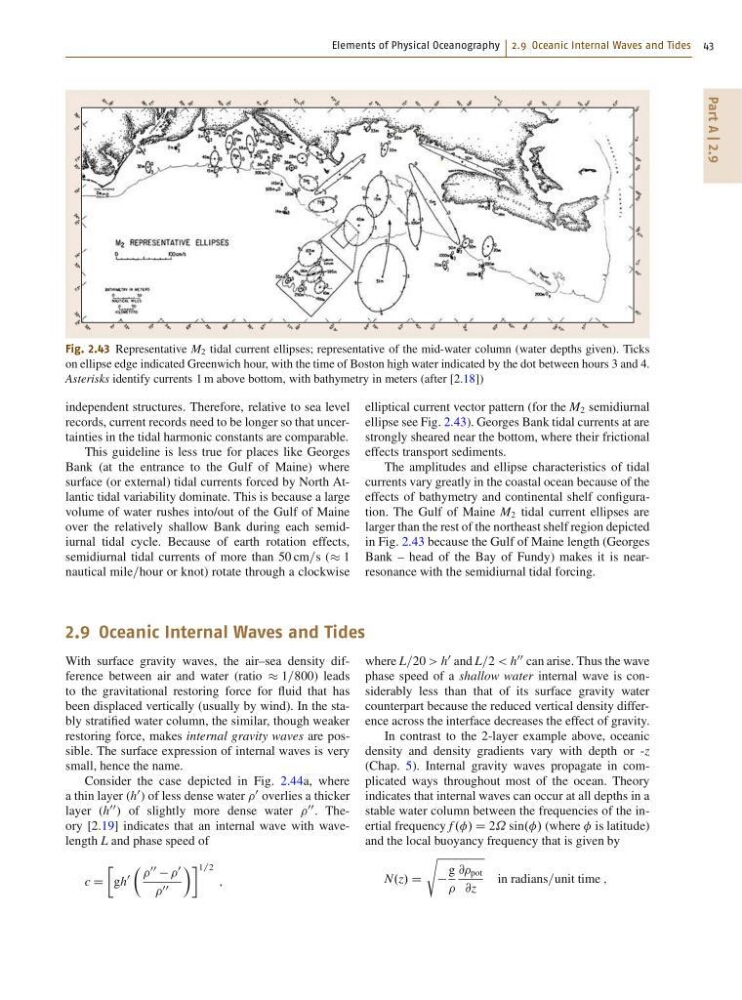
Fig. 2.43 Representative M 2 tidal current ellipses; representative of the mid-water column (water depths given). Ticks
on ellipse edge indicated Greenwich hour, with the time of Boston high water indicated by the dot between hours 3 and 4.
Asterisks identify currents 1 m above bottom, with bathymetry in meters (after [2.18])
independent structures. Therefore, relative to sea level
records, current records need to be longer so that uncertainties in the tidal harmonic constants are comparable.
This guideline is less true for places like Georges
Bank (at the entrance to the Gulf of Maine) where
surface (or external) tidal currents forced by North Atlantic tidal variability dominate. This is because a large
volume of water rushes into/out of the Gulf of Maine
over the relatively shallow Bank during each semidiurnal tidal cycle. Because of earth rotation effects,
semidiurnal tidal currents of more than 50 cm=s ( 1
nautical mile=hour or knot) rotate through a clockwise
elliptical current vector pattern (for the M 2 semidiurnal
ellipse see Fig. 2.43). Georges Bank tidal currents at are
strongly sheared near the bottom, where their frictional
effects transport sediments.
The amplitudes and ellipse characteristics of tidal
currents vary greatly in the coastal ocean because of the
effects of bathymetry and continental shelf configuration. The Gulf of Maine M 2 tidal current ellipses are
larger than the rest of the northeast shelf region depicted
in Fig. 2.43 because the Gulf of Maine length (Georges
Bank – head of the Bay of Fundy) makes it is nearresonance with the semidiurnal tidal forcing.
2.9 Oceanic Internal Waves and Tides
With surface gravity waves, the air–sea density difference between air and water (ratio 1=800) leads
to the gravitational restoring force for fluid that has
been displaced vertically (usually by wind). In the stably stratified water column, the similar, though weaker
restoring force, makes internal gravity waves are possible. The surface expression of internal waves is very
small, hence the name.
Consider the case depicted in Fig. 2.44a, where
a thin layer (h
0 ) of less dense water
0 overlies a thicker
layer (h
00 ) of slightly more dense water
00 . Theory [2.19] indicates that an internal wave with wavelength L and phase speed of
c D
Ä
gh
0
Â
00
0
00
ÃÃ 1=2
;
where L=20 > h
0 and L=2 < h
00 can arise. Thus the wave
phase speed of a shallow water internal wave is considerably less than that of its surface gravity water
counterpart because the reduced vertical density difference across the interface decreases the effect of gravity.
In contrast to the 2-layer example above, oceanic
density and density gradients vary with depth or -z
(Chap. 5). Internal gravity waves propagate in complicated ways throughout most of the ocean. Theory
indicates that internal waves can occur at all depths in a
stable water column between the frequencies of the inertial frequency f ../ D 2˝ sin../ (where is latitude)
and the local buoyancy frequency that is given by
N.z/ D
s
g
@@ pot
@z
in radians=unit time ;
Part A | 2.9
Fig. 2.43 Representative M 2 tidal current ellipses; representative of the mid-water column (water depths given). Ticks
on ellipse edge indicated Greenwich hour, with the time of Boston high water indicated by the dot between hours 3 and 4.
Asterisks identify currents 1 m above bottom, with bathymetry in meters (after [2.18])
independent structures. Therefore, relative to sea level
records, current records need to be longer so that uncertainties in the tidal harmonic constants are comparable.
This guideline is less true for places like Georges
Bank (at the entrance to the Gulf of Maine) where
surface (or external) tidal currents forced by North Atlantic tidal variability dominate. This is because a large
volume of water rushes into/out of the Gulf of Maine
over the relatively shallow Bank during each semidiurnal tidal cycle. Because of earth rotation effects,
semidiurnal tidal currents of more than 50 cm=s ( 1
nautical mile=hour or knot) rotate through a clockwise
elliptical current vector pattern (for the M 2 semidiurnal
ellipse see Fig. 2.43). Georges Bank tidal currents at are
strongly sheared near the bottom, where their frictional
effects transport sediments.
The amplitudes and ellipse characteristics of tidal
currents vary greatly in the coastal ocean because of the
effects of bathymetry and continental shelf configuration. The Gulf of Maine M 2 tidal current ellipses are
larger than the rest of the northeast shelf region depicted
in Fig. 2.43 because the Gulf of Maine length (Georges
Bank – head of the Bay of Fundy) makes it is nearresonance with the semidiurnal tidal forcing.
2.9 Oceanic Internal Waves and Tides
With surface gravity waves, the air–sea density difference between air and water (ratio 1=800) leads
to the gravitational restoring force for fluid that has
been displaced vertically (usually by wind). In the stably stratified water column, the similar, though weaker
restoring force, makes internal gravity waves are possible. The surface expression of internal waves is very
small, hence the name.
Consider the case depicted in Fig. 2.44a, where
a thin layer (h
0 ) of less dense water
0 overlies a thicker
layer (h
00 ) of slightly more dense water
00 . Theory [2.19] indicates that an internal wave with wavelength L and phase speed of
c D
Ä
gh
0
Â
00
0
00
ÃÃ 1=2
;
where L=20 > h
0 and L=2 < h
00 can arise. Thus the wave
phase speed of a shallow water internal wave is considerably less than that of its surface gravity water
counterpart because the reduced vertical density difference across the interface decreases the effect of gravity.
In contrast to the 2-layer example above, oceanic
density and density gradients vary with depth or -z
(Chap. 5). Internal gravity waves propagate in complicated ways throughout most of the ocean. Theory
indicates that internal waves can occur at all depths in a
stable water column between the frequencies of the inertial frequency f ../ D 2˝ sin../ (where is latitude)
and the local buoyancy frequency that is given by
N.z/ D
s
g
@@ pot
@z
in radians=unit time ;