

Part C | 31.2
702 Part C Coastal Design
Chain anchor
Buoy
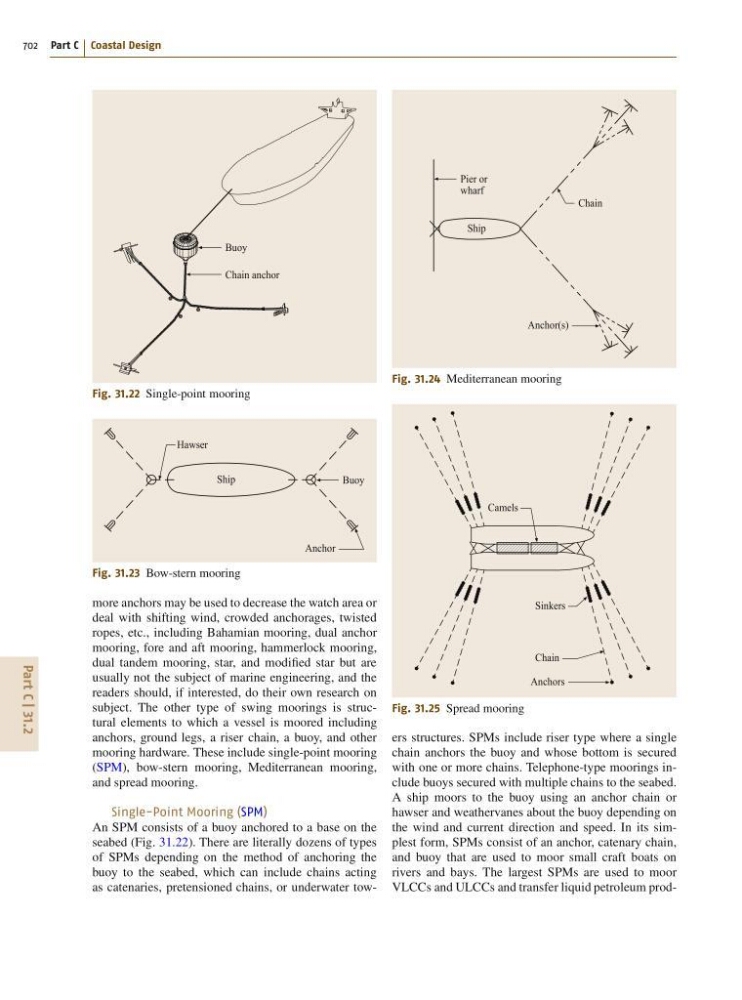
Fig. 31.22 Single-point mooring
Hawser
Buoy
Anchor
Ship
Fig. 31.23 Bow-stern mooring
more anchors may be used to decrease the watch area or
deal with shifting wind, crowded anchorages, twisted
ropes, etc., including Bahamian mooring, dual anchor
mooring, fore and aft mooring, hammerlock mooring,
dual tandem mooring, star, and modified star but are
usually not the subject of marine engineering, and the
readers should, if interested, do their own research on
subject. The other type of swing moorings is structural elements to which a vessel is moored including
anchors, ground legs, a riser chain, a buoy, and other
mooring hardware. These include single-point mooring
(SPM), bow-stern mooring, Mediterranean mooring,
and spread mooring.
Single-Point Mooring (SPM)
An SPM consists of a buoy anchored to a base on the
seabed (Fig. 31.22). There are literally dozens of types
of SPMs depending on the method of anchoring the
buoy to the seabed, which can include chains acting
as catenaries, pretensioned chains, or underwater towPier or
wharf
Chain
Ship
Anchor(s)
Fig. 31.24 Mediterranean mooring
Anchors
Chain
Sinkers
Camels
Fig. 31.25 Spread mooring
ers structures. SPMs include riser type where a single
chain anchors the buoy and whose bottom is secured
with one or more chains. Telephone-type moorings include buoys secured with multiple chains to the seabed.
A ship moors to the buoy using an anchor chain or
hawser and weathervanes about the buoy depending on
the wind and current direction and speed. In its simplest form, SPMs consist of an anchor, catenary chain,
and buoy that are used to moor small craft boats on
rivers and bays. The largest SPMs are used to moor
VLCCs and ULCCs and transfer liquid petroleum prod-