

Port and Harbor Design 31.2 Structure Types 701
Part C | 31.2
Bilge
blocks
Keel
blocks
Face of
wharf
Craddle
Groundways
Wheels
Pile bents
Elevation
Typical section
Walkway
Crane track
Craddle deck
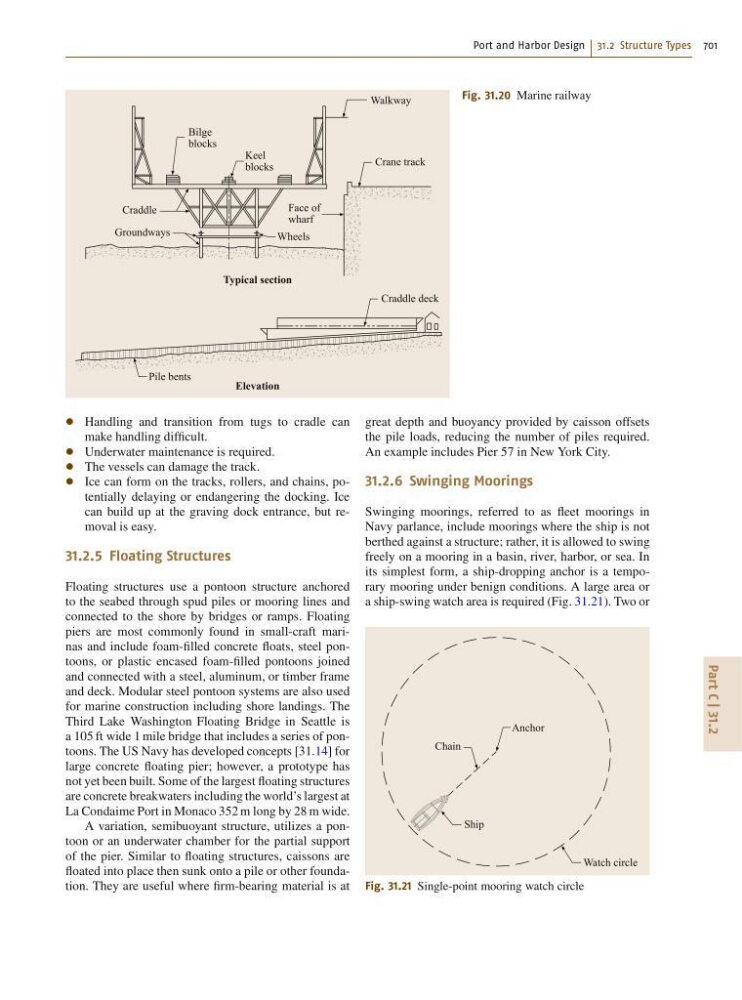
Fig. 31.20 Marine railway
Handling and transition from tugs to cradle can
make handling difficult.
Underwater maintenance is required.
The vessels can damage the track.
Ice can form on the tracks, rollers, and chains, potentially delaying or endangering the docking. Ice
can build up at the graving dock entrance, but removal is easy.
31.2.5 Floating Structures
Floating structures use a pontoon structure anchored
to the seabed through spud piles or mooring lines and
connected to the shore by bridges or ramps. Floating
piers are most commonly found in small-craft marinas and include foam-filled concrete floats, steel pontoons, or plastic encased foam-filled pontoons joined
and connected with a steel, aluminum, or timber frame
and deck. Modular steel pontoon systems are also used
for marine construction including shore landings. The
Third Lake Washington Floating Bridge in Seattle is
a 105 ft wide 1 mile bridge that includes a series of pontoons. The US Navy has developed concepts [31.14] for
large concrete floating pier; however, a prototype has
not yet been built. Some of the largest floating structures
are concrete breakwaters including the world’s largest at
La Condaime Port in Monaco 352 m long by 28 m wide.
A variation, semibuoyant structure, utilizes a pontoon or an underwater chamber for the partial support
of the pier. Similar to floating structures, caissons are
floated into place then sunk onto a pile or other foundation. They are useful where firm-bearing material is at
great depth and buoyancy provided by caisson offsets
the pile loads, reducing the number of piles required.
An example includes Pier 57 in New York City.
31.2.6 Swinging Moorings
Swinging moorings, referred to as fleet moorings in
Navy parlance, include moorings where the ship is not
berthed against a structure; rather, it is allowed to swing
freely on a mooring in a basin, river, harbor, or sea. In
its simplest form, a ship-dropping anchor is a temporary mooring under benign conditions. A large area or
a ship-swing watch area is required (Fig. 31.21). Two or
Ship
Anchor
Watch circle
Chain
Fig. 31.21 Single-point mooring watch circle