

Part C | 31.2
700 Part C Coastal Design
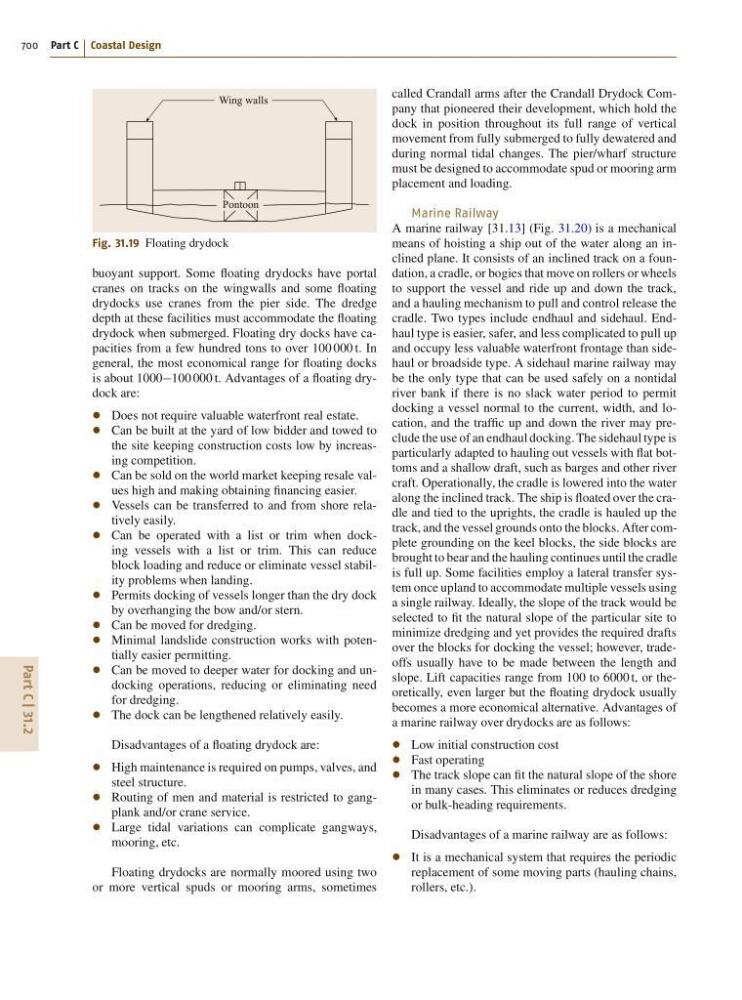
Wing walls
Pontoon
Fig. 31.19 Floating drydock
buoyant support. Some floating drydocks have portal
cranes on tracks on the wingwalls and some floating
drydocks use cranes from the pier side. The dredge
depth at these facilities must accommodate the floating
drydock when submerged. Floating dry docks have capacities from a few hundred tons to over 100 000 t. In
general, the most economical range for floating docks
is about 1000100 000 t. Advantages of a floating drydock are:
Does not require valuable waterfront real estate.
Can be built at the yard of low bidder and towed to
the site keeping construction costs low by increasing competition.
Can be sold on the world market keeping resale values high and making obtaining financing easier.
Vessels can be transferred to and from shore relatively easily.
Can be operated with a list or trim when docking vessels with a list or trim. This can reduce
block loading and reduce or eliminate vessel stability problems when landing.
Permits docking of vessels longer than the dry dock
by overhanging the bow and/or stern.
Can be moved for dredging.
Minimal landslide construction works with potentially easier permitting.
Can be moved to deeper water for docking and undocking operations, reducing or eliminating need
for dredging.
The dock can be lengthened relatively easily.
Disadvantages of a floating drydock are:
High maintenance is required on pumps, valves, and
steel structure.
Routing of men and material is restricted to gangplank and/or crane service.
Large tidal variations can complicate gangways,
mooring, etc.
Floating drydocks are normally moored using two
or more vertical spuds or mooring arms, sometimes
called Crandall arms after the Crandall Drydock Company that pioneered their development, which hold the
dock in position throughout its full range of vertical
movement from fully submerged to fully dewatered and
during normal tidal changes. The pier/wharf structure
must be designed to accommodate spud or mooring arm
placement and loading.
Marine Railway
A marine railway [31.13] (Fig. 31.20) is a mechanical
means of hoisting a ship out of the water along an inclined plane. It consists of an inclined track on a foundation, a cradle, or bogies that move on rollers or wheels
to support the vessel and ride up and down the track,
and a hauling mechanism to pull and control release the
cradle. Two types include endhaul and sidehaul. Endhaul type is easier, safer, and less complicated to pull up
and occupy less valuable waterfront frontage than sidehaul or broadside type. A sidehaul marine railway may
be the only type that can be used safely on a nontidal
river bank if there is no slack water period to permit
docking a vessel normal to the current, width, and location, and the traffic up and down the river may preclude the use of an endhaul docking. The sidehaul type is
particularly adapted to hauling out vessels with flat bottoms and a shallow draft, such as barges and other river
craft. Operationally, the cradle is lowered into the water
along the inclined track. The ship is floated over the cradle and tied to the uprights, the cradle is hauled up the
track, and the vessel grounds onto the blocks. After complete grounding on the keel blocks, the side blocks are
brought to bear and the hauling continues until the cradle
is full up. Some facilities employ a lateral transfer system once upland to accommodate multiple vessels using
a single railway. Ideally, the slope of the track would be
selected to fit the natural slope of the particular site to
minimize dredging and yet provides the required drafts
over the blocks for docking the vessel; however, tradeoffs usually have to be made between the length and
slope. Lift capacities range from 100 to 6000 t, or theoretically, even larger but the floating drydock usually
becomes a more economical alternative. Advantages of
a marine railway over drydocks are as follows:
Low initial construction cost
Fast operating
The track slope can fit the natural slope of the shore
in many cases. This eliminates or reduces dredging
or bulk-heading requirements.
Disadvantages of a marine railway are as follows:
It is a mechanical system that requires the periodic
replacement of some moving parts (hauling chains,
rollers, etc.).