

Part C | 31.2
698 Part C Coastal Design
Crane track
RR track
Coping
Chain handrail
Service gallery
Altar
Electrical
conduits
Curb
Pipe tunnel
Gutter
Floor
Head end
Entrance end
Outer seat
Inner seat
Caisson
Filter course
Pile cutoff
wall
Ship blocking
Body of the dock
Dock chamber
Cross section
Plan
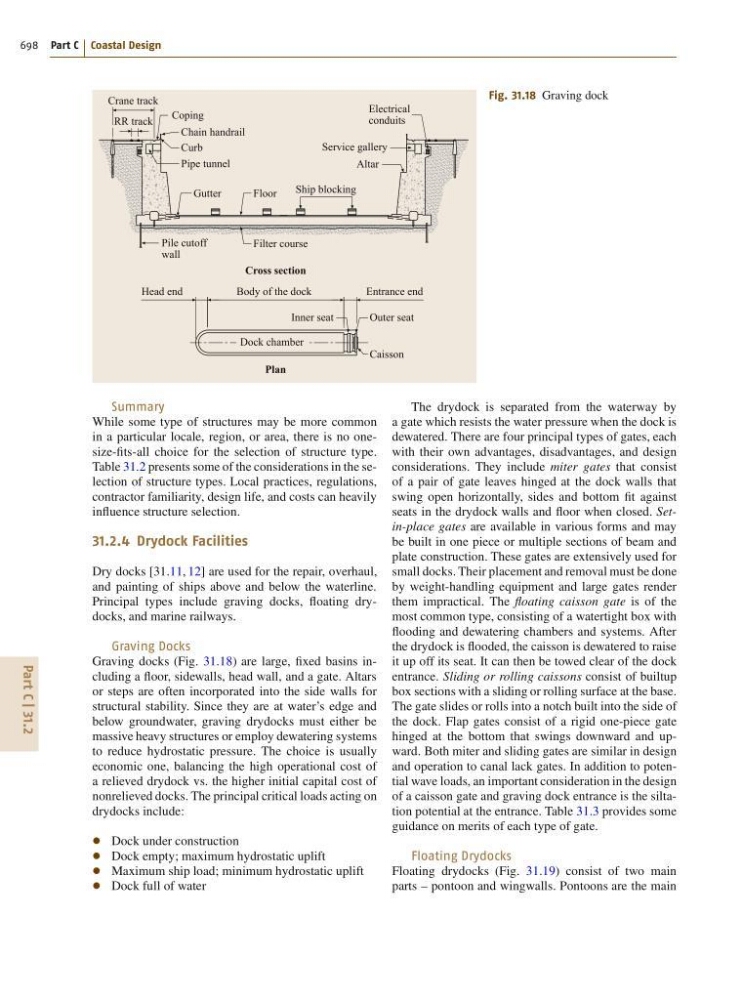
Fig. 31.18 Graving dock
Summary
While some type of structures may be more common
in a particular locale, region, or area, there is no onesize-fits-all choice for the selection of structure type.
Table 31.2 presents some of the considerations in the selection of structure types. Local practices, regulations,
contractor familiarity, design life, and costs can heavily
influence structure selection.
31.2.4 Drydock Facilities
Dry docks [31.11, 12] are used for the repair, overhaul,
and painting of ships above and below the waterline.
Principal types include graving docks, floating drydocks, and marine railways.
Graving Docks
Graving docks (Fig. 31.18) are large, fixed basins including a floor, sidewalls, head wall, and a gate. Altars
or steps are often incorporated into the side walls for
structural stability. Since they are at water’s edge and
below groundwater, graving drydocks must either be
massive heavy structures or employ dewatering systems
to reduce hydrostatic pressure. The choice is usually
economic one, balancing the high operational cost of
a relieved drydock vs. the higher initial capital cost of
nonrelieved docks. The principal critical loads acting on
drydocks include:
Dock under construction
Dock empty; maximum hydrostatic uplift
Maximum ship load; minimum hydrostatic uplift
Dock full of water
The drydock is separated from the waterway by
a gate which resists the water pressure when the dock is
dewatered. There are four principal types of gates, each
with their own advantages, disadvantages, and design
considerations. They include miter gates that consist
of a pair of gate leaves hinged at the dock walls that
swing open horizontally, sides and bottom fit against
seats in the drydock walls and floor when closed. Setin-place gates are available in various forms and may
be built in one piece or multiple sections of beam and
plate construction. These gates are extensively used for
small docks. Their placement and removal must be done
by weight-handling equipment and large gates render
them impractical. The floating caisson gate is of the
most common type, consisting of a watertight box with
flooding and dewatering chambers and systems. After
the drydock is flooded, the caisson is dewatered to raise
it up off its seat. It can then be towed clear of the dock
entrance. Sliding or rolling caissons consist of builtup
box sections with a sliding or rolling surface at the base.
The gate slides or rolls into a notch built into the side of
the dock. Flap gates consist of a rigid one-piece gate
hinged at the bottom that swings downward and upward. Both miter and sliding gates are similar in design
and operation to canal lack gates. In addition to potential wave loads, an important consideration in the design
of a caisson gate and graving dock entrance is the siltation potential at the entrance. Table 31.3 provides some
guidance on merits of each type of gate.
Floating Drydocks
Floating drydocks (Fig. 31.19) consist of two main
parts – pontoon and wingwalls. Pontoons are the main