

Port and Harbor Design 31.2 Structure Types 697
Part C | 31.2
Dredged
bottom
Flexible pavement
Select
granular
fill
Select fill
Rock
fill
Rock
fill
Filters if
required
Fill
Fender
system
Conc. cap
Precast conc.
caisson
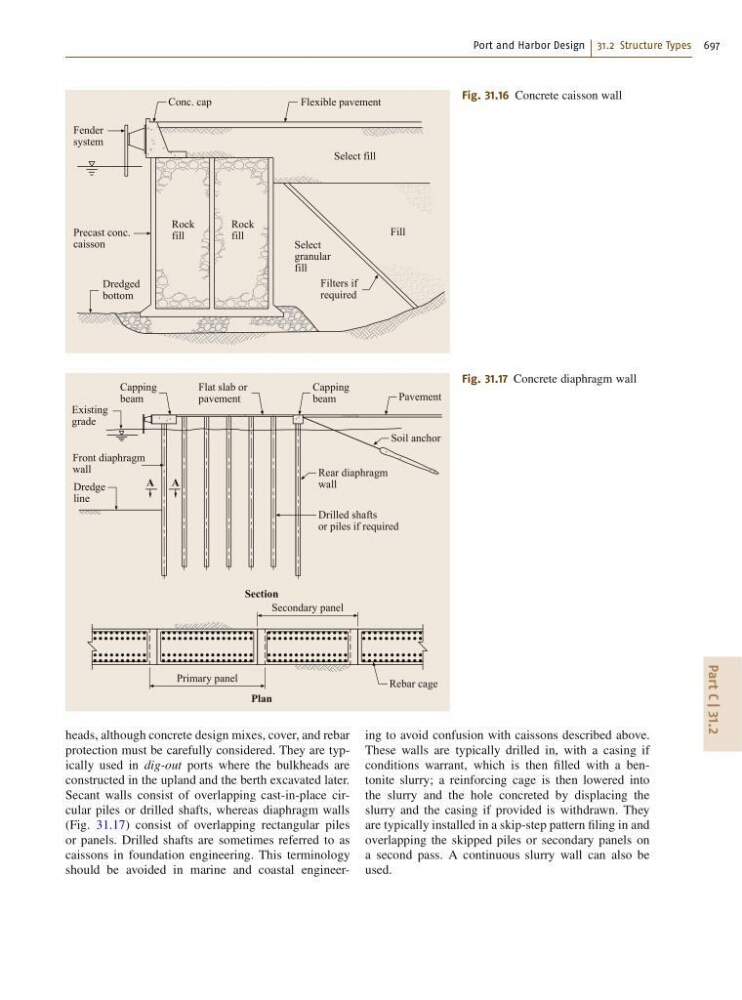
Fig. 31.16 Concrete caisson wall
Section
Plan
A
A
Dredge
line
Pavement
Soil anchor
Rear diaphragm
wall
Drilled shafts
or piles if required
Secondary panel
Primary panel
Rebar cage
Capping
beam
Capping
beam
Flat slab or
pavement
Existing
grade
Front diaphragm
wall
Fig. 31.17 Concrete diaphragm wall
heads, although concrete design mixes, cover, and rebar
protection must be carefully considered. They are typically used in dig-out ports where the bulkheads are
constructed in the upland and the berth excavated later.
Secant walls consist of overlapping cast-in-place circular piles or drilled shafts, whereas diaphragm walls
(Fig. 31.17) consist of overlapping rectangular piles
or panels. Drilled shafts are sometimes referred to as
caissons in foundation engineering. This terminology
should be avoided in marine and coastal engineering to avoid confusion with caissons described above.
These walls are typically drilled in, with a casing if
conditions warrant, which is then filled with a bentonite slurry; a reinforcing cage is then lowered into
the slurry and the hole concreted by displacing the
slurry and the casing if provided is withdrawn. They
are typically installed in a skip-step pattern filing in and
overlapping the skipped piles or secondary panels on
a second pass. A continuous slurry wall can also be
used.