

Port and Harbor Design 31.2 Structure Types 693
Part C | 31.2
tion of a breakwater is wave protection. The degree
of protection required (or allowable wave conditions
within the harbor) will depend on the vessel characteristics, harbor operational and downtime requirements.
In practice, a numerical wave model with diffraction
capability needs to be employed to investigate the optimum layout of breakwater and wave climate within
the harbor. For breakwater design, bathymetry and
geotechnical considerations are very important because
it will determine the applicability of various types of
breakwaters, the volume of material needed to build
the breakwater, and scour requirements. Wave height
and their frequency of occurrence (both during normal
conditions and extreme storm events) are the most important inputs for the optimum design of a breakwater.
Wave run-up and overtopping analysis also need to be
conducted to determine the elevation of the breakwater.
Guidance for the design of breakwaters may be found
in [31.6, Chap. 5]. For navigation safety, aids to navigation are typically needed at the head and along the
trunk of breakwater. During design, the availability and
cost of construction materials and equipment need to
be considered. Revetments often found adjacent to or
beneath in the case of pile supported marginal wharfs.
Design principles for revetments are similar to breakwaters and in addition to [31.6] guidance may be found
in [31.7].
31.2.2 Open Pile Platforms
Open pile platforms allow water to flow underneath and
are supported on steel, concrete, timber, or composite
piles or drilled shafts. Typically, a solid deck is provided, except for liquid and dry bulk facilities, which
use pipelines, conveyors, or other methods to transfer
bulk products, where only a frame may be provided.
Deck types can include either concrete two-way flat
plate slabs or concrete pile caps with one-way deck
slabs with the pile caps typically oriented normal to
the pier’s or wharf’s length to take advantage of the
pile cap’s greater strength to resist lateral loads due to
berthing or mooring. One-way deck systems may be
cast in place but more commonly use precast planks
(solid or voided) or less frequently beams (box, tee,
etc.) since such deck components can be more easily precast and erected rapidly. Two-way deck systems
with or without pile caps in one or both directions
are also common; these usually employ longitudinal
beams/girders to accommodate heavy wheel loads, such
as container and other travelling cranes, often on rails.
Two-way slabs without beams are less common since
a cast-in-place deck is usually necessitated requiring
a high-cost formwork over the water; drop panels over
piles if used further increase costs. A deck cast on
ground and then soil below removed is also possible,
but there is a challenge in removing the soil below. Two
main types of open pile platforms include high- and
low-level platforms. In addition to berthing and mooring loads discussed hereafter, the design of open pile
platforms must consider current and wave loads on substructure elements. Guidance may be found in [31.6,
Chap. 5].
Low-Level or Relieving Platforms
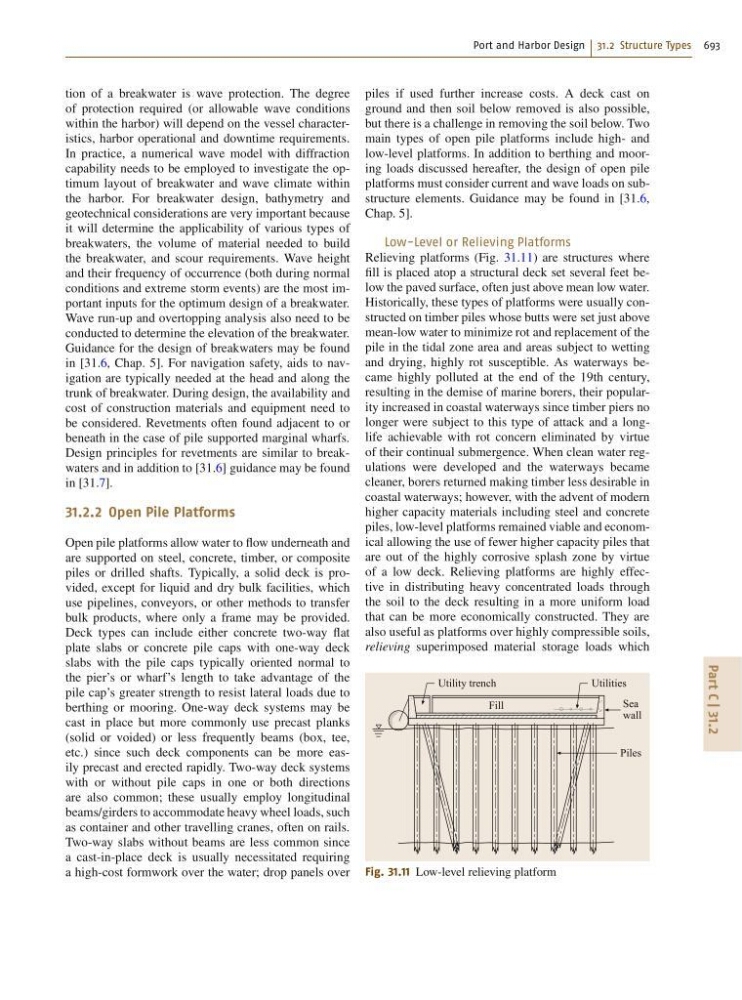
Relieving platforms (Fig. 31.11) are structures where
fill is placed atop a structural deck set several feet below the paved surface, often just above mean low water.
Historically, these types of platforms were usually constructed on timber piles whose butts were set just above
mean-low water to minimize rot and replacement of the
pile in the tidal zone area and areas subject to wetting
and drying, highly rot susceptible. As waterways became highly polluted at the end of the 19th century,
resulting in the demise of marine borers, their popularity increased in coastal waterways since timber piers no
longer were subject to this type of attack and a longlife achievable with rot concern eliminated by virtue
of their continual submergence. When clean water regulations were developed and the waterways became
cleaner, borers returned making timber less desirable in
coastal waterways; however, with the advent of modern
higher capacity materials including steel and concrete
piles, low-level platforms remained viable and economical allowing the use of fewer higher capacity piles that
are out of the highly corrosive splash zone by virtue
of a low deck. Relieving platforms are highly effective in distributing heavy concentrated loads through
the soil to the deck resulting in a more uniform load
that can be more economically constructed. They are
also useful as platforms over highly compressible soils,
relieving superimposed material storage loads which
Fill
Utility trench
Utilities
Sea
wall
Piles
Fig. 31.11 Low-level relieving platform