

Part C | 31.2
694 Part C Coastal Design
would otherwise result in an unacceptable settlement
of the facility. Finally, low-level platforms offer the advantage of a no cost space for utilities within the fill
atop structural deck, especially useful for military, service, and outfitting piers. Their main disadvantage is
their intrinsically higher cost since they support higher
dead loads and their construction is limited to periods
of lower water.
High-Level Platforms
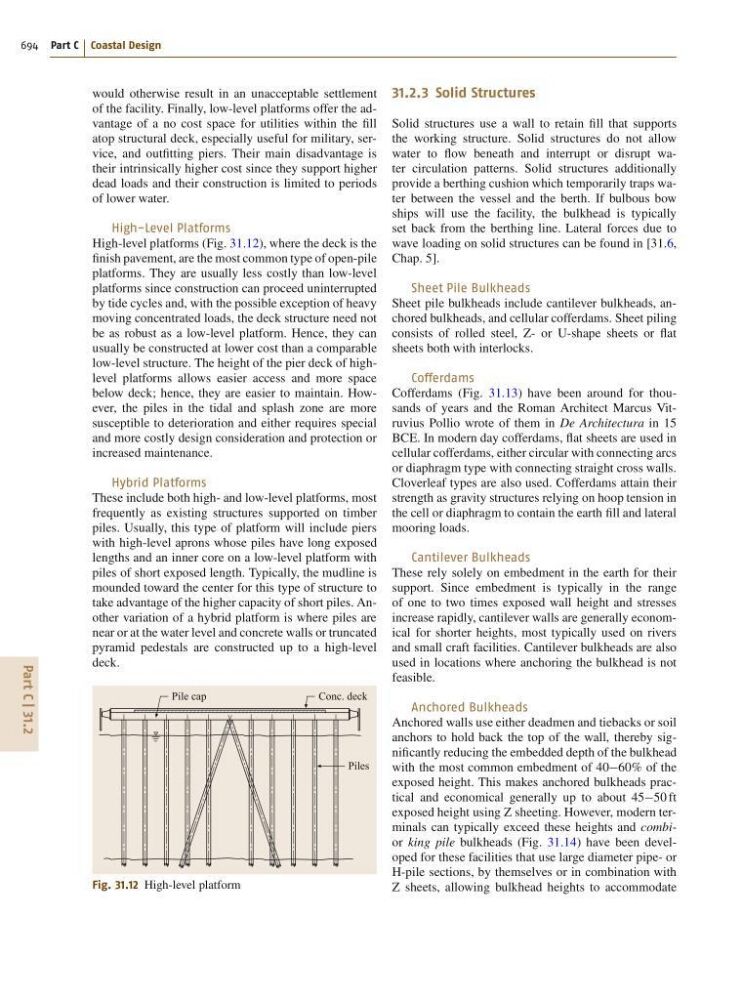
High-level platforms (Fig. 31.12), where the deck is the
finish pavement, are the most common type of open-pile
platforms. They are usually less costly than low-level
platforms since construction can proceed uninterrupted
by tide cycles and, with the possible exception of heavy
moving concentrated loads, the deck structure need not
be as robust as a low-level platform. Hence, they can
usually be constructed at lower cost than a comparable
low-level structure. The height of the pier deck of highlevel platforms allows easier access and more space
below deck; hence, they are easier to maintain. However, the piles in the tidal and splash zone are more
susceptible to deterioration and either requires special
and more costly design consideration and protection or
increased maintenance.
Hybrid Platforms
These include both high- and low-level platforms, most
frequently as existing structures supported on timber
piles. Usually, this type of platform will include piers
with high-level aprons whose piles have long exposed
lengths and an inner core on a low-level platform with
piles of short exposed length. Typically, the mudline is
mounded toward the center for this type of structure to
take advantage of the higher capacity of short piles. Another variation of a hybrid platform is where piles are
near or at the water level and concrete walls or truncated
pyramid pedestals are constructed up to a high-level
deck.
Pile cap
Conc. deck
Piles
Fig. 31.12 High-level platform
31.2.3 Solid Structures
Solid structures use a wall to retain fill that supports
the working structure. Solid structures do not allow
water to flow beneath and interrupt or disrupt water circulation patterns. Solid structures additionally
provide a berthing cushion which temporarily traps water between the vessel and the berth. If bulbous bow
ships will use the facility, the bulkhead is typically
set back from the berthing line. Lateral forces due to
wave loading on solid structures can be found in [31.6,
Chap. 5].
Sheet Pile Bulkheads
Sheet pile bulkheads include cantilever bulkheads, anchored bulkheads, and cellular cofferdams. Sheet piling
consists of rolled steel, Z- or U-shape sheets or flat
sheets both with interlocks.
Cofferdams
Cofferdams (Fig. 31.13) have been around for thousands of years and the Roman Architect Marcus Vitruvius Pollio wrote of them in De Architectura in 15
BCE. In modern day cofferdams, flat sheets are used in
cellular cofferdams, either circular with connecting arcs
or diaphragm type with connecting straight cross walls.
Cloverleaf types are also used. Cofferdams attain their
strength as gravity structures relying on hoop tension in
the cell or diaphragm to contain the earth fill and lateral
mooring loads.
Cantilever Bulkheads
These rely solely on embedment in the earth for their
support. Since embedment is typically in the range
of one to two times exposed wall height and stresses
increase rapidly, cantilever walls are generally economical for shorter heights, most typically used on rivers
and small craft facilities. Cantilever bulkheads are also
used in locations where anchoring the bulkhead is not
feasible.
Anchored Bulkheads
Anchored walls use either deadmen and tiebacks or soil
anchors to hold back the top of the wall, thereby significantly reducing the embedded depth of the bulkhead
with the most common embedment of 4060% of the
exposed height. This makes anchored bulkheads practical and economical generally up to about 4550 ft
exposed height using Z sheeting. However, modern terminals can typically exceed these heights and combior king pile bulkheads (Fig. 31.14) have been developed for these facilities that use large diameter pipe- or
H-pile sections, by themselves or in combination with
Z sheets, allowing bulkhead heights to accommodate