

Elements of Physical Oceanography 2.7 Coastal Ocean Currents 39
Part A | 2.7
Zones where deep
and bottom waters
form and sink
Zones where
intermediate waters
form and sink
Major upwelling
zones
Major routes of deep
and bottom waters
75° N
60° N
30° N
0°
30° S
60° S
60° W
60° E
60° W
120° E
180°
120° W
0°
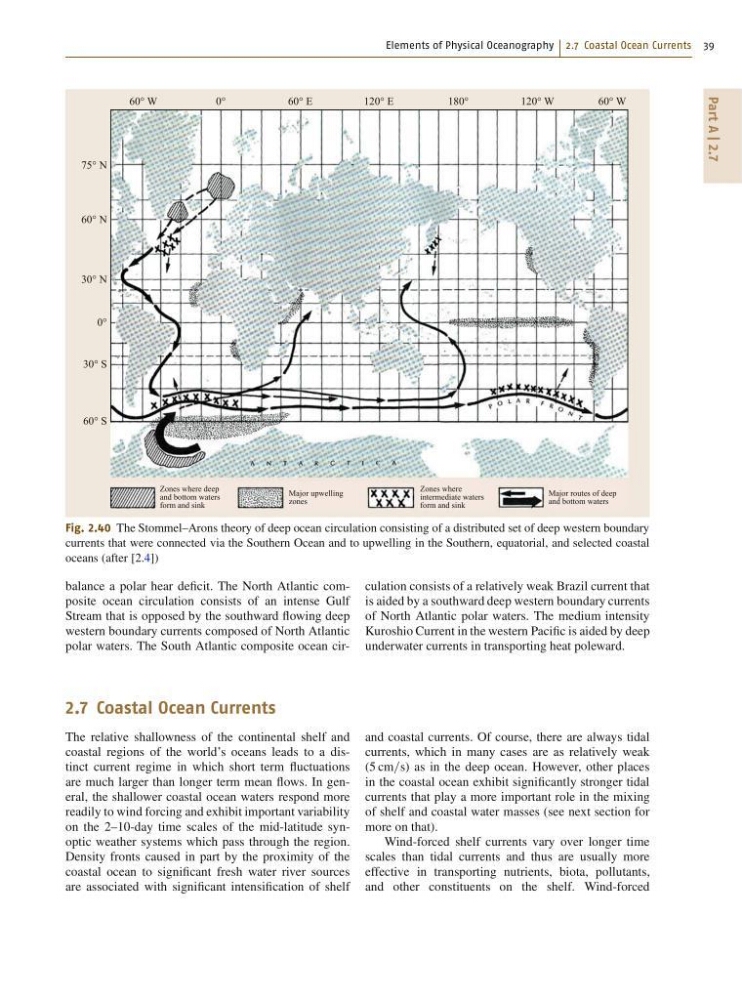
Fig. 2.40 The Stommel–Arons theory of deep ocean circulation consisting of a distributed set of deep western boundary
currents that were connected via the Southern Ocean and to upwelling in the Southern, equatorial, and selected coastal
oceans (after [2.4])
balance a polar hear deficit. The North Atlantic composite ocean circulation consists of an intense Gulf
Stream that is opposed by the southward flowing deep
western boundary currents composed of North Atlantic
polar waters. The South Atlantic composite ocean circulation consists of a relatively weak Brazil current that
is aided by a southward deep western boundary currents
of North Atlantic polar waters. The medium intensity
Kuroshio Current in the western Pacific is aided by deep
underwater currents in transporting heat poleward.
2.7 Coastal Ocean Currents
The relative shallowness of the continental shelf and
coastal regions of the world’s oceans leads to a distinct current regime in which short term fluctuations
are much larger than longer term mean flows. In general, the shallower coastal ocean waters respond more
readily to wind forcing and exhibit important variability
on the 2–10-day time scales of the mid-latitude synoptic weather systems which pass through the region.
Density fronts caused in part by the proximity of the
coastal ocean to significant fresh water river sources
are associated with significant intensification of shelf
and coastal currents. Of course, there are always tidal
currents, which in many cases are as relatively weak
(5 cm=s) as in the deep ocean. However, other places
in the coastal ocean exhibit significantly stronger tidal
currents that play a more important role in the mixing
of shelf and coastal water masses (see next section for
more on that).
Wind-forced shelf currents vary over longer time
scales than tidal currents and thus are usually more
effective in transporting nutrients, biota, pollutants,
and other constituents on the shelf. Wind-forced
Part A | 2.7
Zones where deep
and bottom waters
form and sink
Zones where
intermediate waters
form and sink
Major upwelling
zones
Major routes of deep
and bottom waters
75° N
60° N
30° N
0°
30° S
60° S
60° W
60° E
60° W
120° E
180°
120° W
0°
Fig. 2.40 The Stommel–Arons theory of deep ocean circulation consisting of a distributed set of deep western boundary
currents that were connected via the Southern Ocean and to upwelling in the Southern, equatorial, and selected coastal
oceans (after [2.4])
balance a polar hear deficit. The North Atlantic composite ocean circulation consists of an intense Gulf
Stream that is opposed by the southward flowing deep
western boundary currents composed of North Atlantic
polar waters. The South Atlantic composite ocean circulation consists of a relatively weak Brazil current that
is aided by a southward deep western boundary currents
of North Atlantic polar waters. The medium intensity
Kuroshio Current in the western Pacific is aided by deep
underwater currents in transporting heat poleward.
2.7 Coastal Ocean Currents
The relative shallowness of the continental shelf and
coastal regions of the world’s oceans leads to a distinct current regime in which short term fluctuations
are much larger than longer term mean flows. In general, the shallower coastal ocean waters respond more
readily to wind forcing and exhibit important variability
on the 2–10-day time scales of the mid-latitude synoptic weather systems which pass through the region.
Density fronts caused in part by the proximity of the
coastal ocean to significant fresh water river sources
are associated with significant intensification of shelf
and coastal currents. Of course, there are always tidal
currents, which in many cases are as relatively weak
(5 cm=s) as in the deep ocean. However, other places
in the coastal ocean exhibit significantly stronger tidal
currents that play a more important role in the mixing
of shelf and coastal water masses (see next section for
more on that).
Wind-forced shelf currents vary over longer time
scales than tidal currents and thus are usually more
effective in transporting nutrients, biota, pollutants,
and other constituents on the shelf. Wind-forced