

Part A | 2.6
38 Part A Fundamentals
a)
b)
Gulf
stream
Gulf
stream
Week 1
Week 2
Week 3
Cold
water
Colder
water
Warmer
water
Cloud bank
G
u l f s t r e a m
Warmcore
eddy
Warm
water
Warm-core
ring
Drift
Drift
Cold-core
ring
C
C
W
W
W
C
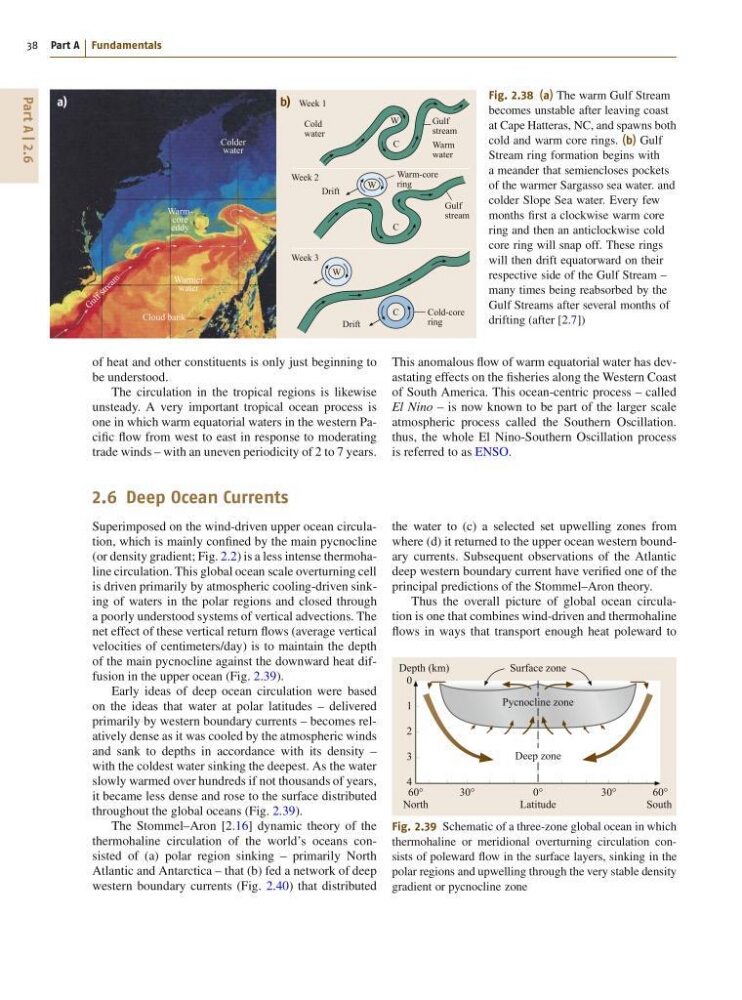
Fig. 2.38 (a) The warm Gulf Stream
becomes unstable after leaving coast
at Cape Hatteras, NC, and spawns both
cold and warm core rings. (b) Gulf
Stream ring formation begins with
a meander that semiencloses pockets
of the warmer Sargasso sea water. and
colder Slope Sea water. Every few
months first a clockwise warm core
ring and then an anticlockwise cold
core ring will snap off. These rings
will then drift equatorward on their
respective side of the Gulf Stream –
many times being reabsorbed by the
Gulf Streams after several months of
drifting (after [2.7])
of heat and other constituents is only just beginning to
be understood.
The circulation in the tropical regions is likewise
unsteady. A very important tropical ocean process is
one in which warm equatorial waters in the western Pacific flow from west to east in response to moderating
trade winds – with an uneven periodicity of 2 to 7 years.
This anomalous flow of warm equatorial water has devastating effects on the fisheries along the Western Coast
of South America. This ocean-centric process – called
El Nino – is now known to be part of the larger scale
atmospheric process called the Southern Oscillation.
thus, the whole El Nino-Southern Oscillation process
is referred to as ENSO.
2.6 Deep Ocean Currents
Superimposed on the wind-driven upper ocean circulation, which is mainly confined by the main pycnocline
(or density gradient; Fig. 2.2) is a less intense thermohaline circulation. This global ocean scale overturning cell
is driven primarily by atmospheric cooling-driven sinking of waters in the polar regions and closed through
a poorly understood systems of vertical advections. The
net effect of these vertical return flows (average vertical
velocities of centimeters/day) is to maintain the depth
of the main pycnocline against the downward heat diffusion in the upper ocean (Fig. 2.39).
Early ideas of deep ocean circulation were based
on the ideas that water at polar latitudes – delivered
primarily by western boundary currents – becomes relatively dense as it was cooled by the atmospheric winds
and sank to depths in accordance with its density –
with the coldest water sinking the deepest. As the water
slowly warmed over hundreds if not thousands of years,
it became less dense and rose to the surface distributed
throughout the global oceans (Fig. 2.39).
The Stommel–Aron [2.16] dynamic theory of the
thermohaline circulation of the world’s oceans consisted of (a) polar region sinking – primarily North
Atlantic and Antarctica – that (b) fed a network of deep
western boundary currents (Fig. 2.40) that distributed
the water to (c) a selected set upwelling zones from
where (d) it returned to the upper ocean western boundary currents. Subsequent observations of the Atlantic
deep western boundary current have verified one of the
principal predictions of the Stommel–Aron theory.
Thus the overall picture of global ocean circulation is one that combines wind-driven and thermohaline
flows in ways that transport enough heat poleward to
60°
30°
30°
0°
60°
North
South
Depth (km)
Latitude
Deep zone
Pycnocline zone
Surface zone
0
1
2
3
4
Fig. 2.39 Schematic of a three-zone global ocean in which
thermohaline or meridional overturning circulation consists of poleward flow in the surface layers, sinking in the
polar regions and upwelling through the very stable density
gradient or pycnocline zone
38 Part A Fundamentals
a)
b)
Gulf
stream
Gulf
stream
Week 1
Week 2
Week 3
Cold
water
Colder
water
Warmer
water
Cloud bank
G
u l f s t r e a m
Warmcore
eddy
Warm
water
Warm-core
ring
Drift
Drift
Cold-core
ring
C
C
W
W
W
C
Fig. 2.38 (a) The warm Gulf Stream
becomes unstable after leaving coast
at Cape Hatteras, NC, and spawns both
cold and warm core rings. (b) Gulf
Stream ring formation begins with
a meander that semiencloses pockets
of the warmer Sargasso sea water. and
colder Slope Sea water. Every few
months first a clockwise warm core
ring and then an anticlockwise cold
core ring will snap off. These rings
will then drift equatorward on their
respective side of the Gulf Stream –
many times being reabsorbed by the
Gulf Streams after several months of
drifting (after [2.7])
of heat and other constituents is only just beginning to
be understood.
The circulation in the tropical regions is likewise
unsteady. A very important tropical ocean process is
one in which warm equatorial waters in the western Pacific flow from west to east in response to moderating
trade winds – with an uneven periodicity of 2 to 7 years.
This anomalous flow of warm equatorial water has devastating effects on the fisheries along the Western Coast
of South America. This ocean-centric process – called
El Nino – is now known to be part of the larger scale
atmospheric process called the Southern Oscillation.
thus, the whole El Nino-Southern Oscillation process
is referred to as ENSO.
2.6 Deep Ocean Currents
Superimposed on the wind-driven upper ocean circulation, which is mainly confined by the main pycnocline
(or density gradient; Fig. 2.2) is a less intense thermohaline circulation. This global ocean scale overturning cell
is driven primarily by atmospheric cooling-driven sinking of waters in the polar regions and closed through
a poorly understood systems of vertical advections. The
net effect of these vertical return flows (average vertical
velocities of centimeters/day) is to maintain the depth
of the main pycnocline against the downward heat diffusion in the upper ocean (Fig. 2.39).
Early ideas of deep ocean circulation were based
on the ideas that water at polar latitudes – delivered
primarily by western boundary currents – becomes relatively dense as it was cooled by the atmospheric winds
and sank to depths in accordance with its density –
with the coldest water sinking the deepest. As the water
slowly warmed over hundreds if not thousands of years,
it became less dense and rose to the surface distributed
throughout the global oceans (Fig. 2.39).
The Stommel–Aron [2.16] dynamic theory of the
thermohaline circulation of the world’s oceans consisted of (a) polar region sinking – primarily North
Atlantic and Antarctica – that (b) fed a network of deep
western boundary currents (Fig. 2.40) that distributed
the water to (c) a selected set upwelling zones from
where (d) it returned to the upper ocean western boundary currents. Subsequent observations of the Atlantic
deep western boundary current have verified one of the
principal predictions of the Stommel–Aron theory.
Thus the overall picture of global ocean circulation is one that combines wind-driven and thermohaline
flows in ways that transport enough heat poleward to
60°
30°
30°
0°
60°
North
South
Depth (km)
Latitude
Deep zone
Pycnocline zone
Surface zone
0
1
2
3
4
Fig. 2.39 Schematic of a three-zone global ocean in which
thermohaline or meridional overturning circulation consists of poleward flow in the surface layers, sinking in the
polar regions and upwelling through the very stable density
gradient or pycnocline zone