

Part A | 2.8
40 Part A Fundamentals
shelf fluctuations are usually most intense (typically
1050 cm=s) in the along-shelf direction, with the maximum currents occurring at mid-shelf.
The presence of significant across-shelf density
changes, such as those found along the East Coast
of North America, leads to a modified current structure in which maximum along-shelf currents are concentrated in the density front along the outer shelf.
These currents change over longer time scales in response to the more slowly changing density structures.
Occasionally, deeper ocean currents in the form of
Gulf Stream warm core rings penetrate onto the shelf
and disturb the normal distribution of currents found
there.
On many continental shelves, including the East
Coast of North America, there is a more or less steady
along-shelf flow superimposed on the fluctuating tidal,
buoyancy-induced and wind-driven current field. Typical velocities of these steady flows are usually about
510 cm=s. Thus, while astronomical wind forcing
plays an important role in shelf currents, their superimposition leads to complex and, as yet, unpredictable
patterns crudely described by the characteristics discussed above.
2.8 Ocean Surface Tides
The astronomically forced surface gravitational tide has
wavelengths that are long compared to the ocean depth
and thus is a shallow water wave. Tidal waves are
strongly forced by the motion of the earth relative to
the moon and the sun and thus differ from freely propagating wind-generated surface gravity waves. Unlike
most short period wind-driven waves, tidal waves have
periods on the order of a day – enough to be influenced
by the earth’s rotation (Fig. 2.2).
The tidal response of the global oceans is complex because of the combined astronomical tidal forcing
of the earth, moon and sun. The observed tides dif1 2 3 4 5 6 7 8 9 10 11 12 13 14 15
September
16 17 18 19 20 21 22 23 24 25 26 27 28 29 30
Springs
Springs
Tidal datum
Feet
MHWS
MHW
MLW
MLWS
*
Port Adelaide
Neaps
a)
b)
10
8
6
4
2
0
1 2 3 4 5 6 7 8 9 10 11 12 13 14
Pakhoi
Neaps
Neaps
Springs
Springs
Springs
15
September
16 17 18 19 20 21 22 23 24 25 26 27 28 29 30
Tidal datum
Feet
MHHW
MLLW
*
18
16
14
12
10
8
6
4
2
0
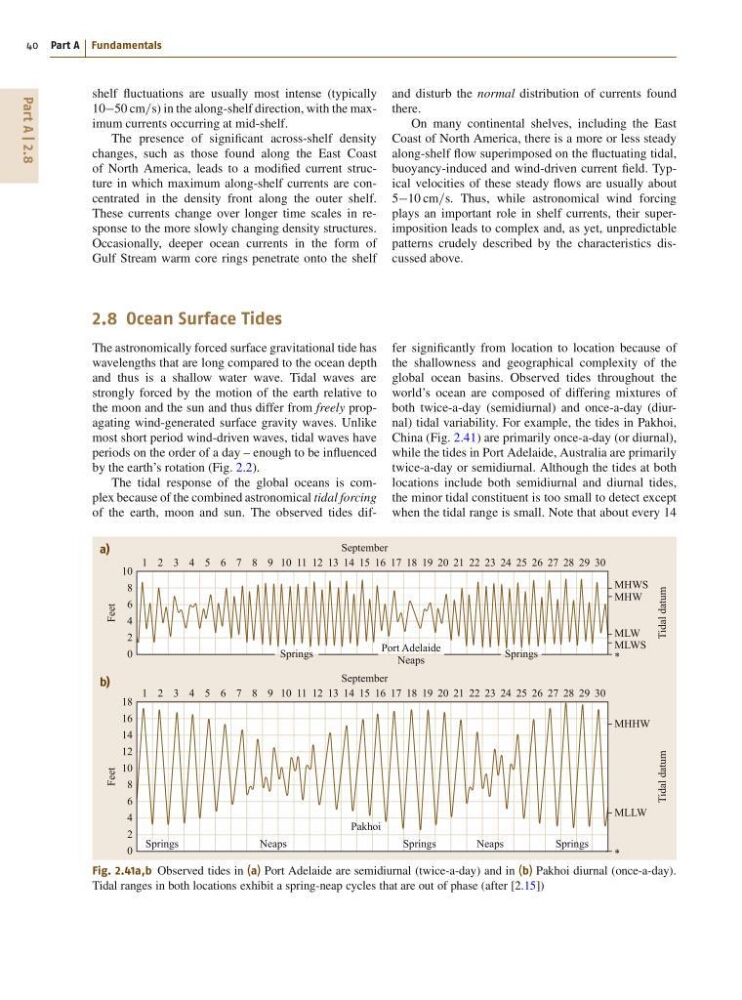
Fig. 2.41a,b Observed tides in (a) Port Adelaide are semidiurnal (twice-a-day) and in (b) Pakhoi diurnal (once-a-day).
Tidal ranges in both locations exhibit a spring-neap cycles that are out of phase (after [2.15])
fer significantly from location to location because of
the shallowness and geographical complexity of the
global ocean basins. Observed tides throughout the
world’s ocean are composed of differing mixtures of
both twice-a-day (semidiurnal) and once-a-day (diurnal) tidal variability. For example, the tides in Pakhoi,
China (Fig. 2.41) are primarily once-a-day (or diurnal),
while the tides in Port Adelaide, Australia are primarily
twice-a-day or semidiurnal. Although the tides at both
locations include both semidiurnal and diurnal tides,
the minor tidal constituent is too small to detect except
when the tidal range is small. Note that about every 14
40 Part A Fundamentals
shelf fluctuations are usually most intense (typically
1050 cm=s) in the along-shelf direction, with the maximum currents occurring at mid-shelf.
The presence of significant across-shelf density
changes, such as those found along the East Coast
of North America, leads to a modified current structure in which maximum along-shelf currents are concentrated in the density front along the outer shelf.
These currents change over longer time scales in response to the more slowly changing density structures.
Occasionally, deeper ocean currents in the form of
Gulf Stream warm core rings penetrate onto the shelf
and disturb the normal distribution of currents found
there.
On many continental shelves, including the East
Coast of North America, there is a more or less steady
along-shelf flow superimposed on the fluctuating tidal,
buoyancy-induced and wind-driven current field. Typical velocities of these steady flows are usually about
510 cm=s. Thus, while astronomical wind forcing
plays an important role in shelf currents, their superimposition leads to complex and, as yet, unpredictable
patterns crudely described by the characteristics discussed above.
2.8 Ocean Surface Tides
The astronomically forced surface gravitational tide has
wavelengths that are long compared to the ocean depth
and thus is a shallow water wave. Tidal waves are
strongly forced by the motion of the earth relative to
the moon and the sun and thus differ from freely propagating wind-generated surface gravity waves. Unlike
most short period wind-driven waves, tidal waves have
periods on the order of a day – enough to be influenced
by the earth’s rotation (Fig. 2.2).
The tidal response of the global oceans is complex because of the combined astronomical tidal forcing
of the earth, moon and sun. The observed tides dif1 2 3 4 5 6 7 8 9 10 11 12 13 14 15
September
16 17 18 19 20 21 22 23 24 25 26 27 28 29 30
Springs
Springs
Tidal datum
Feet
MHWS
MHW
MLW
MLWS
*
Port Adelaide
Neaps
a)
b)
10
8
6
4
2
0
1 2 3 4 5 6 7 8 9 10 11 12 13 14
Pakhoi
Neaps
Neaps
Springs
Springs
Springs
15
September
16 17 18 19 20 21 22 23 24 25 26 27 28 29 30
Tidal datum
Feet
MHHW
MLLW
*
18
16
14
12
10
8
6
4
2
0
Fig. 2.41a,b Observed tides in (a) Port Adelaide are semidiurnal (twice-a-day) and in (b) Pakhoi diurnal (once-a-day).
Tidal ranges in both locations exhibit a spring-neap cycles that are out of phase (after [2.15])
fer significantly from location to location because of
the shallowness and geographical complexity of the
global ocean basins. Observed tides throughout the
world’s ocean are composed of differing mixtures of
both twice-a-day (semidiurnal) and once-a-day (diurnal) tidal variability. For example, the tides in Pakhoi,
China (Fig. 2.41) are primarily once-a-day (or diurnal),
while the tides in Port Adelaide, Australia are primarily
twice-a-day or semidiurnal. Although the tides at both
locations include both semidiurnal and diurnal tides,
the minor tidal constituent is too small to detect except
when the tidal range is small. Note that about every 14