

Storm Hazard Mitigation Structures 30.2 Coastal Armoring Structures 661
Part C | 30.2
Safety of traffic
Structural safety
q
m
3 /s per m
q
l /s per m
Vehicles
Pedestrians
Buildings
Grass
sea-dikes
Embankment
seawalls
Revetments
Unsafe at
any speed
Unsafe parking on
horizontal composit breakwaters
Very dangerous
Dangerous
on vertical wall
breakwaters
Structural
damage
Dangerous on
grass sea dikes,
and horizontal
composite
breakwaters
Minor damage
to fittings, sign
posts, etc.
No damage
No damage
No damage
No damage
Damage even
for paved
promenade
Damage if
promenade not
paved
Start of damage
Damage even if
fully protected
Damage if back
slope not protected
Damage if crest
not protected
Damage
Uncomfortable
but not
dangerous
Wet, but not
uncomfortable
Unsafe parking on
vertical wall
breakwaters
Unsafe driving at
heigh speed
Safe driving at
all speeds
10
0
10
–1
10
–2
10
–3
10
–4
10
–5
10
–6
10
–7
1000
200
50
100
20
10
2
1
0.1
0.03
0.02
0.01
0.004
0.001
0.0001
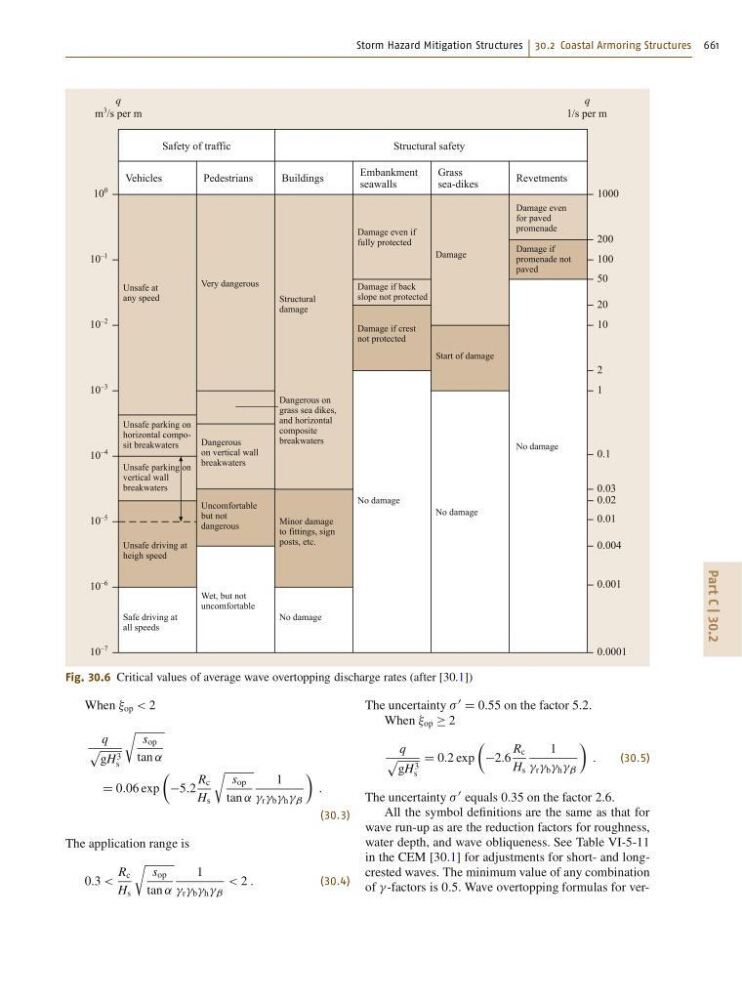
Fig. 30.6 Critical values of average wave overtopping discharge rates (after [30.1])
When op < 2
q
p
gH 3
s
r
s op
tan ˛
D 0:06 exp
Â
5:2
R c
H s
r
s op
tan ˛
1
r b h ˇ
Ã
:
(30.3)
The application range is
0:3 <
R c
H s
r
s op
tan ˛
1
r b h ˇ
< 2 :
(30.4)
The uncertainty
0
D 0:55 on the factor 5:2.
When op 2
q
p
gH 3
s
D 0:2 exp
Â
2:6
R c
H s
1
r b h ˇ
Ã
:
(30.5)
The uncertainty
0 equals 0:35 on the factor 2:6.
All the symbol definitions are the same as that for
wave run-up as are the reduction factors for roughness,
water depth, and wave obliqueness. See Table VI-5-11
in the CEM [30.1] for adjustments for short- and longcrested waves. The minimum value of any combination
of -factors is 0:5. Wave overtopping formulas for ver-