

Part C | 29.2
638 Part C Coastal Design
B
B
h *
h *
Δy 0
Δy 0
Δy 0
Δy 0
Δy 0
Δy 0
Δy 0
Fig. 29.3 Seaward profile advancement due to beach nourishment
29.2.2 Significance of Good Quality Sand
Understanding the significance of nourishing with good
quality sand is essential to design and prediction of
a beach nourishment project. Good quality infers that
the nourishment sand hydraulic characteristics are similar to the native, a feature usually referred to as compatibility. In most cases, sand hydraulic characteristics
equate to sand size characteristics; however, in those
cases where the sand particle shape differs, such as for
shell fragments, the fall velocity is a better indicator
of sediment (and hydraulic) compatibility. Thus, our
main concern here in the performance of nourishment
projects is with the physical and hydraulic properties of
the sediment although color may be of significant interest in some projects.
The main issue with sediment compatibility is that
finer sands will equilibrate to a milder slope than for
compatible sand. Thus for a given nourishment volume
density, the additional dry beach width, an important
parameter for the beach user and funding agencies,
will be less for the finer sediment than for compatible sediments. A second effect is that the planform
centroids of projects constructed of finer sand will
0
100
200
d N = 0.2 mm
dF
= 0 .2 7 5 m m , σ = 0 .0
dF
= 0 .2 7 5 m m , σ = 0 .5
dF = 0 .1 4 m m , σ = 0 .0
dF = 0. 14 m m , σ = 0. 5
dF = 0 .2 m m , σ = 0 .0
300
400
500
600
700
800
Shoreline displacement (m)
Volume density (m
3
/m)
140
120
100
80
60
40
20
0
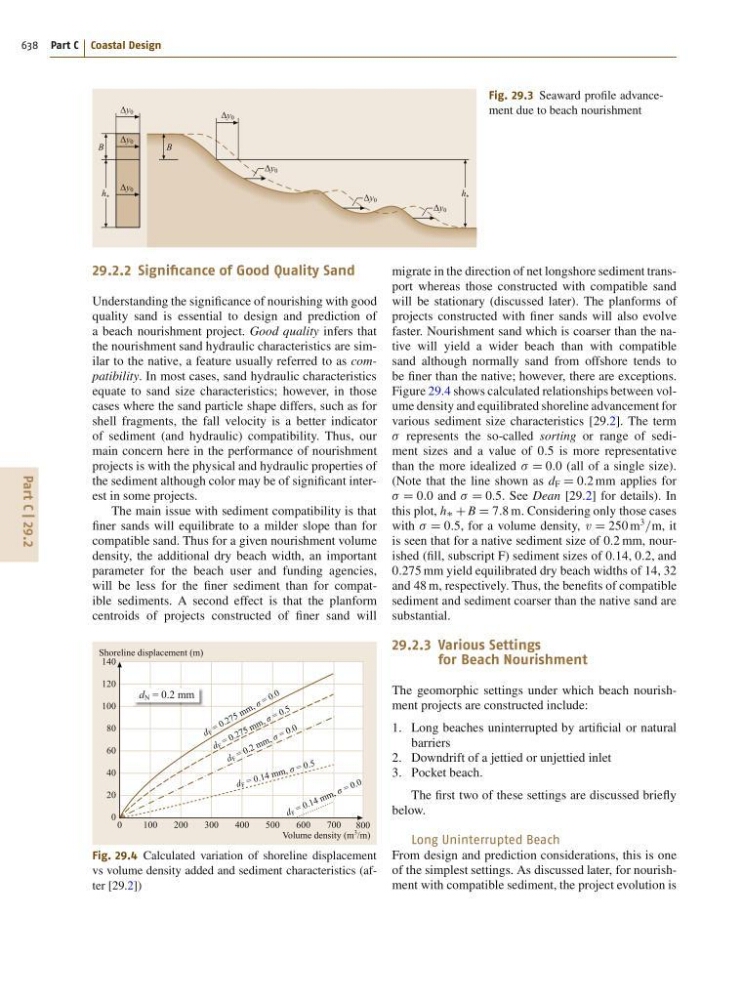
Fig. 29.4 Calculated variation of shoreline displacement
vs volume density added and sediment characteristics (after [29.2])
migrate in the direction of net longshore sediment transport whereas those constructed with compatible sand
will be stationary (discussed later). The planforms of
projects constructed with finer sands will also evolve
faster. Nourishment sand which is coarser than the native will yield a wider beach than with compatible
sand although normally sand from offshore tends to
be finer than the native; however, there are exceptions.
Figure 29.4 shows calculated relationships between volume density and equilibrated shoreline advancement for
various sediment size characteristics [29.2]. The term
represents the so-called sorting or range of sediment sizes and a value of 0:5 is more representative
than the more idealized D 0:0 (all of a single size).
(Note that the line shown as d F D 0:2 mm applies for
D 0:0 and D 0:5. See Dean [29.2] for details). In
this plot, h C B D 7:8 m. Considering only those cases
with D 0:5, for a volume density, v D 250 m
3
=m, it
is seen that for a native sediment size of 0:2 mm, nourished (fill, subscript F) sediment sizes of 0:14, 0:2, and
0:275 mm yield equilibrated dry beach widths of 14, 32
and 48 m, respectively. Thus, the benefits of compatible
sediment and sediment coarser than the native sand are
substantial.
29.2.3 Various Settings
for Beach Nourishment
The geomorphic settings under which beach nourishment projects are constructed include:
1. Long beaches uninterrupted by artificial or natural
barriers
2. Downdrift of a jettied or unjettied inlet
3. Pocket beach.
The first two of these settings are discussed briefly
below.
Long Uninterrupted Beach
From design and prediction considerations, this is one
of the simplest settings. As discussed later, for nourishment with compatible sediment, the project evolution is