

Modeling of Coastal Morphological Processes 28.3 Modeling Approaches 627
Part C | 28.3
0
1 0
2 0
3 0
4 0
a) Distance (m)
Distance (m)
15
10
5
0
0
1 0
2 0
3 0
4 0
b) Distance (m)
15
10
5
0
0
1 0
2 0
3 0
4 0
c) Distance (m)
15
10
5
0
0
–10
–20
–30
–40 m
0
1 0
2 0
3 0
4 0
d) Distance (m)
15
10
5
0
0
1 0
2 0
3 0
4 0
e) Distance (m)
15
10
5
0
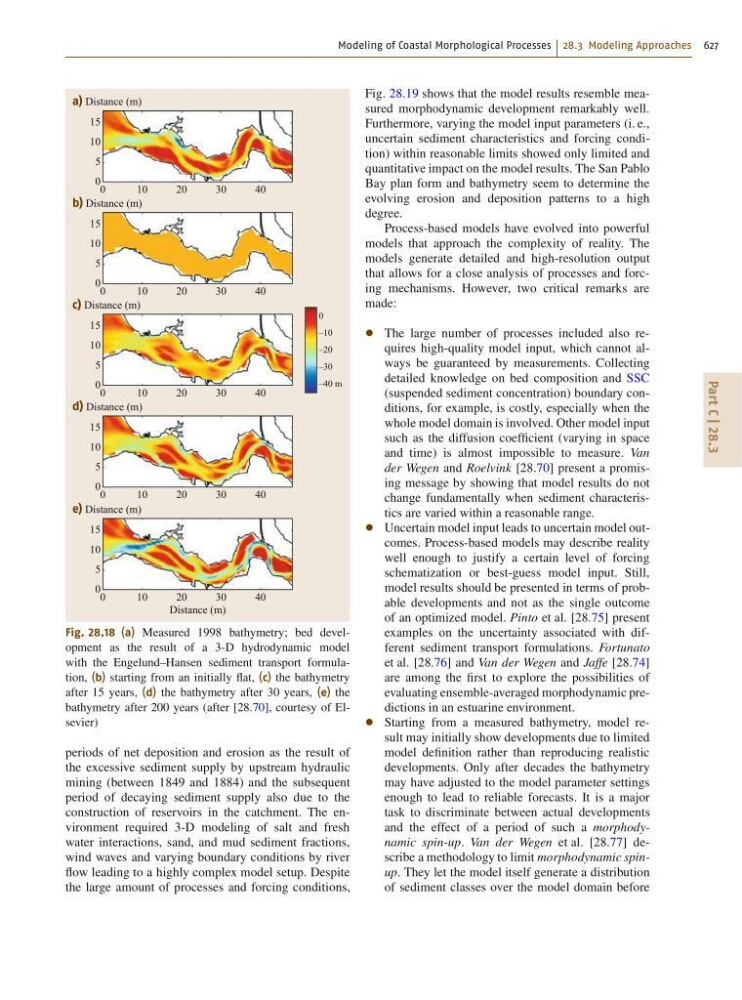
Fig. 28.18 (a) Measured 1998 bathymetry; bed development as the result of a 3-D hydrodynamic model
with the Engelund–Hansen sediment transport formulation, (b) starting from an initially flat, (c) the bathymetry
after 15 years, (d) the bathymetry after 30 years, (e) the
bathymetry after 200 years (after [28.70], courtesy of Elsevier)
periods of net deposition and erosion as the result of
the excessive sediment supply by upstream hydraulic
mining (between 1849 and 1884) and the subsequent
period of decaying sediment supply also due to the
construction of reservoirs in the catchment. The environment required 3-D modeling of salt and fresh
water interactions, sand, and mud sediment fractions,
wind waves and varying boundary conditions by river
flow leading to a highly complex model setup. Despite
the large amount of processes and forcing conditions,
Fig. 28.19 shows that the model results resemble measured morphodynamic development remarkably well.
Furthermore, varying the model input parameters (i. e.,
uncertain sediment characteristics and forcing condition) within reasonable limits showed only limited and
quantitative impact on the model results. The San Pablo
Bay plan form and bathymetry seem to determine the
evolving erosion and deposition patterns to a high
degree.
Process-based models have evolved into powerful
models that approach the complexity of reality. The
models generate detailed and high-resolution output
that allows for a close analysis of processes and forcing mechanisms. However, two critical remarks are
made:
The large number of processes included also requires high-quality model input, which cannot always be guaranteed by measurements. Collecting
detailed knowledge on bed composition and SSC
(suspended sediment concentration) boundary conditions, for example, is costly, especially when the
whole model domain is involved. Other model input
such as the diffusion coefficient (varying in space
and time) is almost impossible to measure. Van
der Wegen and Roelvink [28.70] present a promising message by showing that model results do not
change fundamentally when sediment characteristics are varied within a reasonable range.
Uncertain model input leads to uncertain model outcomes. Process-based models may describe reality
well enough to justify a certain level of forcing
schematization or best-guess model input. Still,
model results should be presented in terms of probable developments and not as the single outcome
of an optimized model. Pinto et al. [28.75] present
examples on the uncertainty associated with different sediment transport formulations. Fortunato
et al. [28.76] and Van der Wegen and Jaffe [28.74]
are among the first to explore the possibilities of
evaluating ensemble-averaged morphodynamic predictions in an estuarine environment.
Starting from a measured bathymetry, model result may initially show developments due to limited
model definition rather than reproducing realistic
developments. Only after decades the bathymetry
may have adjusted to the model parameter settings
enough to lead to reliable forecasts. It is a major
task to discriminate between actual developments
and the effect of a period of such a morphodynamic spin-up. Van der Wegen et al. [28.77] describe a methodology to limit morphodynamic spinup. They let the model itself generate a distribution
of sediment classes over the model domain before