

Part C | 28.3
628 Part C Coastal Design
0
0.5
1
1.5
2
2.5
a) Distance (× 10
4 m)
Distance (× 10
4 m)
2.2
2
1.8
1.6
1.4
1.2
1
0.8
0.6
0.4
0.2
0
0
0.5
1
1.5
2
2.5
c) Distance (× 10
4 m)
2.2
2
1.8
1.6
1.4
1.2
1
0.8
0.6
0.4
0.2
0
0
0.5
1
1.5
2
2.5
b) Distance (× 10
4 m)
Distance (× 10
4 m)
2.2
2
1.8
1.6
1.4
1.2
1
0.8
0.6
0.4
0.2
0
5 m (accretion)
0
–5 m (accretion)
0
0.5
1
1.5
2
2.5
d) Distance (× 10
4 m)
2.2
2
1.8
1.6
1.4
1.2
1
0.8
0.6
0.4
0.2
0
Distance (× 10
4 m)
0
0.5
1
1.5
2
2.5
e) Distance (× 10
4 m)
2.2
2
1.8
1.6
1.4
1.2
1
0.8
0.6
0.4
0.2
0
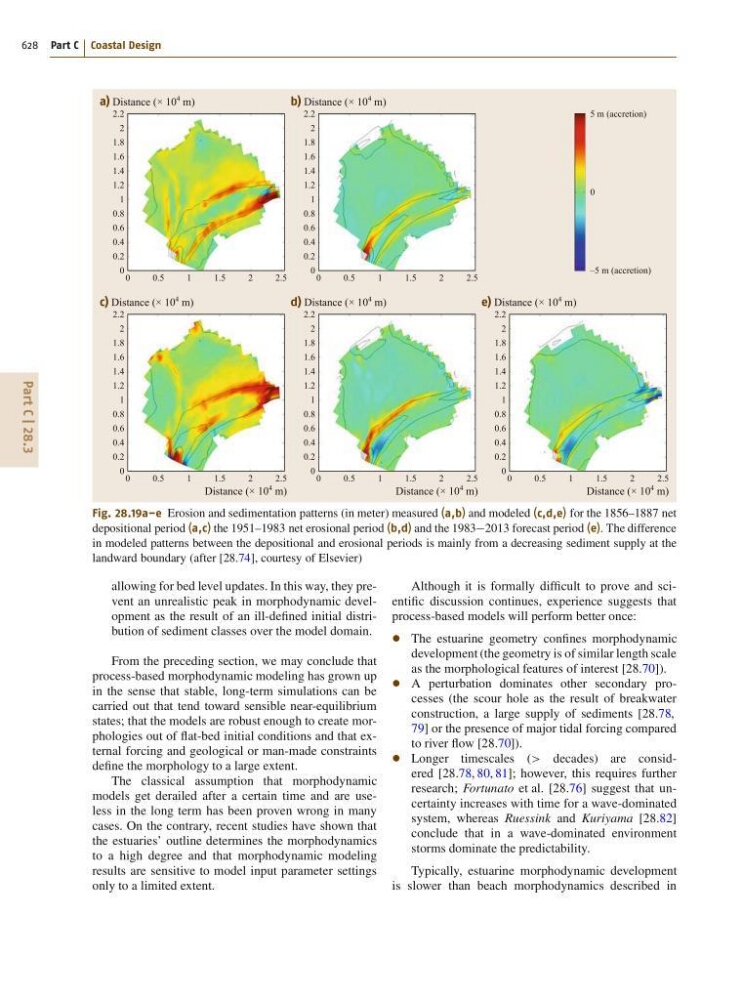
Fig. 28.19a–e Erosion and sedimentation patterns (in meter) measured (a,b) and modeled (c,d,e) for the 1856–1887 net
depositional period (a,c) the 1951–1983 net erosional period (b,d) and the 19832013 forecast period (e). The difference
in modeled patterns between the depositional and erosional periods is mainly from a decreasing sediment supply at the
landward boundary (after [28.74], courtesy of Elsevier)
allowing for bed level updates. In this way, they prevent an unrealistic peak in morphodynamic development as the result of an ill-defined initial distribution of sediment classes over the model domain.
From the preceding section, we may conclude that
process-based morphodynamic modeling has grown up
in the sense that stable, long-term simulations can be
carried out that tend toward sensible near-equilibrium
states; that the models are robust enough to create morphologies out of flat-bed initial conditions and that external forcing and geological or man-made constraints
define the morphology to a large extent.
The classical assumption that morphodynamic
models get derailed after a certain time and are useless in the long term has been proven wrong in many
cases. On the contrary, recent studies have shown that
the estuaries’ outline determines the morphodynamics
to a high degree and that morphodynamic modeling
results are sensitive to model input parameter settings
only to a limited extent.
Although it is formally difficult to prove and scientific discussion continues, experience suggests that
process-based models will perform better once:
The estuarine geometry confines morphodynamic
development (the geometry is of similar length scale
as the morphological features of interest [28.70]).
A perturbation dominates other secondary processes (the scour hole as the result of breakwater
construction, a large supply of sediments [28.78,
79] or the presence of major tidal forcing compared
to river flow [28.70]).
Longer timescales (> decades) are considered [28.78, 80, 81]; however, this requires further
research; Fortunato et al. [28.76] suggest that uncertainty increases with time for a wave-dominated
system, whereas Ruessink and Kuriyama [28.82]
conclude that in a wave-dominated environment
storms dominate the predictability.
Typically, estuarine morphodynamic development
is slower than beach morphodynamics described in