

Part C | 28.3
626 Part C Coastal Design
28.3.3 Long-Term Modeling of Estuaries
The morphodynamic modeling of estuaries is an area
where much progress has been made in recent years,
in physical modeling, analytical, semiempirical, or aggregated methods and in process-based numerical modeling. In the following section, we aim to present an
overview of recent advances and case studies of estuarine morphodynamic modeling efforts with processbased models. We distinguish studies with a fundamental approach from studies with a more realistic approach. The fundamental approach is more schematized
and aims to develop understanding on the long-term
evolution or equilibrium conditions of morphodynamic
systems. The realistic approach aims at morphodynamic predictions in a realistic environment on an
engineering timescale up to decades.
System Understanding –
Schematized Approach
Process-based numerical models can be used to explore
equilibrium conditions of the longitudinal estuarine bed
profile by tidal forcing under idealized 1-D forcing
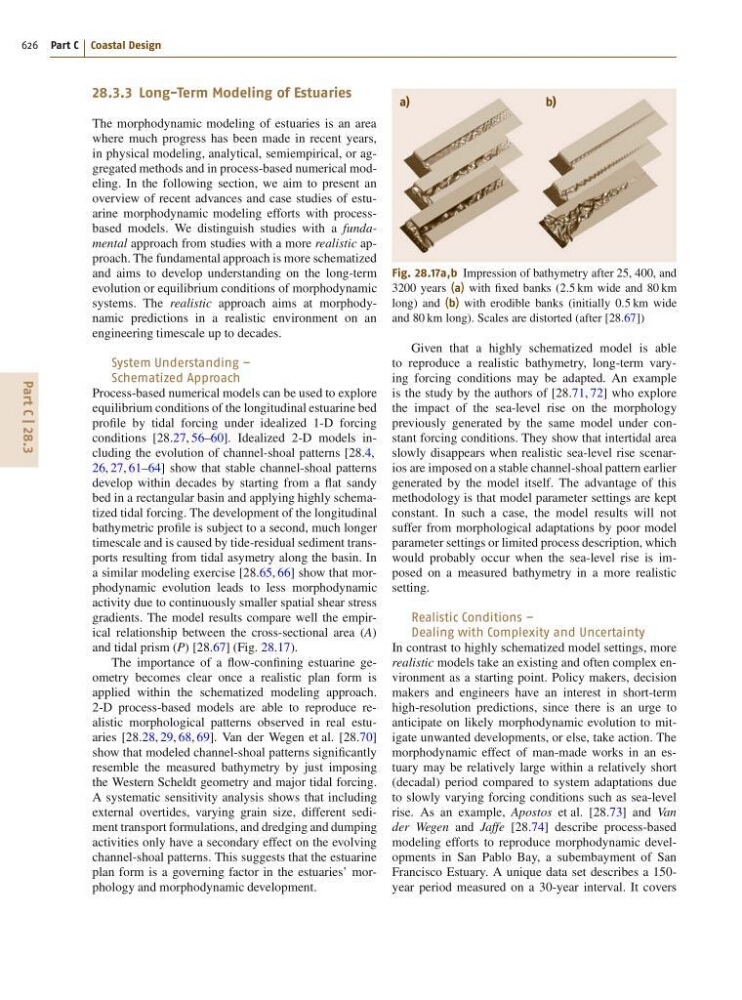
conditions [28.27, 56–60]. Idealized 2-D models including the evolution of channel-shoal patterns [28.4,
26, 27, 61–64] show that stable channel-shoal patterns
develop within decades by starting from a flat sandy
bed in a rectangular basin and applying highly schematized tidal forcing. The development of the longitudinal
bathymetric profile is subject to a second, much longer
timescale and is caused by tide-residual sediment transports resulting from tidal asymetry along the basin. In
a similar modeling exercise [28.65, 66] show that morphodynamic evolution leads to less morphodynamic
activity due to continuously smaller spatial shear stress
gradients. The model results compare well the empirical relationship between the cross-sectional area (A)
and tidal prism (P) [28.67] (Fig. 28.17).
The importance of a flow-confining estuarine geometry becomes clear once a realistic plan form is
applied within the schematized modeling approach.
2-D process-based models are able to reproduce realistic morphological patterns observed in real estuaries [28.28, 29, 68, 69]. Van der Wegen et al. [28.70]
show that modeled channel-shoal patterns significantly
resemble the measured bathymetry by just imposing
the Western Scheldt geometry and major tidal forcing.
A systematic sensitivity analysis shows that including
external overtides, varying grain size, different sediment transport formulations, and dredging and dumping
activities only have a secondary effect on the evolving
channel-shoal patterns. This suggests that the estuarine
plan form is a governing factor in the estuaries’ morphology and morphodynamic development.
a)
b)
Fig. 28.17a,b Impression of bathymetry after 25, 400, and
3200 years (a) with fixed banks (2:5 km wide and 80 km
long) and (b) with erodible banks (initially 0:5 km wide
and 80 km long). Scales are distorted (after [28.67])
Given that a highly schematized model is able
to reproduce a realistic bathymetry, long-term varying forcing conditions may be adapted. An example
is the study by the authors of [28.71, 72] who explore
the impact of the sea-level rise on the morphology
previously generated by the same model under constant forcing conditions. They show that intertidal area
slowly disappears when realistic sea-level rise scenarios are imposed on a stable channel-shoal pattern earlier
generated by the model itself. The advantage of this
methodology is that model parameter settings are kept
constant. In such a case, the model results will not
suffer from morphological adaptations by poor model
parameter settings or limited process description, which
would probably occur when the sea-level rise is imposed on a measured bathymetry in a more realistic
setting.
Realistic Conditions –
Dealing with Complexity and Uncertainty
In contrast to highly schematized model settings, more
realistic models take an existing and often complex environment as a starting point. Policy makers, decision
makers and engineers have an interest in short-term
high-resolution predictions, since there is an urge to
anticipate on likely morphodynamic evolution to mitigate unwanted developments, or else, take action. The
morphodynamic effect of man-made works in an estuary may be relatively large within a relatively short
(decadal) period compared to system adaptations due
to slowly varying forcing conditions such as sea-level
rise. As an example, Apostos et al. [28.73] and Van
der Wegen and Jaffe [28.74] describe process-based
modeling efforts to reproduce morphodynamic developments in San Pablo Bay, a subembayment of San
Francisco Estuary. A unique data set describes a 150year period measured on a 30-year interval. It covers