

Part C | 28.3
620 Part C Coastal Design
u (T )
20 s < T < 200 s
Cg
E w (T )
Bound wave
Wave breaking
Motions dominated by
long waves not short
waves
Leaky wave
√
—
gh
Fig. 28.6 Principle sketch physics of wave groups and surf
beat
conditions provided by the wind, wave, and surge models and its main output to be transferred back will be the
time-varying bathymetry and possibly discharges over
breached barrier island sections.
Physical Processes Included in XBeach
The model solves coupled 2-D horizontal equations for
wave propagation, flow, sediment transport, and bottom
changes, for varying (spectral) wave and flow boundary
conditions.
Because the model takes into account the variation in wave height in time (long known to surfers) it
resolves the long wave (infragravity) motions created
by this variation. This so-called surf beat is responsible for most of the swash waves that actually hit the
dune front or overtop it. Because of this innovation, the
XBeach model is better able to model the development
of the dune erosion profile and to predict when a dune
or barrier island will start overwashing and breaching. The physics behind the surf beat formulations in
0 hr
8 hr comp.
8 hr meas.
0 hr
8 hr comp.
8 hr meas.
0 hr
8 hr comp.
8 hr meas.
100 120 140 160 180 200
a) z b (m)
x (m)
6
5
4
3
2
0
2
4
6
8
b) Dune retreat (m)
Time (h)
10
8
6
4
2
0
150 160 170 180 190 200
c) z b (m)
x (m)
150 160 170 180 190 200
d) z b (m)
x (m)
6
5.5
5
4.5
4
3.5
3
6
5.5
5
4.5
4
3.5
3
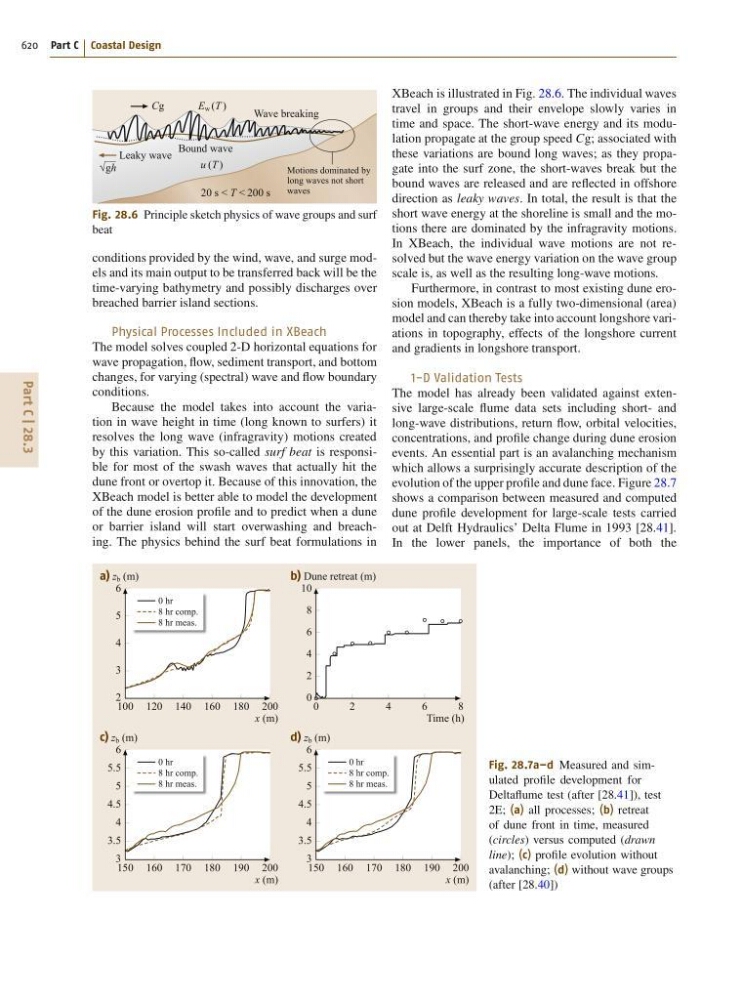
Fig. 28.7a–d Measured and simulated profile development for
Deltaflume test (after [28.41]), test
2E; (a) all processes; (b) retreat
of dune front in time, measured
(circles) versus computed (drawn
line); (c) profile evolution without
avalanching; (d) without wave groups
(after [28.40])
XBeach is illustrated in Fig. 28.6. The individual waves
travel in groups and their envelope slowly varies in
time and space. The short-wave energy and its modulation propagate at the group speed Cg; associated with
these variations are bound long waves; as they propagate into the surf zone, the short-waves break but the
bound waves are released and are reflected in offshore
direction as leaky waves. In total, the result is that the
short wave energy at the shoreline is small and the motions there are dominated by the infragravity motions.
In XBeach, the individual wave motions are not resolved but the wave energy variation on the wave group
scale is, as well as the resulting long-wave motions.
Furthermore, in contrast to most existing dune erosion models, XBeach is a fully two-dimensional (area)
model and can thereby take into account longshore variations in topography, effects of the longshore current
and gradients in longshore transport.
1-D Validation Tests
The model has already been validated against extensive large-scale flume data sets including short- and
long-wave distributions, return flow, orbital velocities,
concentrations, and profile change during dune erosion
events. An essential part is an avalanching mechanism
which allows a surprisingly accurate description of the
evolution of the upper profile and dune face. Figure 28.7
shows a comparison between measured and computed
dune profile development for large-scale tests carried
out at Delft Hydraulics’ Delta Flume in 1993 [28.41].
In the lower panels, the importance of both the