

Modeling of Coastal Morphological Processes 28.3 Modeling Approaches 619
Part C | 28.3
can be used. A drawback of the method is that it
is technically somewhat involved, but once implemented correctly it makes long-term simulations
in complex areas including wave effects feasible;
Dastgheib [28.34] used it to make a very detailed
50-year hindcast of the development of the Marsdiep inlet in the Netherlands after closure of the
Zuiderzee.
An important aspect of the upscaling approach is
the necessary input reduction in the forcing; in order to
simulate with high morfac or using the tide-averaging
approach, the wind, discharge, and wave climate must
be schematized to a smaller number of representative
conditions. A number of approaches have been developed to do this; for extensive discussions, see [28.10,
35, 36].
28.3 Modeling Approaches
In the following sections, we will discuss a sampling
of process-based coastal morphodynamic modeling approaches for cases where there has been much recent
development.
In the first approach, we discuss modeling of storm
or swell events impacting complex coasts, where longshore uniformity cannot be assumed, impacts may go
from collision to full inundation regimes [28.37], and
where wave-group-related long waves can be dominant.
In the second study, we describe recent developments and insights into modeling the mechanisms of
cross-shore breaker bar cycles, the understanding of
which is necessary to design local engineering works
or nourishments, which often interact with the bar behavior and are studied on timescales of months to years.
In the discussion, we stick to alongshore uniform conditions but the model concepts are readily extendable to
coastal area models.
The last case describes the long-term modeling
of estuaries, using a schematized 2DH process-based
modeling approach. This type of modeling has important implications for understanding the response of
tidal systems to sea-level rise, but can also support geological research as it can actually generate realistic
morphologies, not just predict bottom changes.
28.3.1 Storm Event Modeling
Background
In this approach, we describe the modeling of fast and
complex processes during extreme events, where high
temporal and spatial resolution are required. We do this
based on a recent model development which has allowed a paradigm shift from simple, quasi-stationary,
largely empirical approaches to a physics-based approach where the lessons learned from decades of
model development have led to a robust modeling tool
where the important processes during such events are
resolved. In the following section, we will focus on
storm events rather than tsunamis, since the vast majority of modeling studies related to tsunamis, their impact and design consequences deal with hydrodynamics
only, as the morphology changes during a tsunami do
not affect the flow speeds and runup heights much.
However, morphological studies are increasingly carried out in order to interpret tsunami deposits, which
will be discussed in Sect. 28.4.6.
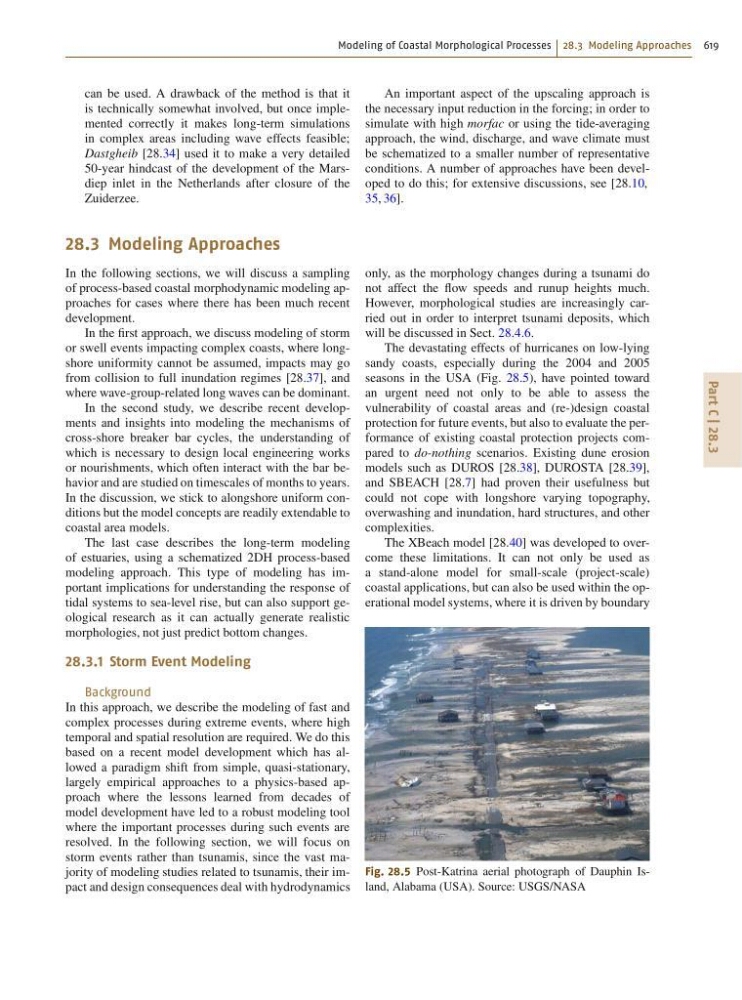
The devastating effects of hurricanes on low-lying
sandy coasts, especially during the 2004 and 2005
seasons in the USA (Fig. 28.5), have pointed toward
an urgent need not only to be able to assess the
vulnerability of coastal areas and (re-)design coastal
protection for future events, but also to evaluate the performance of existing coastal protection projects compared to do-nothing scenarios. Existing dune erosion
models such as DUROS [28.38], DUROSTA [28.39],
and SBEACH [28.7] had proven their usefulness but
could not cope with longshore varying topography,
overwashing and inundation, hard structures, and other
complexities.
The XBeach model [28.40] was developed to overcome these limitations. It can not only be used as
a stand-alone model for small-scale (project-scale)
coastal applications, but can also be used within the operational model systems, where it is driven by boundary
Fig. 28.5 Post-Katrina aerial photograph of Dauphin Island, Alabama (USA). Source: USGS/NASA