

Elements of Physical Oceanography 2.5 Wind-Forced Ocean Processes 33
Part A | 2.5
76° W
74° W
72° W
70° W
68° W
Hourly surface current field (5 MHz): 2012-Oct-27 20:00
a)
Current velocity (m/s)
42° N
40° N
38° N
36° N
34° N
0.6
0.5
0.4
0.3
0.2
0.1
0
76° W
74° W
72° W
70° W
68° W
Hourly surface current field (5 MHz): 2012-Oct-29 14:00
b)
42° N
40° N
38° N
36° N
34° N
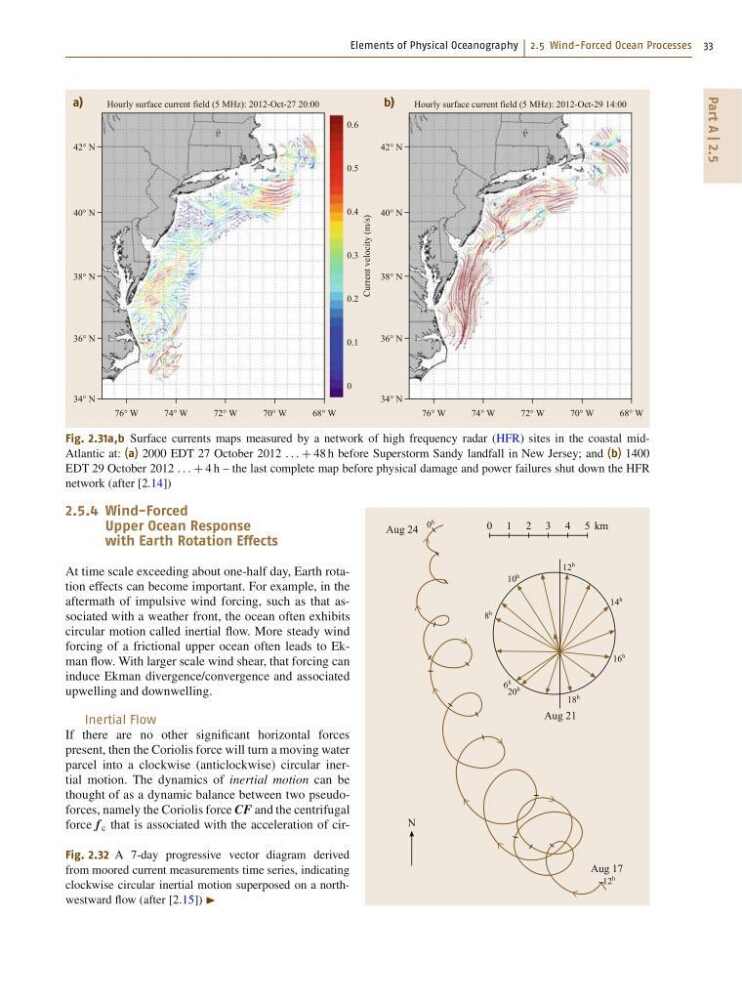
Fig. 2.31a,b Surface currents maps measured by a network of high frequency radar (HFR) sites in the coastal midAtlantic at: (a) 2000 EDT 27 October 2012 : : : C 48 h before Superstorm Sandy landfall in New Jersey; and (b) 1400
EDT 29 October 2012 : : : C 4 h – the last complete map before physical damage and power failures shut down the HFR
network (after [2.14])
2.5.4 Wind-Forced
Upper Ocean Response
with Earth Rotation Effects
At time scale exceeding about one-half day, Earth rotation effects can become important. For example, in the
aftermath of impulsive wind forcing, such as that associated with a weather front, the ocean often exhibits
circular motion called inertial flow. More steady wind
forcing of a frictional upper ocean often leads to Ekman flow. With larger scale wind shear, that forcing can
induce Ekman divergence/convergence and associated
upwelling and downwelling.
Inertial Flow
If there are no other significant horizontal forces
present, then the Coriolis force will turn a moving water
parcel into a clockwise (anticlockwise) circular inertial motion. The dynamics of inertial motion can be
thought of as a dynamic balance between two pseudoforces, namely the Coriolis force CF and the centrifugal
force f c that is associated with the acceleration of cirFig. 2.32 A 7-day progressive vector diagram derived
from moored current measurements time series, indicating
clockwise circular inertial motion superposed on a northwestward flow (after [2.15]) I
N
0 1 2 3 4 5 km
Aug 21
Aug 17
Aug 24
0
h
10
h
12
h
14
h
16
h
18
h
12
h
20
h
6
h
8
h
Part A | 2.5
76° W
74° W
72° W
70° W
68° W
Hourly surface current field (5 MHz): 2012-Oct-27 20:00
a)
Current velocity (m/s)
42° N
40° N
38° N
36° N
34° N
0.6
0.5
0.4
0.3
0.2
0.1
0
76° W
74° W
72° W
70° W
68° W
Hourly surface current field (5 MHz): 2012-Oct-29 14:00
b)
42° N
40° N
38° N
36° N
34° N
Fig. 2.31a,b Surface currents maps measured by a network of high frequency radar (HFR) sites in the coastal midAtlantic at: (a) 2000 EDT 27 October 2012 : : : C 48 h before Superstorm Sandy landfall in New Jersey; and (b) 1400
EDT 29 October 2012 : : : C 4 h – the last complete map before physical damage and power failures shut down the HFR
network (after [2.14])
2.5.4 Wind-Forced
Upper Ocean Response
with Earth Rotation Effects
At time scale exceeding about one-half day, Earth rotation effects can become important. For example, in the
aftermath of impulsive wind forcing, such as that associated with a weather front, the ocean often exhibits
circular motion called inertial flow. More steady wind
forcing of a frictional upper ocean often leads to Ekman flow. With larger scale wind shear, that forcing can
induce Ekman divergence/convergence and associated
upwelling and downwelling.
Inertial Flow
If there are no other significant horizontal forces
present, then the Coriolis force will turn a moving water
parcel into a clockwise (anticlockwise) circular inertial motion. The dynamics of inertial motion can be
thought of as a dynamic balance between two pseudoforces, namely the Coriolis force CF and the centrifugal
force f c that is associated with the acceleration of cirFig. 2.32 A 7-day progressive vector diagram derived
from moored current measurements time series, indicating
clockwise circular inertial motion superposed on a northwestward flow (after [2.15]) I
N
0 1 2 3 4 5 km
Aug 21
Aug 17
Aug 24
0
h
10
h
12
h
14
h
16
h
18
h
12
h
20
h
6
h
8
h