

Part A | 2.5
34 Part A Fundamentals
a)
b)
Spiraling
currents
45° Su rfa ce cu rre nt
Net water
transport
No water motion
Water moving offshore
due to Coriolis effect
Wind from north
W
i n d
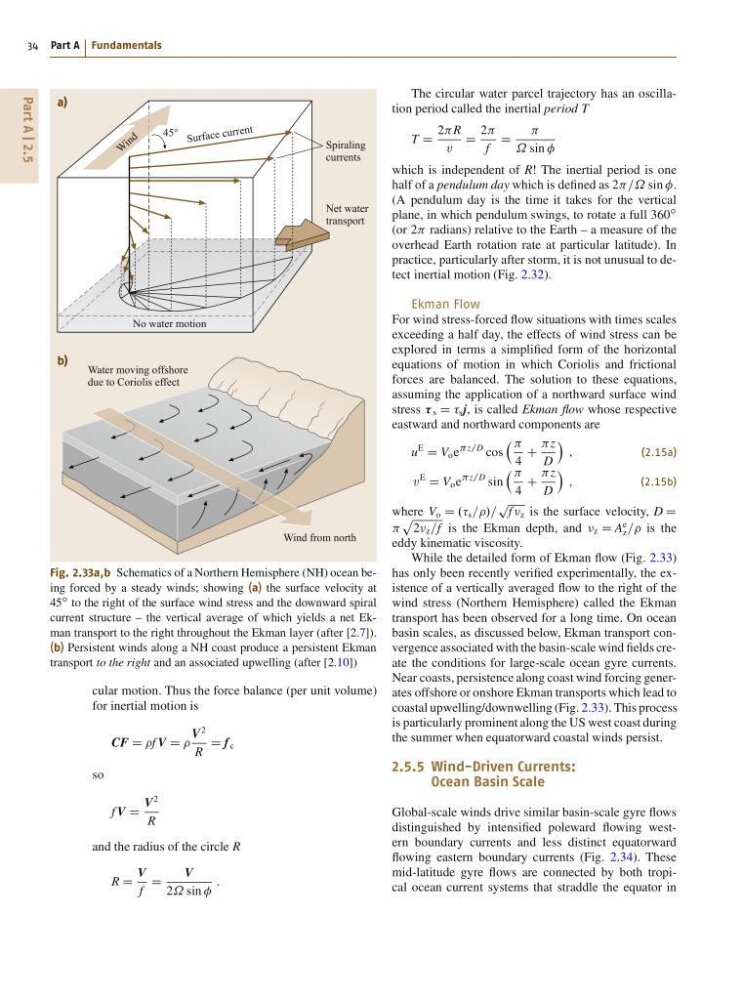
Fig. 2.33a,b Schematics of a Northern Hemisphere (NH) ocean being forced by a steady winds; showing (a) the surface velocity at
45
ı to the right of the surface wind stress and the downward spiral
current structure – the vertical average of which yields a net Ekman transport to the right throughout the Ekman layer (after [2.7]).
(b) Persistent winds along a NH coast produce a persistent Ekman
transport to the right and an associated upwelling (after [2.10])
cular motion. Thus the force balance (per unit volume)
for inertial motion is
CF D f V D
V
2
R
D f c
so
f V D
V
2
R
and the radius of the circle R
R D
V
f
D
V
2˝ sin
:
The circular water parcel trajectory has an oscillation period called the inertial period T
T D
2R
v
D
2
f
D
˝ sin
which is independent of R! The inertial period is one
half of a pendulum day which is defined as 2=˝ sin .
(A pendulum day is the time it takes for the vertical
plane, in which pendulum swings, to rotate a full 360
ı
(or 2 radians) relative to the Earth – a measure of the
overhead Earth rotation rate at particular latitude). In
practice, particularly after storm, it is not unusual to detect inertial motion (Fig. 2.32).
Ekman Flow
For wind stress-forced flow situations with times scales
exceeding a half day, the effects of wind stress can be
explored in terms a simplified form of the horizontal
equations of motion in which Coriolis and frictional
forces are balanced. The solution to these equations,
assuming the application of a northward surface wind
stress s D s j, is called Ekman flow whose respective
eastward and northward components are
u
E
D V o e
z=D cos
4
C
z
D
Á
;
(2.15a)
v
E
D V o e
z=D sin
4
C
z
D
Á
;
(2.15b)
where V o D .. s ==/=
p
f z is the surface velocity, D D
p
2 z =f is the Ekman depth, and z D A
e
z == is the
eddy kinematic viscosity.
While the detailed form of Ekman flow (Fig. 2.33)
has only been recently verified experimentally, the existence of a vertically averaged flow to the right of the
wind stress (Northern Hemisphere) called the Ekman
transport has been observed for a long time. On ocean
basin scales, as discussed below, Ekman transport convergence associated with the basin-scale wind fields create the conditions for large-scale ocean gyre currents.
Near coasts, persistence along coast wind forcing generates offshore or onshore Ekman transports which lead to
coastal upwelling/downwelling (Fig. 2.33). This process
is particularly prominent along the US west coast during
the summer when equatorward coastal winds persist.
2.5.5 Wind-Driven Currents:
Ocean Basin Scale
Global-scale winds drive similar basin-scale gyre flows
distinguished by intensified poleward flowing western boundary currents and less distinct equatorward
flowing eastern boundary currents (Fig. 2.34). These
mid-latitude gyre flows are connected by both tropical ocean current systems that straddle the equator in
34 Part A Fundamentals
a)
b)
Spiraling
currents
45° Su rfa ce cu rre nt
Net water
transport
No water motion
Water moving offshore
due to Coriolis effect
Wind from north
W
i n d
Fig. 2.33a,b Schematics of a Northern Hemisphere (NH) ocean being forced by a steady winds; showing (a) the surface velocity at
45
ı to the right of the surface wind stress and the downward spiral
current structure – the vertical average of which yields a net Ekman transport to the right throughout the Ekman layer (after [2.7]).
(b) Persistent winds along a NH coast produce a persistent Ekman
transport to the right and an associated upwelling (after [2.10])
cular motion. Thus the force balance (per unit volume)
for inertial motion is
CF D f V D
V
2
R
D f c
so
f V D
V
2
R
and the radius of the circle R
R D
V
f
D
V
2˝ sin
:
The circular water parcel trajectory has an oscillation period called the inertial period T
T D
2R
v
D
2
f
D
˝ sin
which is independent of R! The inertial period is one
half of a pendulum day which is defined as 2=˝ sin .
(A pendulum day is the time it takes for the vertical
plane, in which pendulum swings, to rotate a full 360
ı
(or 2 radians) relative to the Earth – a measure of the
overhead Earth rotation rate at particular latitude). In
practice, particularly after storm, it is not unusual to detect inertial motion (Fig. 2.32).
Ekman Flow
For wind stress-forced flow situations with times scales
exceeding a half day, the effects of wind stress can be
explored in terms a simplified form of the horizontal
equations of motion in which Coriolis and frictional
forces are balanced. The solution to these equations,
assuming the application of a northward surface wind
stress s D s j, is called Ekman flow whose respective
eastward and northward components are
u
E
D V o e
z=D cos
4
C
z
D
Á
;
(2.15a)
v
E
D V o e
z=D sin
4
C
z
D
Á
;
(2.15b)
where V o D .. s ==/=
p
f z is the surface velocity, D D
p
2 z =f is the Ekman depth, and z D A
e
z == is the
eddy kinematic viscosity.
While the detailed form of Ekman flow (Fig. 2.33)
has only been recently verified experimentally, the existence of a vertically averaged flow to the right of the
wind stress (Northern Hemisphere) called the Ekman
transport has been observed for a long time. On ocean
basin scales, as discussed below, Ekman transport convergence associated with the basin-scale wind fields create the conditions for large-scale ocean gyre currents.
Near coasts, persistence along coast wind forcing generates offshore or onshore Ekman transports which lead to
coastal upwelling/downwelling (Fig. 2.33). This process
is particularly prominent along the US west coast during
the summer when equatorward coastal winds persist.
2.5.5 Wind-Driven Currents:
Ocean Basin Scale
Global-scale winds drive similar basin-scale gyre flows
distinguished by intensified poleward flowing western boundary currents and less distinct equatorward
flowing eastern boundary currents (Fig. 2.34). These
mid-latitude gyre flows are connected by both tropical ocean current systems that straddle the equator in